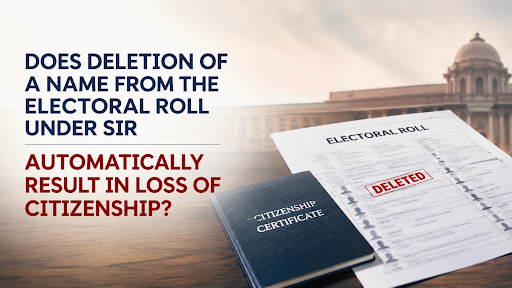
The Election Commission of India has ordered a Special Intensive Revision in 23 states and UTs from April 2026 to clean electoral rolls through door to door verification. Backed by the Representation of the People Act 1950 and Articles 324 to 326, it targets ghost voters, migration gaps, and future reforms like a common electoral roll.
Copyright infringement not intended
Picture Courtesy: moneycontrol
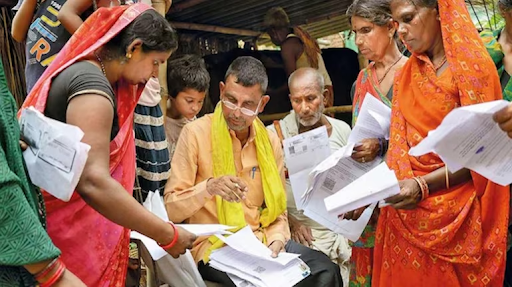
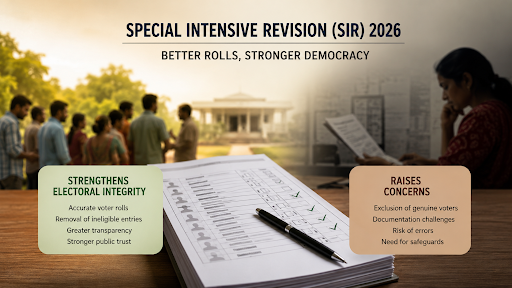
The Election Commission of India (ECI) has directed 23 States and Union Territories to prepare for a Special Intensive Revision (SIR) of their electoral rolls.
|
Read all about: Special Intensive Revision (SIR) l Election Commission Announced Special Intensive Revision |
The SIR is a comprehensive process to update electoral rolls, mandated under Section 21 of the Representation of the People Act (RPA), 1950.
|
|
Special Intensive Revision (SIR) |
Special Summary Revision (SSR) |
|
Methodology |
Proactive & Intensive: Election officials (BLOs) conduct door-to-door visits to verify voters. |
Reactive & Voluntary: Relies on individual voters to file claims and objections at designated centres or online. |
|
Scope |
Aims to physically verify every entry, remove deceased/shifted voters, and register unenrolled citizens. |
Primarily focuses on enrolling new voters who have turned 18 and allowing for corrections. |
|
Trigger |
Ordered when rolls have high inaccuracies, after a long gap, or post major demographic events like a census or delimitation. |
An annual, routine exercise conducted across the country. |
Purifying Electoral Rolls
The main goal is to remove "ghost voters" (deceased or relocated individuals) to ensure an accurate roll, which is essential for the "One Person, One Vote" principle.
Inclusion of Marginalized Groups
SIR supports the ECI’s motto of "No Voter to be Left Behind," making a special effort to reach unenrolled citizens, particularly women in rural areas and remote communities.
Standardization of Voter ID
The exercise ensures 100% coverage of the high-security Electors Photo Identity Card (EPIC), which helps prevent voter impersonation and fraud on polling day.
Article 324: Vests "superintendence, direction and control" of elections and electoral roll preparation in the Election Commission of India.
Article 325: Guarantees a single electoral roll for every constituency, prohibiting exclusion based on religion, race, caste, or sex.
Article 326: Establishes Universal Adult Suffrage.
Representation of the People Act, 1950: Provides the legal framework for the preparation and revision of electoral rolls and voter qualifications.
Inderjit Barua vs ECI (1984): Supreme Court held that electoral roll accuracy is fundamental and must be ensured before elections commence.
Urban Apathy and Migration
Low voter turnout in cities (e.g., Hyderabad, Mumbai <50% in 2024) is often caused by domestic migration, as citizens move for work but stay registered in their native villages. The ECI's proposed Remote Electronic Voting Machine (RVM) solution is currently stalled due to a lack of political consensus.
Aadhaar-Voter ID Linking Concerns
The ECI promotes voluntary Aadhaar linking via Form 6B for de-duplication, raising Right to Privacy concerns (Puttaswamy Judgement). Errors like the 2018 deletion of 22 lakh names in Telangana highlight fears of "algorithmic disenfranchisement" and the need for manual checks.
Citizenship and Electoral Rolls
Citizenship complexities impact rolls; Assam is excluded from the current Special Integrated Revision (SIR) exercise as its National Register of Citizens (NRC) is unfinished.
Adopt a Common Electoral Roll
As recommended by the Law Commission (255th Report), using a single electoral roll for both Lok Sabha/Assembly and local body (Panchayat/Municipal) elections would streamline the process and save public resources.
Integrate Technology with Human Oversight
While AI can help identify duplicates, final deletions must only occur after physical verification and proper notice to the voter, a principle emphasized by the Dinesh Goswami Committee on Electoral Reforms (1990).
Move Towards a "Permanent Voter List"
Create a dynamic voter list that is updated in real-time by linking it to the Civil Registration System (CRS) for births and deaths. The Registration of Births and Deaths (Amendment) Act, 2023, provides a legal foundation for this integration.
The Special Intensive Revision is a foundational exercise for a clean, inclusive, and credible electoral roll—the bedrock of free and fair elections. The ECI is strengthening the process, using modern technology and human verification to protect every eligible citizen's right to vote.
Source: NEWSONAIR
|
PRACTICE QUESTION Q. Consider the following statements about the Special Intensive Revision (SIR) of electoral rolls: 1. It is conducted under the Article 324 of the Constitution and the Representation of the People Act, 1950. 2. The process involves preparing a fresh electoral roll from scratch, through house-to-house enumeration. Which of the above statements is/are correct? A) 1 only B) 2 only C) Both 1 and 2 D) Neither 1 nor 2 Answer: C Explanation: Statement 1 is correct: The process of preparing and revising electoral rolls, including the Special Intensive Revision (SIR), is conducted by the Election Commission of India (ECI). The ECI derives its authority from Article 324, which grants it the power of superintendence, direction, and control of elections. The specific legal framework and procedures for the preparation and revision of electoral rolls are laid out in the Representation of the People Act, 1950. Statement 2 is correct: The Special Intensive Revision (SIR) of electoral rolls is a process, where the Election Commission of India is creating a completely new electoral roll through house-to-house enumeration to ensure accuracy and transparency, without relying primarily on the existing voter list. |
SSR is an annual exercise where voters must voluntarily file claims and objections to update their details. SIR is a more rigorous, occasional exercise where election officials (BLOs) physically visit households (door-to-door) to verify voters, remove dead/shifted entries, and register new ones.
The SIR is being conducted to "purify" the rolls by removing "ghost voters" (dead/duplicate/shifted) and to ensure 100% coverage ahead of the 2027 election cycle. It also aligns with the Census Commissioner's activities, likely preparing for post-2026 delimitation.
A "Ghost Voter" refers to an entry in the electoral roll that corresponds to a person who is either deceased, has shifted residence to another constituency, or is a duplicate entry. These entries inflate the electorate size and can lead to impersonation.




© 2026 iasgyan. All right reserved