The Agriculture Ministry launched Bharat-VISTAAR, an AI-based Digital Public Infrastructure for farmers featuring the voice assistant “Bharati.” Accessible via smartphones and feature phones, it reduces information gaps, integrates NPSS and IMD data, and builds on pilots like Telangana’s Saagu Baagu, while addressing digital divide and privacy concerns.
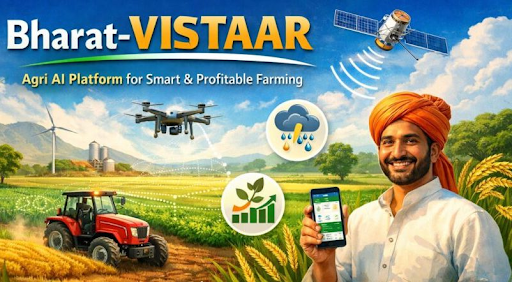
Copyright infringement not intended
Picture Courtesy: indiancooperative
Context
The Union Minister for Agriculture & Farmers’ Welfare launched ‘Bharat-VISTAAR’ (Virtually Integrated System to Access Agricultural Resources), in Jaipur, Rajasthan.
What is Bharat-VISTAAR?
It is an AI-powered multilingual advisory platform announced in the Union Budget 2026-27, to establish a dedicated Digital Public Infrastructure (DPI) for the agriculture sector.
Objective: To provide farmers with timely, personalized, and actionable information.
Key Features
Voice-First AI Interface: It features 'Bharati', a speaking AI assistant that interacts with farmers in their local languages, overcoming literacy barriers.
Multi-Channel Accessibility: The platform is designed for universal access through:
Integrated Service Delivery: It consolidates data from various government agencies into a single, easy-to-access window:
Phased & Collaborative Rollout: Phase-1 covers Hindi and English.
What are the Significance of the Bharat-VISTAAR?
The launch of Bharat-VISTAAR addresses deep-rooted structural challenges in Indian agriculture and aims to boost farmer income and productivity.
Bridging the Information Gap: Farmers often lack real-time market data, leading to distress sales.
Productivity Data: Agriculture sector employs 45.8% of the workforce but contributes only about 18.2% to Gross Value Added (GVA), indicating low per-worker productivity. (Source: Economic Survey).
Overcoming Extension Service Deficits: India faces a severe shortage of agricultural extension workers.
Building Climate Resilience: Climate change threatens agriculture with estimated annual crop yield losses of 4–9% in vulnerable regions, and a 2–6% decline per degree of temperature increase. (Source: IPCC AR6 Report)
What are the potential Implementation Challenges?
The Digital Divide: Low rural internet penetration (57%) and lack of digital literacy are challenges. The "Voice-First" interface and feature phone access can overcome this. (Source: IAMAI)
Data Privacy Concerns: The platform will handle vast amounts of farmer data, including land records and cropping patterns, raising privacy issues.
Quality of Input Data: AI effectiveness is limited by the "Garbage In, Garbage Out" principle, relying on accurate backend data like digitized state land records.
Way Forward
A 'Phygital' Approach: Augmenting digital advice with on-ground verification and support from Krishi Vigyan Kendras (KVKs).
Data Integrity: Accelerating the error-free digitization of land records across all states to ensure the AI provides accurate recommendations.
Building Trust: Maintaining transparency in how AI algorithms work, especially for determining eligibility for government schemes.
Learn Lessons from Domestic & Global Agri-Tech Models
Saagu Baagu (Telangana)
An AI-based advisory collaboration between Telangana government and the World Economic Forum for cotton farmers led to a 21% increase in production per acre and a 9% reduction in pesticide use, demonstrating AI's potential for sustainable agricultural growth. (Source: World Economic Forum).
DigiFarm (Kenya)
A telecom-led platform providing smallholder farmers access to inputs, credit, and advice resulted in a yield increase of over 15% within two years, validated by the strategy of using feature phones to ensure inclusivity and reach the most remote farmers. (Source: GSMA AgriTech Report).
Conclusion
The Bharat-VISTAAR initiative is a key component of the 'Viksit Bharat 2047' vision, aiming to transform Indian farmers into data-driven agri-entrepreneurs through broad access to scientific guidance.
Source: PIB
|
PRACTICE QUESTION Q. Consider the following statements regarding 'Bharat-VISTAAR': 1. It is an AI-powered ecosystem that functions exclusively on smartphones with high-speed internet. 2. It features a voice-first AI assistant named 'Bharati' to interact with farmers in local languages. 3. It integrates data from the India Meteorological Department (IMD) and the National Pest Surveillance System (NPSS). Which of the statements given above is/are correct? A) 1 only B) 2 and 3 only C) 1 and 3 only D) 1, 2, and 3 Answer: B Explanation: Statement 1 is incorrect: Bharat-VISTAAR, an AI ecosystem, is designed for inclusivity to bridge the rural digital divide. It uses low-bandwidth and voice-first technology, reaching farmers regardless of their smartphone's high-speed internet capability. Statement 2 is correct: Bharat-VISTAAR features 'Bharati', an AI voice assistant. It connects farmers to complex agricultural data in local languages, bridging the digital divide. Statement 3 is correct: The platform serves as a "National Digital Backbone," integrating critical data from the India Meteorological Department (IMD) for weather forecasting, the National Pest Surveillance System (NPSS) for pest alerts, and other systems like AgriStack and the Indian Council of Agricultural Research (ICAR). |
Bharat-VISTAAR (Vehicle for Integrated Smart Technology & AI-based Agriculture Reform) is an AI-driven Digital Public Infrastructure (DPI) launched by the Government of India to act as a digital companion and advisor for farmers, integrating various agricultural services into a single platform.
'Bharati' is a "Voice-First" AI assistant embedded within the platform. It allows farmers to interact with the system using voice commands in their local languages, overcoming literacy barriers and the need for typing.
'Saagu Baagu' was a successful pilot project in Telangana (partnered with the World Economic Forum) that used AI to help cotton farmers. It resulted in a 21% increase in yield and reduced pesticide use, serving as a domestic success model for Bharat-VISTAAR.



© 2026 iasgyan. All right reserved