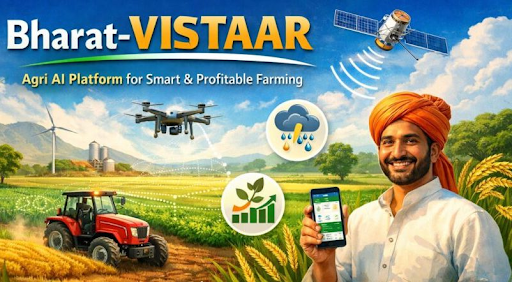
Bharat-VISTAAR is a multilingual AI platform aiming to transform Indian agriculture by combining AgriStack farmer data with scientific inputs from ICAR. It promises personalized advisories and higher incomes, but its impact depends on bridging the digital divide, safeguarding data privacy, and strengthening last-mile extension support.
Copyright infringement not intended
Picture Courtesy: economictimes
Context
In the Union Budget 2026, the Finance Minister announced the launch of 'Bharat-VISTAAR' (Virtually Integrated System to Access Agricultural Resources).
What is Bharat-VISTAAR?
It is a new multilingual Artificial Intelligence (AI) tool to provide customised, data-driven advisory services to farmers.
Objectives: Boost productivity, improve incomes, and enhance climate resilience in agriculture.
Core Components and Functioning
Bharat-VISTAAR is designed as an open, interoperable public digital network.
It functions by integrating key existing digital infrastructures to create a unified advisory system.
Foundation: It integrates two platforms:
AI-Powered Advisory: The system uses AI to analyse data from AgriStack (e.g., soil health, weather patterns) and combines it with ICAR's scientific knowledge, to generate hyper-localised, crop-specific, and real-time advice for farmers.
Accessibility: Its multilingual interface provides advisories in local languages, making advanced agricultural technology accessible to a wider farming community.
What is the significance of this Initiative?
Indian agriculture faces deep-seated structural challenges that necessitate technological intervention like Bharat-VISTAAR.
Fragmented Landholdings: Average farm size is just 1.08 hectares, which limits economies of scale and profitability. (Source: Agriculture Census)
Information Asymmetry: Over 86% of Indian farmers are small and marginal, often lacking access to timely, scientific, and reliable information for decision-making.
Productivity Gaps & Stagnant Incomes: A combination of structural issues, climate risks, and poor market integration has resulted in stagnant farm incomes, a concern highlighted in the Economic Survey 2026.
Climate Change Risks: Increasing climate volatility requires proactive tools for risk management. AI can provide early warnings for weather events and pest attacks, helping build climate resilience.
Potential Benefits and Expected Outcomes
Integrating data, research, and AI offers substantial agricultural benefits. A Telangana AI pilot project achieved a 21% yield increase, proving its potential. (Source: NITI Aayog)
Enhanced Farm Productivity: Provides precise guidance on crop selection, irrigation, and nutrient management to boost yields.
Optimised Resource Use: Promotes precision farming, reducing costs and environmental impact by optimising the use of water, fertilizers, and pesticides.
Improved Market Linkages: Delivers real-time market intelligence, helping farmers sell produce at better prices.
Farmer Empowerment: Democratises access to information, empowering even smallholders to adopt modern agricultural practices.
Way Forward
Bharat-VISTAAR success requires a holistic strategy focusing on a robust "phygital" (physical + digital) ecosystem, prioritising digital literacy for farmers, establishing a strong data protection framework, and strengthening collaboration between the government, agri-tech startups, and Farmer Producer Organisations (FPOs) to ensure effective and inclusive last-mile delivery.
Source: PIB
|
PRACTICE QUESTION Q. The term 'Orange Economy', recently seen in the news, is associated with: A) The production and export of citrus fruits and horticultural products. B) The renewable energy sector focusing on solar power expansion. C) The creative industries including Animation, Visual Effects, Gaming, and Comics (AVGC). D) The transition of the informal labor force into the formal digital economy. Answer: C Explanation: The Orange Economy, also known as the Creative Economy, refers to sectors where value is derived from human creativity, culture, and intellectual property. The term was popularized by Colombian economists Felipe Buitrago and Iván Duque to describe industries that transform ideas into cultural and commercial assets. |
Bharat-VISTAAR (Virtually Integrated System to Access Agricultural Resources) is a multilingual Artificial Intelligence (AI) powered platform announced in the Union Budget 2026. It is designed to provide customized, scientific agricultural advice to farmers across India.
It functions by integrating two key digital infrastructures: AgriStack (a database of farmers and land records) and the ICAR's Package of Practices (scientific farming techniques). Its AI engine processes this data along with real-time inputs like weather to generate hyperlocal, personalized advice for farmers in their local languages.
AgriStack is a federated digital database that includes a registry of farmers with unique IDs, geo-referenced land records, and a crop-sown registry. Its role is to provide the foundational, farm-specific data that the Bharat-VISTAAR AI engine uses to create personalized advisories.



© 2026 iasgyan. All right reserved