The Supreme Court ruled that parental income alone cannot decide OBC ‘creamy layer’ status. The exclusion must be status-based, not purely income-based, and salary or agricultural income should not be counted. The judgment corrects discrimination and aligns reservation rules with the original 1993 DoPT guidelines.
Copyright infringement not intended
Picture Courtesy: THEHINDU
The Supreme Court ruled that "creamy layer" status for Other Backward Classes (OBC) cannot be decided solely by parental income.
|
Read all about: Creamy Layer Policy Explained |
The 'creamy layer' refers to the socially and economically advanced members of OBCs who are ineligible for reservation benefits.
The creamy layer restriction applies only to OBCs to target economic upliftment.
Evolution of the Creamy Layer Principle
Judicial Origin (1976): The term was first used in the State of Kerala vs N.M. Thomas case, where judges advised that reservation benefits should not be monopolised by the affluent sections of backward classes.
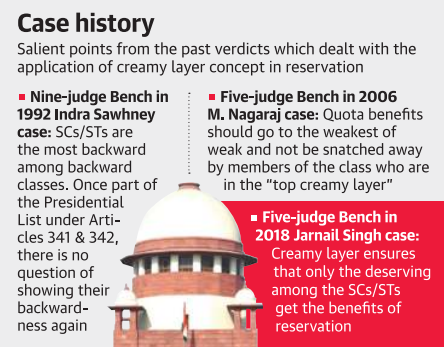
Constitutional Mandate (1992): The concept was constitutionally validated by a nine-judge bench in the Indra Sawhney vs Union of India case (Mandal Commission case).
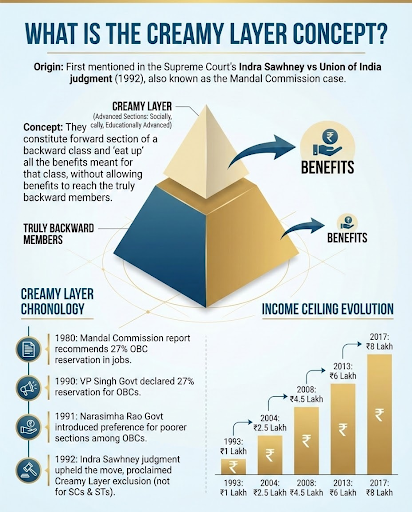
Executive Implementation (1993): Following the verdict, the government issued an Office Memorandum (OM) via the Department of Personnel and Training (DoPT) in September 1993.
The core legal conflict arose from a contradictory interpretation between the foundational 1993 OM and a clarificatory letter issued in 2004.
|
Provision |
1993 DoPT Office Memorandum (OM) |
2004 "Clarificatory" Letter |
|
Treatment of Salary & Agricultural Income |
Stated that income from salaries and agricultural land "shall not be clubbed" in the wealth test. |
Suggested that for PSU/bank employees, salary income could be included to determine creamy layer status. |
|
Basis for Exclusion |
Based on the parent's post and social status, signifying social advancement. |
Shifted the basis to purely economic income for a specific group of employees. |
|
Outcome |
Equitable application for children of all employees, focused on social standing. |
Created a discriminatory situation where children of government servants were eligible, but children of PSU employees with similar status were not. |
Primacy of 'Status' over 'Income'
The Court held that the creamy layer criteria are fundamentally status-based. Social advancement within a service hierarchy is the primary indicator, not just income level.
Mandatory Exclusion of Certain Incomes
It reaffirmed the plain language of the 1993 OM, ruling that income from salaries and agriculture must be excluded from the income/wealth test for all categories of employment.
Strikes Down Discrimination
The judgment declared that treating children of PSU employees differently from those of government servants is "hostile discrimination" and violates the principles of equality enshrined in Articles 14, 15, and 16 of the Constitution.
Supremacy of the 1993 OM
The Court ruled that the 2004 clarificatory letter, which created confusion, cannot override the substantive legal framework established by the 1993 OM.
What are the potential Implications of the Recent Judgment?
Widening the Reservation Pool
Children of PSU, Public Sector Bank, and autonomous body employees may now be eligible for OBC reservation, as their parents' salary is no longer a disqualifying factor.
Ensuring Equitable Application
It establishes a uniform and fair application of the creamy layer principle, removing the arbitrary distinction between different employment sectors.
Onus on Government for 'Equivalence'
The judgment mandates the government to quickly establish the equivalence of posts between PSUs/other bodies and government services to create a stable, status-based assessment framework.
Reignites Income Threshold Debate
The creamy layer income ceiling, unchanged since 2017 at ₹8 lakh per annum, is set for revision following demands from bodies like the National Commission for Backward Classes (NCBC) to increase the limit.
Issue Clear Guidelines
The DoPT must issue a new, unambiguous Office Memorandum that aligns with the Supreme Court's ruling to prevent future misinterpretations.
Expedite Equivalence Determination
A time-bound committee should be formed to establish a clear equivalence of posts across all public and autonomous bodies.
Periodic and Rational Review
The creamy layer criteria, especially the income threshold, should be reviewed periodically (e.g., every 3-5 years) based on inflation and objective data.
Strengthen Verification
While the criteria are clarified, the verification process for issuing OBC-NCL (Non-Creamy Layer) certificates must be strengthened to ensure benefits reach the genuinely deserving.
The Supreme Court's judgment corrects the creamy layer principle, prioritizing social status over income to ensure reservation empowers the most disadvantaged and reinforces equality.
Source: THEHINDU
|
PRACTICE QUESTION Q. With reference to the Indra Sawhney vs Union of India (1992) case, consider the following statements: 1. The Supreme Court upheld the 27% reservation for Other Backward Classes (OBCs) while introducing the "creamy layer" concept. 2. The Court ruled that the "creamy layer" exclusion must also apply to Scheduled Castes (SCs) and Scheduled Tribes (STs) to ensure substantive equality. 3. It established a 50% ceiling on total reservations, which can only be breached in "extraordinary circumstances." How many of the statements given above are correct? A) Only one B) Only two C) All three D) None Answer: B Explanation: Statement 1 is correct: In the Indra Sawhney vs Union of India (1992) case, a nine-judge bench upheld the notification providing 27% reservation for Other Backward Classes (OBCs). It also introduced the "creamy layer" concept, directing that advanced sections among the OBCs be excluded from reservation benefits. Statement 2 is incorrect: The 1992 judgment specifically excluded Scheduled Castes (SCs) and Scheduled Tribes (STs) from the creamy layer concept, ruling that it applied only to OBCs. (Note: While later cases like Jarnail Singh (2018) discussed applying the creamy layer to SCs/STs for promotions, the Indra Sawhney ruling itself did not). Statement 3 is correct: The Court established that total reservations should not exceed a 50% ceiling, except in "extraordinary circumstances" or "far-flung areas" where unique demographics might justify a breach. |
The 'creamy layer' refers to the socially and economically advanced members of the Other Backward Classes (OBCs). They are considered capable of progressing without reservation benefits, which are therefore reserved for the more disadvantaged members of the OBC community.
The Supreme Court ruled that parental income from salary and agriculture cannot be the sole criterion for determining creamy layer status. It emphasized that the exclusion is based on the parent's 'status' (e.g., their post in a hierarchy), not just their income.
The concept of the 'creamy layer' was constitutionally mandated by a nine-judge Supreme Court bench in the Indra Sawhney & Others vs Union of India (1992) case, also known as the Mandal Commission case.




© 2026 iasgyan. All right reserved