The NFHS-6 report reveals India's progress in institutional deliveries (90.6%), child immunization (87.1%), and health insurance coverage (60.2%). However, the data also highlights emerging public health challenges today, notably a sharp rise in obesity and diabetes.
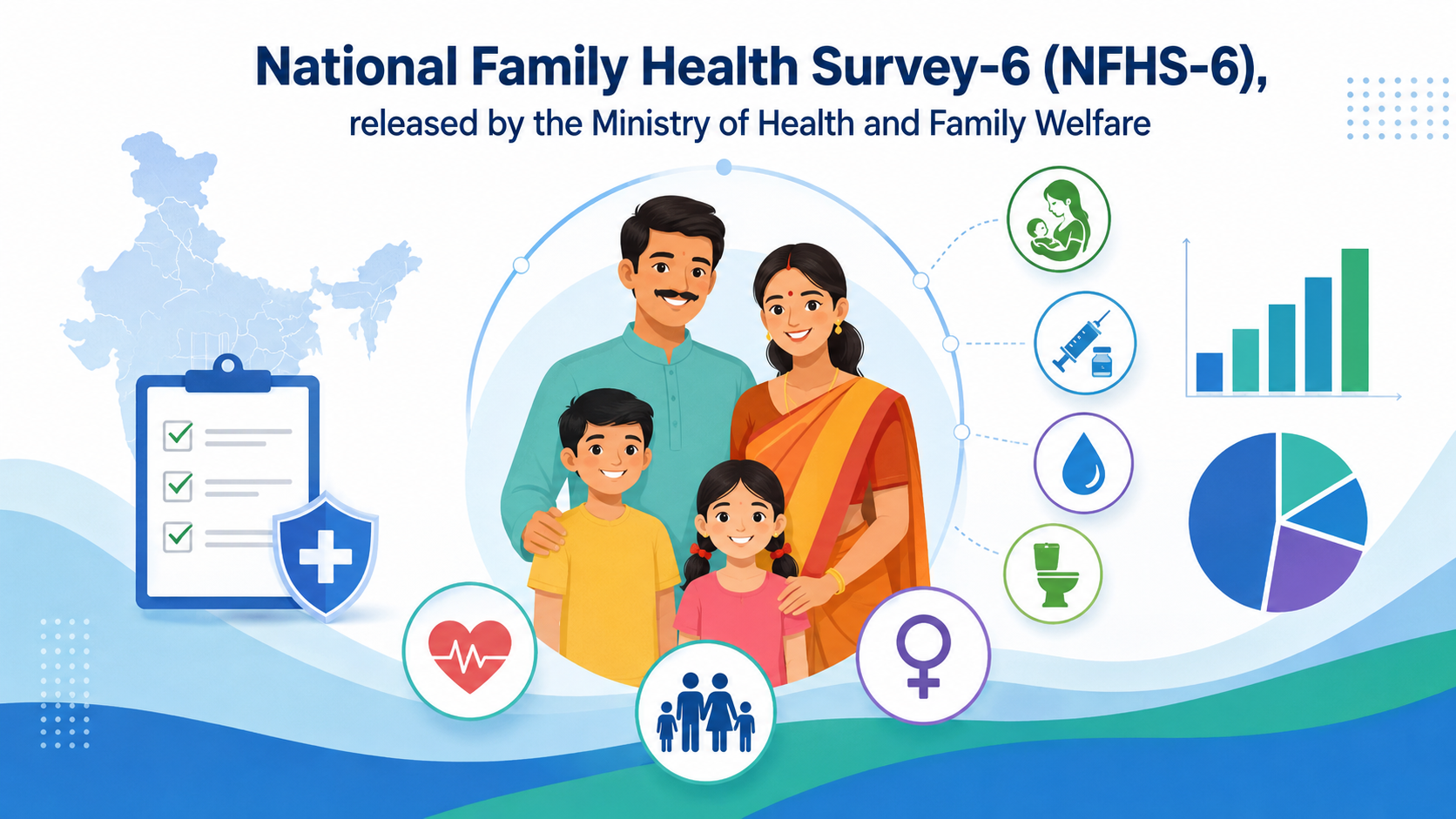
The National Family Health Survey-6 (2023-24), released by the Union Ministry of Health and Family Welfare (MoHFW), provides a comprehensive evidence-based snapshot of India's population, health, and nutrition indicators.
The NFHS is a multi-round household survey conducted across India. Established in the early 1990s, it serves as the primary data source for tracking health and social indicators nationwide.
Nodal Agency: The International Institute for Population Sciences (IIPS), Mumbai, manages the survey without external technical or financial support for this round.
Survey Methodology: Uses Computer Assisted Personal Interviewing (CAPI) across four schedules: Household, Woman’s, Man’s, and Biomarker.
Expansion of Scope: NFHS-6 introduces new modules on Direct Bank Transfer (DBT), Self-Help Group (SHG) coverage, digital literacy, and expanded clinical testing for HIV, Hepatitis-B, and Hepatitis-C.
Purpose: The survey tracks progress toward Sustainable Development Goals (SDGs), sets benchmarks for the health sector, and evaluates the effectiveness of government flagship programs.
Demographic and Fertility Trends
Maintains National Fertility: The Total Fertility Rate (TFR) for India remains stable at 2.0, which is below the replacement level of 2.1.
Improves Contraceptive Use: The Contraceptive Prevalence Rate (CPR) increases from 66.7% to 69.1%.
Reduces Unmet Need: Total unmet need for family planning drops to 8.5% from 9.4%.
Signals Demographic Shift: Specific regions like Andhra Pradesh face a shrinking workforce and ageing population. The state's fertility rate has fallen significantly (reported at 1.5 in some regions, though official survey tables indicate 1.8), with the proportion of elderly (60+) rising to 13.9%.
Maternal and Child Healthcare (MCH)
Boosts Antenatal Care (ANC): ANC coverage rises to 95.9%. Women receiving at least four ANC visits increased from 58.5% to 65.2%.
Universalizes Institutional Births: Institutional deliveries reach 90.6% nationally. In states like Andhra Pradesh, this figure is as high as 98.4%.
Enhances Postnatal Care: Postnatal care for newborns within two days of delivery improves to 85.3%.
Improves Maternal Nutrition: Mothers consuming iron folic acid (IFA) for 180 days or more during pregnancy rises from 26.0% to 37.8%.
Concerns over C-Sections: Caesarean section deliveries rise to 27.2% nationally. In private facilities, the rate reaches a high of 54.1%.
Child Immunization and Health
Advances Full Immunization: Full vaccination coverage among children (12-23 months) increases to 87.1%.
Doubles Rotavirus Coverage: Rotavirus vaccination coverage jumps from 36.4% to 85.4%.
Trusts Public Facilities: 95.6% of children receive their vaccinations through the public healthcare system.
Reduces Childhood Illness: Prevalence of Acute Respiratory Infection (ARI) symptoms drops to 1.9%, and severe diarrhea prevalence declines to 0.5%.
Nutritional Transition and Outcomes
Reduces Stunting: Prevalence of stunting (low height-for-age) among children under five drops from 35.5% to 29.3% (a 17% reduction).
Cuts Severe Wasting: Severe wasting (too thin for height) declines sharply from 7.7% to 5.2% (a 32% reduction).
Promotes Breastfeeding: Early initiation of breastfeeding (within one hour of birth) increases to 50.1%.
Identifies Dual Burden: While undernutrition declines, adult obesity rises. Overweight/obese women now constitute 30.7% of the population, up from 24.0%.
Non-Communicable Diseases (NCDs) and Lifestyle Risks
Monitors Blood Sugar: The proportion of adults with high or very high blood sugar (or on medication) rises; women stand at 17.8% and men at 20.9%.
Tracks Hypertension: Elevated blood pressure (or medication use) is prevalent in 19.4% of women and 22.1% of men.
Reduces Tobacco/Alcohol: Use of tobacco among men declines to 36.3% (from 38.0%), while alcohol consumption remains largely stable.
Women’s Empowerment and Financial Inclusion
Double Digital Access: Women who have ever used the internet nearly doubled from 33.3% to 64.3%.
Expands Bank Ownership: Women operating their own bank/savings accounts increase to 89.0%.
Improves Menstrual Hygiene: Use of hygienic protection methods among young women (15-24 years) rises to 79.2%.
Reduces Gender-Based Violence: Spousal violence experience among ever-married women (18-49 years) declines to 22.3% from 29.2%.
Maternal Health: Janani Suraksha Yojana (JSY), Janani Shishu Suraksha Karyakram (JSSK), and Pradhan Mantri Matru Vandana Yojana (PMMVY 2.0) drive the rise in institutional deliveries and antenatal care.
Child Nutrition: POSHAN Abhiyaan, Saksham Anganwadi, and POSHAN 2.0 contribute to the significant reduction in stunting and wasting.
Immunization: The Universal Immunization Programme and digital platforms like U-WIN strengthen last-mile delivery and vaccine tracking.
Financial Protection: Ayushman Bharat – Pradhan Mantri Jan Arogya Yojana (PM-JAY) expands health insurance coverage, which now reaches 60.2% of households.
Women's Empowerment: The Menstrual Hygiene Scheme and Rashtriya Kishor Swasthya Karyakram (RKSK) improve health awareness and hygienic practices among young women.
Way Forward
Address Demographic Aging: Develop robust elderly care infrastructure and social security systems to support the growing 60+ population. Some states may need to consider incentives for larger families to stabilize the workforce.
Strengthen Preventive Healthcare: Shift the focus from curative care to preventive measures for NCDs. This includes promoting physical activity, healthy diets, and regular screening for hypertension and diabetes at the primary level.
Regulate Surgical Deliveries: Implement stricter protocols to monitor and curb unnecessary C-sections, particularly in private hospitals, to avoid risks to mothers and newborns.
Enhance Financial Protection: Expand Ayushman Bharat-PMJAY coverage to reduce out-of-pocket expenditure and prevent catastrophic healthcare spending.
Promote Nutritional Practices: Reinvigorate campaigns for exclusive breastfeeding and infant and young child feeding (IYCF) practices to sustain gains in child survival.
Leverage Digital Inclusion: Use the rising digital literacy among women to disseminate health information, track vaccinations through digital platforms like U-WIN, and facilitate Direct Bank Transfers (DBT) for maternal benefits.
Combat Tobacco and Alcohol: Strengthen enforcement of tobacco control laws and public health campaigns to reduce the risk of cardiovascular diseases and cancers.
NFHS-6 indicates India is advancing toward Sustainable Development Goals via enhanced maternal care, child nutrition, and health insurance. However, emerging demographic shifts and lifestyle diseases pose new policy hurdles.
Source: PIB
|
PRACTICE QUESTION Q. Consider the following statements regarding the findings of the National Family Health Survey-6 (NFHS-6):
Which of the statements given above is/are correct? (a) 1 and 2 only (b) 2 and 3 only (c) 1 and 3 only (d) 1, 2, and 3 Answer: (c) Explanation: Statement 1 is correct: Institutional deliveries in India have successfully crossed the 90% mark, rising to 90.6% Over 90% of Indian babies born in hospitals, 87% of one-year-olds fully vaccinated: NFHS-6. Statement 2 is incorrect: The prevalence of stunting and severe wasting among children under five years has declined rather than increased when compared to NFHS-5 Over 90% of Indian babies born in hospitals, 87% of one-year-olds fully vaccinated: NFHS-6. Stunting dropped from 35.5% (in NFHS-5) to 29.3%, and severe wasting fell from 7.7% to 5.2% Over 90% of Indian babies born in hospitals, 87% of one-year-olds fully vaccinated: NFHS-6. Statement 3 is correct: Household health insurance coverage has significantly expanded, jumping from 41% during NFHS-5 to 60.2% in NFHS-6 Over 90% of Indian babies born in hospitals, 87% of one-year-olds fully vaccinated: NFHS-6. |
Institutional deliveries in India have reached 90.6%, moving the country closer to universal coverage, while births attended by skilled personnel improved to 91.3%.
Household health insurance and financing scheme coverage saw a massive jump, expanding from 41.0% in NFHS-5 to 60.2% in NFHS-6, heavily supported by Ayushman Bharat-PMJAY.
India's Total Fertility Rate (TFR) remains stable at 2.0 children per woman, which is below the replacement level of 2.1.



© 2026 iasgyan. All right reserved