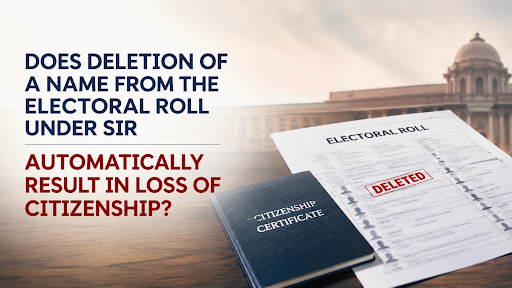
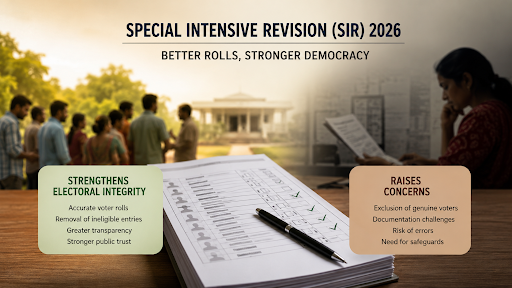
The Special Intensive Revision (SIR) 2026 updates India's electoral rolls to remove duplicate or deceased voters. However, strict legacy documentation requirements and algorithmic deletions risk unconstitutionally disenfranchising marginalized communities, imposing immense administrative burdens on citizens and grassroots officials alike.
Why In News?
The Election Commission of India (ECI) mandates parental legacy details for new voter registrations under the Special Intensive Revision (SIR) 2026, prompting direct Supreme Court intervention and UN Special Rapporteurs' concerns over large-scale, non-transparent voter exclusions.
What is the Special Intensive Revision (SIR) of Electoral Rolls?
The SIR is an extensive, house-to-house enumeration exercise conducted by the ECI to verify voter details, update current records, and map existing electors to historical legacy databases, primarily the 2002-2004 SIR rolls.
Objectives: To leave no eligible elector (including urban, young, and migrant voters) behind, purge duplicate, deceased, permanently shifted, untraceable, and non-citizen electors, and rationalize polling stations to cap voter limits at 1,200 electors per booth.
Why is the Special Intensive Revision Important for Indian Electoral Democracy?
Ensures Free and Fair Elections: The revision validates ordinary residence and ensures a pure electoral base required under Article 326 of the Constitution.
Prevents Duplicate and Fraudulent Enrolments: The process weeds out ghost voters. In Bihar alone, the ECI's baseline deduplication target catches orchestrated registrations at fictitious addresses.
Strengthens Electoral Credibility: The exercise updates highly mobile populations resulting from frequent migration, ensuring voters do not cast ballots across multiple constituencies.
Improves Quality of Voter Databases: The ECI leverages the Registrar General of India (RGI) database to automatically obtain death registration data under the Registration of Births and Deaths Act, 1969.
Enhances Democratic Participation: The initiative directly integrates new, 18-year-old voters safely and accurately into the democratic mainstream via the Enumeration Phase.
What are the Key Features of SIR 2026?
Comprehensive Verification of Electoral Rolls: The framework requires Booth Level Officers (BLOs) to make at least 3 physical visits to elector households to collect Enumeration Forms (EFs).
Enhanced Documentation Requirements: The policy imposes strict documentation rules based on birth year; for instance, citizens born after 02.12.2004 must provide self-proof alongside documents from both their mother and father.
Digital and Physical Verification Processes: The system utilizes ECINet databases to algorithmically map existing voters to the 2002-2004 SIR lists using Demographically Similar Entries logic.
Focus on New Voter Registration: The ECI overhauls Form 6 administratively, preventing applicants from proceeding online without declaring their parents' historical SIR status.
Mechanisms for Claims and Objections: The process invokes Rule 20 and Rule 21A of the Registration of Electors Rules (RER) 1960, allowing citizens to dispute exclusions via Form 7 and file appeals with the District Magistrate (1st Appeal) and Chief Electoral Officer (2nd Appeal).
What Benefits Can SIR 2026 Offer?
Greater Electoral Transparency: The ECI publishes draft rolls in local Gram Panchayats, mandating a transparent period for claims and objections.
Accurate Voter Lists: The system reduces voter misidentification by utilizing Aadhaar linking under Section 23(5) of the Representation of the People Act (RPA) 1950.
Improved Election Management: The administration reallocates voters into new polling stations in high-rise and slum clusters to minimize crowding and voter friction.
Reduced Electoral Malpractices: The revision prevents political operatives from engineering demographic advantages ahead of state assembly elections.
Increased Public Trust in Elections: The rigorous verification ensures that only authentic, constitutionally verified citizens dictate electoral mandates.
What are the Major Concerns Associated with SIR 2026?
Risk of Exclusion of Genuine Voters:
Gujarat Case Study: Authorities delete over 68.12 lakh voters (15.47%) using unverified "Absent, Shifted, Dead" lists, bypassing statutory hearing mandates.
West Bengal Case Study: Flawed mapping software flags 1.31 crore voters based on minor transliteration errors from Bengali to English, shifting the burden of proof to innocent citizens.
Documentation and Accessibility Issues
Voters born post-1987 face the difficult task of proving 20-year-old legacy data. For example, Inamul Haq, a tenant in Varanasi, faces disenfranchisement because his landlord refuses to provide house tax receipts required for Domicile Certificates.
Administrative Burden on Citizens
Grassroots Booth Level Officers (BLOs) face difficult targets resulting in high stress. Tragically, high stress triggers over 110 to 160 deaths and suicides among BLOs and panicked voters in West Bengal alone.
Concerns Regarding Privacy and Data Collection
The ECI allegedly shares highly sensitive EPIC databases containing photographs and demographics with private tech firms for facial recognition, violating privacy norms.
Potential Impact on Marginalised Communities:
Weaponization of Form 7: Malicious actors submit mass fraudulent deletion requests. In Goalpara, Assam, a woman named Naba Bala Ray unknowingly faces 64 forged objections filed under her name against legitimate voters.
Marginalised Exclusions: The SABAR Institute documents that the Matua community (Namashudra refugees) in West Bengal suffers disproportionate exclusions due to rigid documentation rules.
What Measures Can Strengthen Electoral Roll Revision While Protecting Voter Rights?
Ensuring Inclusive Documentation Standards: Authorities must strictly follow the Supreme Court directive mandating the acceptance of Class 10 Admit Cards, Aadhaar cards, and Yellow Ration Cards as primary proof to protect citizens lacking legacy data.
Expanding Voter Awareness Campaigns: Establish Voter Assistance Centres in every Gram Panchayat to digitally map voters and compile necessary documents without bureaucratic harassment.
Strengthening Grievance Redressal Mechanisms: The Supreme Court orders the creation of special appellate bodies manned by sitting or former High Court Judges to hear rejected voter claims impartially.
Leveraging Technology for Verification: Implement transparent, socially audited deduplication software and prohibit untested algorithms that trigger mass unverified deletions through linguistic mismatches.
Safeguarding Privacy and Data Protection: Constructs robust guardrails restricting political parties and private tech platforms from unlawfully accessing citizen EPIC databases.
Conclusion
While refining electoral rolls is paramount for democratic integrity, the SIR 2026 must execute verifiable, transparent audits rather than algorithmic purges to guarantee that no constitutionally eligible citizen suffers mechanical disenfranchisement.
Source: THEHINDU
|
PRACTICE QUESTION Q. Examine the significance of Special Intensive Revision (SIR) exercises and the challenges associated with voter verification processes. (150 Words, 10 Marks) |
SIR is a rigorous house-to-house enumeration process supervised by the ECI to update electoral rolls, link current voters to historical 2002-2004 databases, and remove duplicate or deceased electors.
The ECI initiated SIR 2026 to ensure no eligible elector is left behind, prevent fraudulent voting, and update rolls to account for high migration rates ahead of major state assembly elections.
Strict demands for 20-year-old legacy documents place immense burdens on post-1987 voters, tenants, and marginalized groups. Supreme Court interventions were required to force the ECI to accept basic identity proofs like Aadhaar.
Voters must interact with BLOs during house visits, submit valid documents (like Aadhaar or Class 10 admit cards), track their status online (via ECINet), and file a Form 8 for corrections or an appeal if wrongfully issued a deletion notice.




© 2026 iasgyan. All right reserved