UDISE+ is India's premier digital platform for school education data. Managed by the Ministry of Education, it tracks students, teachers, and infrastructure, enabling data-driven governance, improving resource allocation, and ensuring the effective implementation of the National Education Policy 2020.

Why In News?
The Union Ministry of Education released the Unified District Information System for Education Plus (UDISE+) 2025-26 report.
What is Unified District Information System for Education Plus (UDISE+)?
Comprehensive Digital Platform: UDISE+ operates as India’s largest Management Information System (MIS) for school education, collecting real-time data on schools, students, teachers, infrastructure, and learning indicators.
Unique Identification: The platform assigns a unique UDISE code to every recognized school in the country to streamline administrative tracking.
System Evolution: The system originates in 2012-13 as a paper-based tool, transitions to online real-time collection in 2018-19, and shifts to individual student-wise tracking in 2022-23 to collect over 60 data fields per student.
One Nation One Database: The initiative establishes a unified national database for the school education sector.
Data Accuracy: The platform captures precise, real-time metrics to eliminate duplicate or ghost entries.
Student Tracking: It assigns a unique Educational ID (EID) and integrates voluntary Child Aadhaar details for precise tracking.
Key Findings of UDISE+ 2025-26
Teacher Strength: Total teacher strength climbs to 1.02 crore (an 8.3% increase from 2022-23), with women accounting for 54.9% of the workforce.
Pupil-Teacher Ratio (PTR): National PTR outperforms NEP targets, standing at 10 for Foundational, 12 for Preparatory, 17 for Middle, and 21 for Secondary levels.
Declining Dropout Rates: Secondary school dropout rates drop to 7.0% (down from 8.2% in the previous year and 13.8% in 2022-23), while preparatory level dropouts plummet to 1.8%.
Enhanced Monitoring: The Gross Enrolment Ratio (GER) at the secondary level spikes to 71.7%, transition rates from middle to secondary reach 88.3%, and zero-enrollment schools decline by 29%.
Major Components of UDISE+
School Database: Captures data for 14.7 lakh schools, recording management types (government, aided, private) and geographical locations.
Student Database: Maintains detailed profiles of 24.69 crore students, mapping social categories (SC/ST/OBC/Minority), gender, and progression via the APAAR ID system.
Teacher Database: Monitors over 1 crore teachers, tracking professional qualifications, gender distribution, and stage-wise deployment.
Infrastructure Monitoring: Tracks digital and basic facilities, recording computer access at 69.9%, internet access at 67.4%, and basic electricity at 95.0% in 2025-26.
GIS and Digital Tracking: Integrates Application Programming Interfaces (APIs) and AI tools for smart verification, automated flagging, and seamless data harmonization across state portals.
Significance of UDISE+
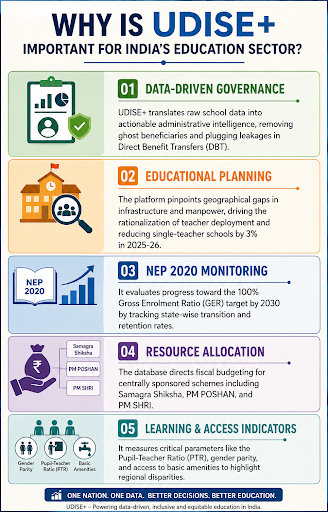
Policy Formulation: Provides authentic data that helps policymakers formulate targeted interventions for states with lagging indicators.
Educational Outcomes: Traces dropouts using unique student IDs to re-integrate them into the system, supporting NEP 2020 universal access goals.
Transparency and Accountability: Employs inbuilt validation protocols to verify uploaded data at block, district, and state levels.
Resource Distribution: Pinpoints infrastructure deficits, guiding targeted spending to achieve 98.5% coverage for Girls' Toilets and 99.5% for Safe Drinking Water.
Educational Equity: Tracks marginalized groups, showing that girls account for 48.4% of total enrollments and monitoring Children with Disabilities (CwD) inclusion through ramp availability (58.2%).
What are the Major Concerns Associated with UDISE+?
Data Quality: Relies on voluntary uploads by schools, risking over-reporting or under-reporting to secure government funds without strict independent auditing.
Digital Infrastructure Gaps: Exhibits severe digital divides between private and government schools, leaving many rural government schools without robust ICT and internet setups.
Capacity Constraints: School administrators and teachers lack the technical training required for complex, real-time data entry, leading to input errors.
Real-Time Updates: Suffers from delays in record correction, causing the database to lag behind actual ground realities of admissions and transfers.
Privacy and Security: Demands highly secure, encrypted cyber infrastructure to protect over 60 data fields per student, voluntary Child Aadhaar, and demographic data from breaches.
Way Forward
Real-Time Validation: Implements advanced Artificial Intelligence (AI) for automated data flagging, smart verification queues, and AI helpdesks to eliminate human error.
Learning Outcome Integration: Connects input tracking with outcome-based indices like the National Achievement Survey (NAS) and PARAKH to measure actual learning levels.
Digital Capacity Expansion: Provides dedicated IT hardware and trained data-entry operators at school and block levels, freeing teachers to focus on pedagogy.
Data Analytics Capabilities: Evolves UDISE+ into an AI-compliant decision support system that forecasts educational trends and dropout risks.
Public Access and Transparency: Creates transparent public dashboards to allow civil society and local panchayats to cross-verify school data and hold administrations accountable.
Conclusion
UDISE+ serves as the education sector's digital backbone, converting demographic and infrastructural data into actionable insights to ensure equitable, inclusive, and quality learning under the NEP 2020 framework.
Source: PIB
|
PRACTICE QUESTION Q. Consider the following statements regarding the Unified District Information System for Education Plus (UDISE+):
Which of the statements given above is/are correct? A) 1 and 2 only B) 2 only C) 2 and 3 only D) 1, 2, and 3 Answer: B Explanation: Statement 1 is incorrect: UDISE+ is maintained by the Department of School Education and Literacy, Ministry of Education, rather than the NITI Aayog. Statement 2 is correct: Starting from the 2022–23 academic year, UDISE+ shifted its data collection from aggregate, school-wise data to individual, student-wise tracking to improve the precision of educational planning and monitoring. Statement 3 is incorrect: UDISE+ collects and captures enrolment data across all recognized schools, which includes private institutions along with government and government-aided schools. |






© 2026 iasgyan. All right reserved