The Draft National Health Research Policy 2026 establishes a unified framework to transform India's medical research. It targets increasing public investment to 0.15% of GDP, enhancing disease-burden aligned indigenous innovation, and implementing a three-tier governance ecosystem for public health.
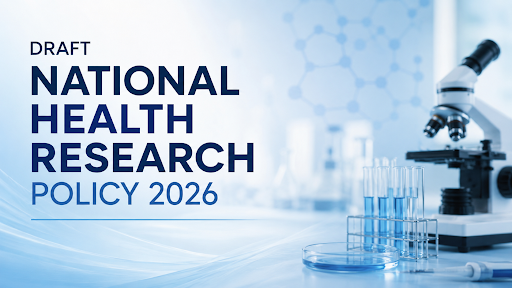
Why In News?
The Department of Health Research (DHR), under the Union Ministry of Health and Family Welfare, released the Draft National Health Research Policy 2026 .
What is the Draft National Health Research Policy 2026?
Unified Framework: India’s first unified national framework spanning biomedical science, clinical medicine, public health, digital health, epidemiology, behavioural sciences, and emerging technologies.
Strategic Vision: Establishes a capable, inclusive, self-reliant, and responsive health research ecosystem to position India among global leaders in medical innovation and knowledge generation.
Why India Needs a New Health Research Policy
Fragmented Research Ecosystem: Poor institutional coordination creates duplication of efforts and wastes vital resources across academic, government, and private sector boundaries.
Priority Mismatch: Existing research priorities track academic trends rather than reflecting India's actual disease burden, rural-urban health disparities, or pandemic preparedness requirements.
Limited Translation: Administrative and regulatory roadblocks delay funded research and slow down the translation of scientific discoveries into actionable healthcare delivery and clinical practice.
Inadequate Funding: India currently invests only 0.024% of GDP on health research, falling short of the 0.27% average spent by high-income nations.
Emerging Disease Burden: Rising threats of Antimicrobial Resistance (AMR), climate-sensitive diseases, and complex zoonotic outbreaks mandate aggressive, structured interdisciplinary studies under a unified mandate.
Technological Integration: Rapid tech progress requires regulatory and validation frameworks to safely, ethically use Artificial Intelligence (AI), genomic profiling, and electronic health records.
Key Features of the Draft National Health Research Policy 2026
National Health Research Agenda: Periodically revised agenda to dictate research areas based on disease burden, social equity, scientific opportunity, and strategic national interests.
Three-Tier Governance Framework:
Disease Burden-Based Prioritisation: Redirects funding toward high-burden areas like Tuberculosis (TB), cancer, mental health, anaemia, vector-borne illnesses, and Non-Communicable Diseases (NCDs).
AI and Digital Health Promotion: Advocate the responsible use of AI in healthcare, establishes validation centers for algorithmic tools, and leverages interconnected datasets to predict health outcomes.
Biomedical Data Ecosystems: Establishes the ICMR Health Research Data Repository to safely archive clinical records, biospecimens, and bio-bank materials for secure sharing among researchers.
Escalated Funding Targets: Ramp up government health research spending from the baseline of 0.024% of GDP to 0.072% by 2037 and ultimately 0.15% by 2047.
Indigenous Innovation Focus: Promotes indigenous development, targeting an increase in approved homegrown health technologies from 0.01 per million population (2023) to 0.1 by 2047.
Industry-Academia Collaboration: De-risks startup involvement via soft loans and grants, incentivizing public-private partnerships to translate basic discoveries into affordable healthcare products.
Expected Benefits for India's Healthcare System
Evidence-Based Policymaking: Basing health strategies on scientific data optimizes resource allocation for universal coverage.
Rapid Indigenous Technology Development: Incubators and reduced bureaucracy accelerate commercializing affordable, locally developed vaccines and diagnostics.
Improved Disease Surveillance: Integration with the National One Health Mission interlinks data across human, animal, and environmental interfaces to supercharge early warning systems.
Robust Pandemic Preparedness: A sustained research infrastructure allows India to swiftly generate medical countermeasures—including diagnostics and therapeutics—against novel public health emergencies.
Global Research Competitiveness: The policy targets elevating India's composite global standing in health sciences research from 18th place directly into the Top 3 by 2047.
Enhanced Public Health Outcomes: Evaluating research through the ICMR-IRIS scale forces institutions to deliver innovations that tangibly benefit patient survival and clinical practice.
Source: THEHINDU
|
PRACTICE QUESTION Q. "India's health challenges require a research ecosystem that is aligned with national priorities and capable of translating knowledge into public health outcomes." Examine (250 Words, 15 Marks) |




© 2026 iasgyan. All right reserved