Maharashtra's Ladki Bahin Scheme faces intense scrutiny after the removal of 92 lakh ineligible beneficiaries and a CAG audit flagging significant financial mismanagement. The crisis highlights the delicate balance between women's economic empowerment and sustainable welfare governance in India.
Why In News?
The Comptroller and Auditor General (CAG) releases the State Finances Audit Report 2024-25 exposing severe financial mismanagement and unauthorized excess expenditure under the Mukhyamantri Majhi Ladki Bahin Yojana.
What is the Ladki Bahin Scheme?
It is an Unconditional Cash Transfer (UCT) programme to support women across the state.
The scheme delivers a Direct Benefit Transfer (DBT) of ₹1,500 per month directly to women aged 21 to 65 years who possess a family annual income below ₹2.5 lakh.
Objectives: Enhances women's economic independence, improves nutritional and health outcomes, and increases female decision-making power within households.
Why Has the Scheme Come Under Scrutiny?
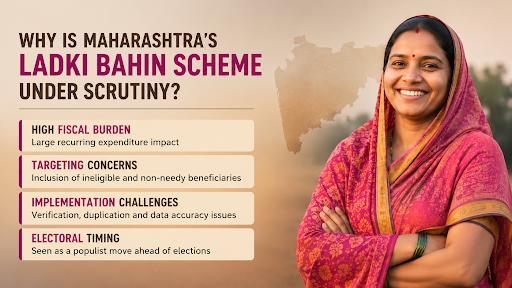
e-KYC Failures: The government drops nearly 92 lakh women from the beneficiary list for failing mandatory electronic Know Your Customer (e-KYC) authentication.
Income and Eligibility Violations: Verification filters remove approximately 16 lakh beneficiaries exceeding the ₹2.5 lakh income ceiling, over 4.42 lakh individuals linked to government employees, and roughly 29,000 male applicants who improperly receive funds.
Unjustified Excess Expenditure: The CAG identifies an excess expenditure of ₹3,541.16 crore incurred without any specific justification.
Budgetary Indiscipline: The audit exposes the parking of ₹15,586 crore in Virtual Personal Deposit Accounts (VPDA) during the last financial quarter despite lacking immediate utilization requirements, which severely undermines budgetary discipline.
Electoral Timing and Controversy: Opposition parties question the scheme's timing, alleging that the implementation primarily targets short-term electoral gains rather than sustainable, long-term welfare.
Financial Leakage: Estimates suggest the state exchequer distributes roughly ₹14,000 crore to ineligible beneficiaries before verification officials halt the payments.
Why is the Scheme Important for Women's Empowerment?
Direct Financial Support: Cash transfers raise month-end bank balances by approximately 84% (₹6,884) and boost spending by 46% (₹1,349) per beneficiary, reducing women's reliance on male relatives for daily consumption. (Source: EAC-PM)
Enhanced Financial Inclusion: The scheme connects millions of women to the formal banking system via Aadhaar-enabled, single-holder accounts, accelerating UPI adoption and digital financial literacy among rural and low-income demographics.
Improved Household Welfare: Beneficiaries allocate their marginal income heavily toward nutrition, health, and children's education, which generates positive intergenerational externalities.
Mitigating Time Poverty: The monthly transfer compensates women for unpaid care work, helping them renegotiate the household division of labour and reducing overall time poverty.
Strengthening Economic Agency: Placing cash directly under women's control shifts intra-household bargaining power and alters resource allocation equilibriums in favor of women.
Breaking Financial Dependency: Direct access to funds fosters independent financial decision-making, breaking traditional patterns of financial dependency on male family members.
Relieving Liquidity Constraints: A high Marginal Propensity to Consume (MPC) of 0.90 proves that the scheme effectively relieves severe liquidity constraints among the poorest deciles. (Source: EAC-PM)
Precautionary Savings Buffer: The cash acts as a vital buffer against economic shocks, fostering robust precautionary savings specifically among older beneficiaries aged 55 and above.
What are the Key Governance Challenges Highlighted by the Controversy?
Severe Inclusion Errors: Initial rollouts suffer from massive inclusion errors, enrolling thousands of ineligible demographics including men, taxpayers, and government staff.
Weak Verification Mechanisms: The absence of a stringent upfront e-KYC process creates a massive retrospective administrative burden and forces reactive, rather than proactive, filtering.
Fiscal Sustainability Threats: State expenditure on women's welfare balloons from ₹261.78 crore to ₹33,554.36 crore—a staggering 12,700% increase in just one year—which shrinks capital formation and infrastructure investments.
Escalating State Debt: The massive spending contributes to a state fiscal deficit of ₹1.2 lakh crore and outstanding liabilities of ₹8.6 lakh crore.
Weak Financial Controls: The lack of justification for ₹3,541 crore in excess spending indicates weak budgetary estimations and inadequate internal financial controls.
Competitive Welfarism Risks: Political competition drives governments to launch populist cash transfers close to elections, which bypasses rigorous fiscal planning and triggers severe macroeconomic risks.
What Lessons Does the Issue Offer for Welfare Governance?
Dynamic Social Registries: Developing dynamic and interoperable social registries prevents duplicate claims and enforces income and asset ceilings accurately across state departments.
Continuous e-KYC Verification: Implementing periodic e-KYC authentication weeds out "ghost" and ineligible recipients effectively without disrupting genuine beneficiaries.
Strengthening DBT Systems: Coupling DBT with targeted financial literacy minimizes dormant accounts and maximizes the utility of transferred funds.
Strict Financial Oversight: Adhering strictly to budgetary discipline ensures that departments utilize funds for immediate expenditure rather than parking them idly in deposit accounts.
Targeting Efficiency: Utilizing targeted transfers yields higher welfare gains per rupee spent than universal models, which demands precise exclusion criteria in developing economies.
What Measures Can Improve Welfare Scheme Delivery?
Mandatory Upfront e-KYC: Mandating digital authentication before disbursal avoids retrospective recoveries and prevents massive financial losses to the exchequer.
Inter-Departmental Data Integration: Integrating databases like income tax and vehicle registration flags ineligible applicants automatically during the application stage.
Community-Led Transparency: Publishing sanitized beneficiary lists and establishing localized Gram Sabha verifications upholds community accountability and filters out unqualified applicants.
Regular Social and Financial Audits: Instituting mandatory quarterly audits prevents arbitrary excess expenditures and the unauthorized parking of public funds.
Robust Grievance Redressal: Establishing accessible channels allows wrongly excluded beneficiaries to present valid documentation and reclaim their entitlements swiftly.
Conclusion
Effective welfare governance requires transitioning from politically driven populist handouts to meticulously targeted, fiscally sustainable, and rigorously audited empowerment programs.
Source: INDIANEXPRESS
|
PRACTICE QUESTION Q. "Effective welfare delivery requires balancing inclusion, transparency and fiscal sustainability." Examine. 150 words |




© 2026 iasgyan. All right reserved