The Supreme Court ruled that removing a voter's name during the Election Commission's Special Intensive Revision (SIR) cancels local voting rights but does not revoke Indian citizenship. Only the Home Ministry can legally determine citizenship through established due process.
Why In News?
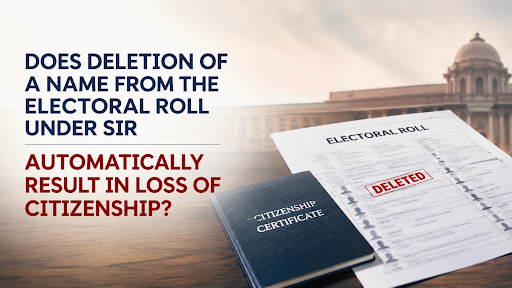
The Supreme Court ruled that removing a name from the electoral roll during the Special Intensive Revision (SIR) cancels voting rights but does not result in the loss of citizenship.
What is Special Intensive Revision (SIR)?
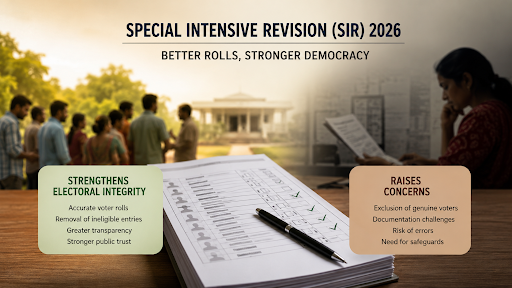
The Election Commission of India (ECI) initiates the SIR as a comprehensive, ground-up administrative exercise to update and verify electoral rolls before major elections.
The process mandates physical door-to-door verification where citizens must submit fresh enumeration forms alongside documentary proof of age and residence, unlike routine annual summary revisions.
The exercise identifies and removes duplicate, deceased, migrated, and undocumented immigrant voters from the electoral list.
The ECI maintains accurate electoral rolls to ensure democratic legitimacy under Section 21 of the Representation of the People Act, 1950.
Why Deletion from the Electoral Roll Does Not Mean Loss of Citizenship
Distinct Legal Concepts: Electoral rolls determine voting eligibility in specific geographic constituencies, whereas citizenship constitutes a broader national legal status determining overall civil and political rights.
Voting Rights vs Citizenship: The Supreme Court affirms that a voter's removal from an electoral roll indicates a loss of voting rights in that specific list, not the deprivation of national citizenship.
Due Process Requirement: The Supreme Court directs the ECI to refer cases of deleted names directly to the Ministry of Home Affairs for formal adjudication under the Citizenship Act, 1955.
Intact Constitutional Status: An individual's constitutional status as a citizen remains entirely intact until the competent authority explicitly adjudicates and formally revokes citizenship.
Limited ECI Jurisdiction: The ECI lacks constitutional authority to decide citizenship status under Articles 9, 10, and 11 of the Constitution, limiting its jurisdiction strictly to controlling and managing electoral rolls.
Constitutional and Legal Provisions Governing Citizenship
Articles 5–11: These provisions establish the criteria identifying Indian citizens at the commencement of the Constitution, with Article 11 empowering Parliament to regulate citizenship acquisition and termination.
Citizenship Act, 1955: Enacted under Article 246(1) read with Article 11, this Act provides the exhaustive legal framework for acquiring citizenship (by birth, descent, registration, naturalization, and incorporation of territory) and terminating it (renunciation, termination, and deprivation).
Representation of the People Act, 1950: Section 21 authorizes the ECI to conduct special revisions of electoral rolls at any time for recorded reasons, while Section 16 explicitly disqualifies non-citizens from enrolling.
Article 324: This article vests the superintendence, direction, and control of electoral roll preparation exclusively in the ECI to ensure free and fair elections.
Principles of Natural Justice: The Supreme Court holds that arbitrary deprivation of voting rights without due notice violates the Rule of Law, preserving the statutory right of citizens to file claims and objections before Appellate Tribunals.
Significance of the Supreme Court Judgment
Protects Due Process: The ruling prevents the ECI from executing a "backdoor NRC (National Register of Citizens)" by mandating that citizenship revocation requires a stringent formal inquiry by the Ministry of Home Affairs.
Prevents Arbitrary Denial of Welfare: The judgment halts state governments from denying crucial welfare benefits like the Public Distribution System (PDS), Annapurna Yojana, and caste certificates to citizens struck from the SIR rolls.
Reinforces Rule of Law: The Supreme Court asserts that democratic processes cannot disenfranchise marginalized voters through summary administrative actions and documentation technicalities.
Demarcates Institutional Powers: The ruling clearly separates the ECI's administrative authority over voter lists from the Central Government's exclusive statutory authority over citizenship determination.
Safeguards Constitutional Rights: The decision upholds Article 326 (universal adult suffrage), protecting millions from statelessness and ensuring that impoverished voters do not face penalties for lacking legacy documentation.
Major Challenges Associated with Electoral Roll Revision
Exclusion of Genuine Voters: The SIR in Bihar led to the deletion of approximately 65 lakh names, frequently omitting living voters incorrectly marked as dead or migrated, while West Bengal recorded the exclusion of over 58 lakh electors during the initial enumeration phase.
Heavy Burden of Proof: Voters enrolled after 2003 face rigorous documentation requirements, including birth certificates or parents' legacy data, which disproportionately impacts the poor, women, and migrant laborers.
Administrative Errors: Inadequately trained Booth Level Officers (BLOs) execute revisions arbitrarily, leading to conflicting field instructions and targeted scrutiny in marginalized localities.
Balancing Integrity and Rights: The strict documentary regime risks systematically disenfranchising legitimate Indian citizens who lack access to neat documentary proof in their efforts to purge illegal immigrants.
Grievance Redressal Bottlenecks: Systemic delays plague the appeals process; for instance, in West Bengal, out of 34 lakh pending appeals before 19 Appellate Tribunals, authorities decided only around 38,000 cases.
Measures to Strengthen Electoral Roll Management
Transparent Verification Procedures: The Supreme Court directs the ECI to publish district-wise, booth-level searchable lists of deleted voters alongside specific administrative reasons for their deletion.
Timely Notice and Hearing: Authorities must serve physical hearing notices via BLOs and electronic notices at least seven days prior, allowing citizens adequate time to substantiate claims before Appellate Tribunals.
Robust Appeals Mechanism: Appellate Tribunals must adopt time-bound schedules for appeal disposals, frame simplified guides in local languages (Hindi, English, Bangla), and permit appellant appearances via video conferencing.
Digital Verification Integration: The Supreme Court directs the ECI to accept widely held identity proofs, specifically including Aadhaar cards and EPIC (Voter ID), to support inclusion claims and objections.
Public Awareness and Voter Facilitation: Booth Level Agents (BLAs) appointed by political parties and civil society organizations must actively assist excluded voters in navigating the complex claims process to prevent soft disenfranchisement.
Conclusion
The Supreme Court's distinction between electoral roll inclusion and national citizenship status safeguards democratic participation while directly preventing administrative errors from triggering arbitrary statelessness and welfare deprivation.
Source: INDIANEXPRESS
|
PRACTICE QUESTION Q. "Electoral roll revision is essential for ensuring free and fair elections, but it must also uphold constitutional guarantees of due process and individual rights." Discuss . 250 words |
The Special Intensive Revision (SIR) is a comprehensive, ground-up exercise initiated by the Election Commission of India to update electoral rolls. Unlike regular updates, it involves house-to-house enumeration to rigorously verify voter details and remove duplicate, deceased, and undocumented immigrant voters.
The Supreme Court has clarified that deletion from an electoral roll solely means a loss of voting rights in that specific constituency, not the loss of national citizenship status.
Only the competent authority under the Central Government (Ministry of Home Affairs), functioning under the strict provisions of the Citizenship Act, 1955, holds the legal authority to determine or revoke Indian citizenship.
The Supreme Court explicitly intervened against states arbitrarily denying access to benefits like the Public Distribution System (PDS), Annapurna Yojana, or caste certificates to individuals deleted from the electoral roll, ruling that their citizenship and civil rights remain entirely intact until legally revoked by the Home Ministry





© 2026 iasgyan. All right reserved