The Allahabad High Court ruled that statutory child protection laws, including PCMA and POCSO, universally override religious personal laws. This judicial stance ensures uniform protection against child marriage, criminalizes underage sexual relations, and safeguards constitutional rights across all religions.
Why In News?
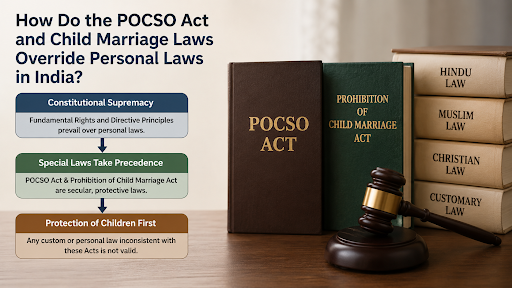
The Allahabad High Court rules that secular child protection statutes, specifically the Prohibition of Child Marriage Act, 2006 (PCMA) and the Protection of Children from Sexual Offences (POCSO) Act, 2012, override all personal laws.
Legal Conflict: Personal Laws vs Child Protection Statutes
Shariat Law Provisions: The Muslim Personal Law (Shariat) Application Act, 1937 governs marriage matters for Muslims, recognizing puberty (presumed at 15 years) as the legal age for marriage.
Statutory Prohibitions: The PCMA, 2006 mandates the legal marriage age as 18 years for females and 21 years for males, while the POCSO Act, 2012 defines a child as anyone under 18 years and criminalizes sexual relations with minors.
Core Friction: A direct clash arises between religious freedom under Article 25 and child protection statutes when parties solemnize the marriage of a minor above 15 years but below 18 years.
Judicial Position on Personal Laws and Child Protection
Overriding Authority of Statutes: The Allahabad High Court aligns with the Kerala High Court ruling in Moidutty Musliyar vs Sub Inspector, reinforcing that personal laws cannot dilute the strict operation of the POCSO Act.
Rejection of Puberty Defense: Courts establish that biological maturity does not grant legal capacity to consent under criminal law, while the Supreme Court consistently questions personal laws prevailing over the PCMA.
|
Constitutional Provisions Supporting Child Protection Article 14 (Equality Before Law): Mandates the State to ensure equal protection of laws across India, rejecting different marriage ages based on religion. Article 15(3) (Special Provisions): Empowers the State to enact affirmative, special legislations like the PCMA and POCSO Act explicitly for the welfare of women and children. Article 21 (Right to Life and Dignity): Protects minors from child marriage, which directly deprives them of personal liberty, health, and a dignified life. Article 39(f) (Protection of Childhood): Directs the State to secure opportunities for children to develop in a healthy manner and protect them against exploitation and moral/material abandonment. Article 45 (Early Childhood Care): Mandates the State to prioritize education and childhood care, which child marriage systematically interrupts. |
Key Features of PCMA, 2006 and POCSO Act, 2012
PCMA Uniform Application: The PCMA applies universally to every Indian citizen, completely disregarding religious affiliations.
PCMA Objective: The Act strictly prohibits child marriages and classifies them as voidable at the option of the minor.
PCMA Penalties: The statute imposes rigorous imprisonment and heavy fines on adults contracting child marriages and officials or parents facilitating them.
POCSO Age Threshold: The POCSO Act universally defines a child as any individual below 18 years of age.
Irrelevance of Consent: Under Sections 3 and 4 of the POCSO Act, penetrative sexual assault against minors constitutes a strict criminal offense, rendering the minor's consent completely immaterial.
Why Did the Court Hold that Personal Laws Cannot Override These Acts?
Constitutional Imperative: The PCMA and POCSO Act implement public health and national policies, translating scientific understanding into prohibitory statutes that permit no exceptions.
Overriding Statutory Effect: Parliament-enacted modern social safety legislations encompass the entire citizenry, naturally prevailing over outdated personal customs.
Welfare of the Child: Permitting underage marriage implicitly sanctions carnal relations, which directly violates the POCSO Act as sexual intercourse with a minor constitutes statutory rape.
Public Policy Protection: Customary laws cannot defeat public policy, as allowing them to dictate marriage age directly undermines the state's capacity to protect vulnerable minors.
Equality Before Law: Uniform protection requires a single legal age of marriage for every citizen, aligning with Article 14 of the Constitution.
Significance of the Judgment
Strengthening Child Rights: The ruling eliminates legal loopholes that perpetrators exploit under the guise of religious freedom, ensuring rigorous enforcement of the POCSO Act.
Reinforcing Constitutional Morality: The judgment places fundamental rights above discriminatory customary practices, securing the State's duty to protect children.
Promoting Gender Justice: Preventing child marriages enables young girls to access education, fostering autonomy, dignity, and economic independence.
Addressing Statistics: The National Family Health Survey-5 (2019-21) by the Ministry of Health and Family Welfare reveals that 23.3% of women aged 20-24 in India still marry before 18, highlighting the need for legal rigidity.
Deterring Child Marriage: The ruling deters communities from solemnizing underage marriages by establishing that prosecution (Arrests/FIRs) under POCSO is inevitable and personal law offers zero immunity.
Clarifying Legal Hierarchy: The decision explicitly subordinates religious personal laws to secular, protective parliamentary acts, paving the way for a Uniform Civil Code (Article 44).
Major Challenges in Eliminating Child Marriage
Social and Cultural Practices: Deeply entrenched patriarchal traditions view girls as economic liabilities. A study by Outline India Research reports that 45% of respondents in Rajasthan identify cultural practices as prominent drivers of child marriage.
Poverty and Economic Insecurity: Economic hardship remains the primary driver. The Outline study notes that 91% of surveyed respondents cite poverty or poor financial conditions as the dominant cause for marrying off girls before 18.
Gender Inequality: Communities employ early marriage to control sexual behavior and ensure purity. study notes that 39% of respondents in Bihar view early marriage as a method to secure a girl's purity.
Weak Enforcement in Rural Areas: Fear of social stigma impedes reporting. The study indicates that 83% of respondents consider the fear of social stigma the most significant barrier to reporting child marriages.
Lack of Awareness: Many rural communities remain ignorant of the severe legal consequences under POCSO, with lack of awareness affecting 57% of respondents in surveyed villages.
Measures to Strengthen Child Protection
Effective Enforcement of PCMA and POCSO: The state of Assam witnesses an 81% reduction in child marriages across 20 districts between 2021-22 and 2023-24 due to an aggressive "zero tolerance" approach and mass arrests under POCSO.
Strict Criminalization: Courts recommend the strict criminalization of attempts to marry minors and prosecuting middlemen and priests.
Community Awareness Campaigns: Scaling flagship programs like the Government of India's Bal Vivah Mukt Bharat campaign remains vital. Outline India Research notes that 98% of respondents view awareness campaigns as the most impactful intervention.
Girls' Education and Empowerment: States must implement conditional cash transfers, such as the Nijut Moina 2.0 Scheme in Assam, which provides financial incentives to girls pursuing higher education to actively delay marriage.
Strengthening Child Protection Mechanisms: Authorities must ensure mandatory and systematic training for Child Marriage Prohibition Officers (CMPOs), local police, and Child Welfare Committees.
Improved Reporting and Monitoring Systems: Promoting universal marriage registration at the Panchayat level tracks and intercepts underage unions effectively, while digital tracking via the Bal Vivah Mukt Bharat web portal triggers swift police responses
Conclusion
The judicial assertion that statutory child protection laws strictly override religious personal customs successfully fortifies constitutional morality and secures a uniform, exploitation-free childhood for all citizens.
Source: THEHINDU
|
PRACTICE QUESTION Q. Consider the following statements regarding the legal framework of marriage and child protection in India: 1. The Prohibition of Child Marriage Act, 2006, invalidates underage marriages automatically, rendering them void ab initio in all cases. 2. The Protection of Children from Sexual Offences (POCSO) Act, 2012, criminalizes sexual activity with anyone under the age of 18, irrespective of consent or personal laws. 3. According to the Muslim Personal Law (Shariat) Application Act, 1937, a minor who has attained puberty is legally competent to enter into a marriage contract. Which of the statements given above are correct? A) 1 and 2 only B) 2 and 3 only C) 1 and 3 only D) 1, 2, and 3 Answer: B Explanation: Statement 1 is incorrect: According to The Prohibition of Child Marriage Act (PCMA), 2006, underage marriages are not automatically void ab initio. Instead, they are legally voidable at the option of the contracting party who was a child at the time of the marriage. Statement 2 is correct: The Protection of Children from Sexual Offences (POCSO) Act, 2012, defines a child as anyone under the age of 18. It criminalizes all sexual activity with minors, completely overriding personal and customary laws regarding consent. Statement 3 is correct: Under the traditional Muslim Personal Law (Shariat) Application Act, 1937, a minor who has attained puberty is legally presumed to have attained the age of majority and is competent to enter into a marriage contract. |
The Protection of Children from Sexual Offences (POCSO) Act is a secular, universal statute that applies to every citizen within the territory of India, entirely irrespective of their religion, caste, or personal laws.
High Courts have firmly ruled that personal laws (like Shariat allowing marriage at puberty) cannot wipe out or override statutory bans on child marriage enacted for public health and national policy. Child protection statutes inherently supersede customary laws.
Under the Prohibition of Child Marriage Act (PCMA), 2006, the legal age of marriage in India is universally set at 18 years for females and 21 years for males.
The judgment establishes that biological maturity (puberty) does not equal legal capacity. By prioritizing the POCSO Act, the ruling completely outlaws the "puberty defense" used to justify statutory rape within underage marriages, thereby rigorously safeguarding children's fundamental rights to dignity and protection from sexual exploitation.



© 2026 iasgyan. All right reserved