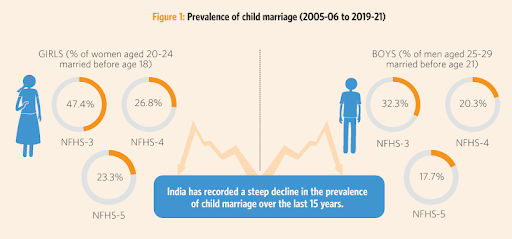
Despite child marriage declining from 47.4% to 23.3% in 15 years, India still risks missing the 2030 elimination target under United Nations SDG 5.3. Poverty, patriarchy, and weak enforcement of the PCMA sustain the gap. Ending it needs strict law enforcement, community mobilisation, and empowering girls through education and livelihoods.
Copyright infringement not intended
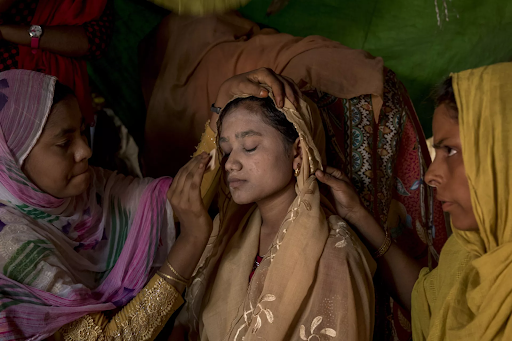
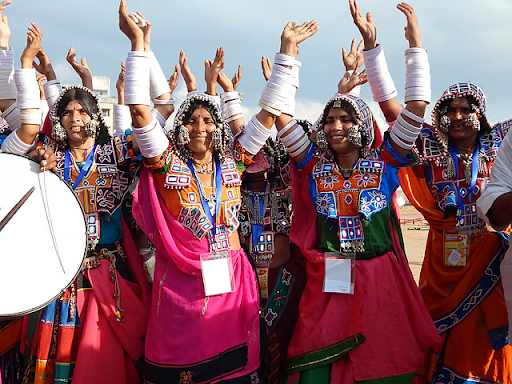
Picture Courtesy: unicef
India has a stated commitment to eliminate child marriage by 2030, aligning with the UN's Sustainable Development Goals (SDG Target 5.3).
|
Read all about: CHHATTISGARH IS ENDING CHILD MARRIAGE l AGE OF CONSENT: MEANING, CHALLENGES, WAY FORWARD l CHILD MARRIAGE l CHILD MARRIAGE IN INDIA l MARRIAGE LAW FOR MINORS |
Child marriage is defined as any formal marriage or informal union between a child under the age of 18 and an adult or another child.
National Prevalence: Percentage of marriage among women aged 20-24 who were married before 18 has decreased from 47.4% in 2005-06 (NFHS-3) to 23.3% in 2019-21 (Source: NFHS-5).
Global Burden: Despite the percentage decline, India is home to the world's largest number of child brides, accounting for approximately one-third of the global total (Source: UNICEF).
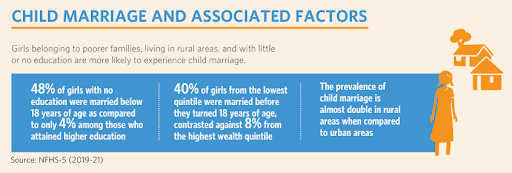
Rural-Urban Divide: The prevalence is higher in rural areas (27%) compared to urban areas (14.7%) (Source: NFHS-5).
State-wise Disparities: Progress is highly uneven across states. Several states have a much higher prevalence than the national average.
|
State |
Prevalence of Child Marriage (Women 20-24 yrs married before 18) |
|
West Bengal |
41.6% |
|
Bihar |
40.8% |
|
Tripura |
40.1% |
|
Jharkhand |
32.2% |
|
Assam |
31.8% |
|
Andhra Pradesh |
29.3% |
|
National Average |
23.3% |
Source: National Family Health Survey (NFHS-5), 2019-21.
Child marriage is a complex issue driven by a combination of socio-cultural norms, economic factors, and legal implementation gaps.
Deep-rooted Patriarchy: Girls are often seen as an economic liability ('paraya dhan'), and their sexuality is controlled through early marriage to protect "family honour".
Social Norms: In many communities, marrying girls early is a long-standing tradition, and deviating from it can lead to social ostracism.
Economic Drivers
Poverty: Poorer families often marry their daughters early to reduce the economic burden. 40% of women from the lowest wealth quintile were married as children, compared to just 8% from the highest (Source: NFHS-5).
Low Education Levels: Education is the single most effective tool against child marriage. 48% of women with no schooling were married before 18, compared to only 4% of women with 12 or more years of schooling (Source: NFHS-5).
Legal & Administrative Gaps
Weak Enforcement of Law: Poor implementation of the Prohibition of Child Marriage Act (PCMA), 2006, leads to low reporting and conviction, weakening its deterrent effect.
Lack of Awareness: Many communities are unaware of the legal age of marriage and the negative consequences of child marriage.
The primary legislation to combat child marriage is the PCMA, 2006. However, its effectiveness is hampered by implementation challenges.
|
Prohibition of Child Marriage Act (PCMA), 2006 - Key Provisions |
|
|
Minimum Age |
18 years for females and 21 years for males. |
|
Nature of Marriage |
A child marriage is voidable at the option of the minor party. They can file a petition to annul the marriage within two years of attaining majority. |
|
Punishment |
Imprisonment up to 2 years and/or a fine for adult males marrying a minor, and anyone who performs, conducts, or abets a child marriage. |
|
Enforcement |
Appointment of Child Marriage Prohibition Officers (CMPOs) to prevent and prosecute cases. |
Health: It leads to early and high-risk pregnancies, increasing maternal and infant mortality rates. Children of adolescent mothers are more likely to be stunted and anaemic.
Education: It abruptly ends a girl's education, trapping her in a cycle of dependency and poverty and limiting her potential.
Economic Impact: It curtails women's participation in the workforce, hindering economic growth and perpetuating household poverty.
Violation of Rights: It is a fundamental violation of human rights, denying a child the right to health, education, protection, and self-determination.
Impact on SDGs: It directly impedes progress on at least nine SDGs, including those related to poverty (SDG 1), health (SDG 3), education (SDG 4), and gender equality (SDG 5).
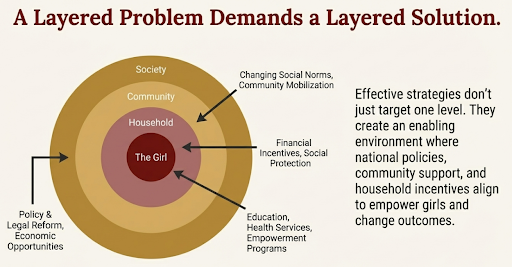
Strengthen Law Enforcement: Ensure mandatory registration of all marriages and improve the capacity of Child Marriage Prohibition Officers (CMPOs). Focus on improving conviction rates to create a strong legal deterrent.
Invest in Girls' Education
Ensure girls complete secondary education by providing safe transport, clean toilets, and introducing financial incentives through schemes like 'Beti Bachao, Beti Padhao'.
Community Mobilization
Engage community leaders, religious figures, and Panchayati Raj Institutions to change deeply entrenched social norms. Models like the Ganjam district in Odisha, which declared itself child-marriage free through community vigilance, should be replicated.
Economic Empowerment
Link education with skill development and employment opportunities for girls. Financial independence gives them greater agency in life decisions.
Promote Behavioural Change
Launch sustained information campaigns to raise awareness about the negative impacts of child marriage and the legal provisions against it.
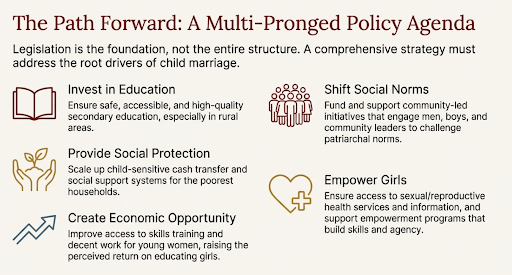
Ending child marriage requires a whole-of-society approach focused on legal frameworks, empowering girls through education, ensuring family economic security, and promoting a societal shift in values.
Source: THEHINDU
|
PRACTICE QUESTION Q. Despite robust legal frameworks like the Prevention of Child Marriage Act (PCMA), 2006, child marriage remains a persistent social evil in India. Critically analyze. 150 words |
According to the National Family Health Survey (NFHS-5), the prevalence of child marriage among women aged 20-24 has declined to 23.3%. However, progress has slowed, and India is still home to the world's largest number of child brides.
As per NFHS-5, states with the highest prevalence are West Bengal (41.6%), Bihar (40.8%), and Tripura (40.1%), all significantly above the national average.
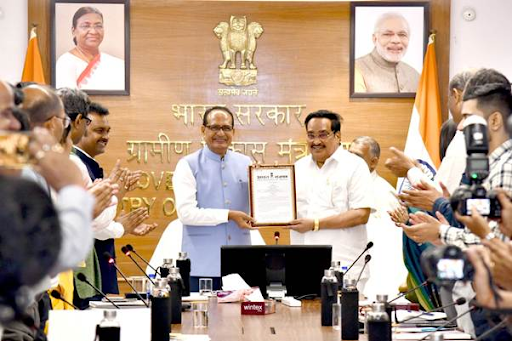
It is a campaign by the Union government aimed at invigorating the mission to eliminate child marriage in India by 2030, in line with Sustainable Development Goal (SDG) Target 5.3.


© 2026 iasgyan. All right reserved