The Sub-Mission on Agricultural Mechanization (SMAM) transforms India's agriculture by providing subsidies and Custom Hiring Centres to smallholders. Expanding Scale-Appropriate Mechanization, integrating AI tools like Bharat VISTAAR, and empowering FPOs can resolve labor shortages, cut costs, and boost sustainable productivity.
Why In News?
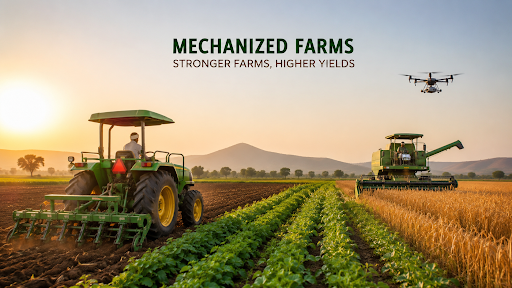
The Government of India accelerates the Sub-Mission on Agricultural Mechanization (SMAM) coverage to combat rural labor shortages and boost overall agricultural yield.
What is the Sub-Mission on Agricultural Mechanization (SMAM)?
The Ministry of Agriculture and Farmers Welfare launched SMAM in 2014-15 as a Centrally Sponsored Scheme under the Rashtriya Krishi Vikas Yojana (RKVY).
The mission shift India towards a service-based mechanization economy, helping smallholders access expensive machinery without the prohibitive burden of full capital ownership
Major Objectives
Reach the Unreached: Expand farm mechanization to small and marginal farmers and geographical regions suffering from low farm power availability.
Offset Economies of Scale: Establish Custom Hiring Centres (CHCs) to mitigate the high capital costs associated with individual machinery ownership.
Create Hi-Tech Hubs: Deploy high-value, high-productivity agricultural equipment specialized for cash crops.
Ensure Quality: Conduct strict performance testing and certification of machinery at designated national testing institutes.
Key Features of SMAM
Financial Assistance: The scheme provides a 40% subsidy on machinery costs for general category progressive farmers and a 50% subsidy for SC/ST farmers, women, and small/marginal farmers.
Direct Benefit Transfer (DBT): The system transfers subsidy funds directly to Aadhaar-linked bank accounts to ensure zero leakage.
Custom Hiring Centres (CHCs): Community rental hubs cover 4-5 surrounding villages, allowing farmers to hire specialized equipment on an hourly or per-acre basis.
FPO and SHG Support: The government offers 40% to 80% financial assistance to Farmer Producer Organizations (FPOs), Self-Help Groups (SHGs), and rural entrepreneurs to set up CHCs and Farm Machinery Banks (FMBs).
Support for Vulnerable Groups: The mission earmarks 30% of total funds specifically for women farmers to enhance gender inclusion and prioritizes rural youth and agriculture graduates for lucrative self-employment opportunities.
Focus on Underserved Regions: A highly favorable 90:10 funding pattern (Centre:State) supports North-Eastern and Himalayan states, granting up to 100% subsidy for small machinery procurement in North-Eastern Region (NER) states.
Why is Agricultural Mechanization Important for India?
Addresses Farm Labour Shortages: Machine power directly substitutes manual labor, mitigating the impact of rural-to-urban migration and reducing labor hours per hectare by 25%.
Enhances Productivity: Mechanization increases overall agricultural productivity by 12% to 34%, boosts cropping intensity by 5% to 22%, and ensures timely farm operations in vulnerable rainfed systems. (Source: India Agristat)
Reduces Cost of Cultivation: Modern tools lower per-hectare cultivation costs by 15% to 30% in highly mechanized agro-zones, while precision tools like the seed-cum-fertilizer drill save 20% on seeds and 15-20% on fertilizers. (Source: India Agristat)
Supports Climate-Smart Agriculture: Laser Land Levellers improve critical water use efficiency by 25% to 30% in water-intensive paddy and wheat cultivation, while Happy Seeders and Super Straw. Management Systems process crop residue to sharply reduce stubble burning and greenhouse gas emissions.
Improves Post-Harvest Management: Grassroots deployment of shellers, graders, and dryers improves the market quality and shelf-life of perishable farm produce.
Challenges Affecting Farm Mechanization
Small and Fragmented Landholdings: Over 86% of operational landholdings in India span less than 2 hectares, making individual ownership of heavy machinery completely uneconomical.
High Cost of Advanced Machinery: Prohibitive capital costs deter smallholder farmers from adopting modern technologies like drip irrigation systems and multi-crop planters.
Limited Awareness: Severe information asymmetry restricts the widespread use of subsidized resources like solar-powered pumps and government rental networks.
Inadequate Rural Repair Infrastructure: A 35% to 50% shortfall in technical manpower for machinery repair increases equipment downtime and maintenance burdens.
Regional Disparities: Farm power availability remains intensely skewed, with states like Punjab and Haryana boasting 80-85% mechanization, while Eastern and NE states languish at 30-40%.
Measures to Strengthen Agricultural Mechanization
Expand Custom Hiring Centres: Scales up Scale-Appropriate Mechanization (SAM) rapidly by deploying small, modular, and crop-specific machinery exclusively through rural CHCs.
Promote AI-Enabled Precision Farming: Digital platforms like the FARMS (Farm Machinery Solutions) App and Bharat VISTAAR connect machinery demand with supply using GPS tagging and real-time tracking algorithms.
Increase Access via FPOs: Empowering Farmer Producer Organizations (FPOs) to collectively secure machinery with 80% subsidies converts them into trusted local mechanization service hubs.
Strengthen Rural Skill Development: A dedicated National Mechanization Skill Mission certifies local youth as operators and technicians via Krishi Vigyan Kendras (KVKs) and Industrial Training Institutes (ITIs).
Encourage Indigenous Agri-Tech Manufacturing: Collaborations between ICAR, local manufacturers, and FPOs reverse-engineer and produce affordable, region-specific tools like wetland rice transplanters.
Conclusion
By strategically shifting towards Scale-Appropriate Mechanization (SAM) and scaling digital-first service models like Custom Hiring Centres (CHCs) and AI platforms, SMAM bridges farm power deficit, making agriculture both climate-resilient and economically viable for millions of smallholders.
Source: BUSINESS-STANDARD
|
PRACTICE QUESTION Q. "Agricultural mechanization is critical for enhancing productivity, reducing cultivation costs and ensuring sustainable agricultural growth in India." Examine. (250 Words, 15 Marks) |
SMAM is a Centrally Sponsored Scheme launched by the Ministry of Agriculture in 2014-15. It aims to promote farm mechanization among small and marginal farmers by providing machinery subsidies and establishing Custom Hiring Centres (CHCs) to offset the high costs of individual ownership.
A Custom Hiring Centre is a community rental hub equipped with various agricultural machinery and implements. It allows smallholder farmers to hire modern equipment on an hourly or per-acre basis, eliminating the need to purchase expensive machinery outright.
A: SMAM earmarks 30% of its total funds specifically for women farmers. Furthermore, SC/ST, women, and small/marginal farmers are eligible for a higher individual machinery subsidy of 50%, compared to 40% for general category farmers.
SAM involves the strategic deployment of small, modular, and crop-specific machinery that aligns with India's heavily fragmented landholdings (where 86% of farms are under 2 hectares). It focuses on affordable, low-HP tools that fit local agro-ecological constraints rather than large, generic tractors.




© 2026 iasgyan. All right reserved