India's voting right remains purely statutory, not fundamental. However, recent Supreme Court rulings protect electoral facets like informed choice. Elevating the ballot to a fundamental right is crucial to prevent arbitrary disenfranchisement and protect vulnerable undertrial prisoners from unjust exclusion.
Why In News?
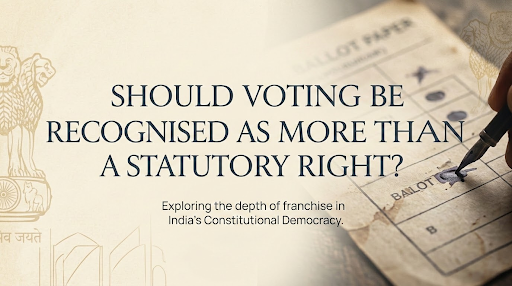
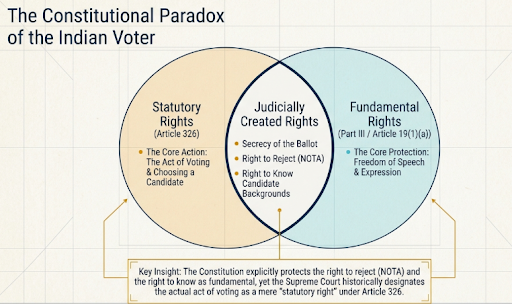
Experts highlighted a constitutional paradox: while essential parts of voting—like the right to an informed choice and NOTA—are protected under fundamental freedoms, the core act of voting itself is still a statutory right.
What is the Right to Vote in India?
The right to vote is a citizen's legal entitlement and formal expression of preference to elect representatives, acting as the primary instrument of popular sovereignty.
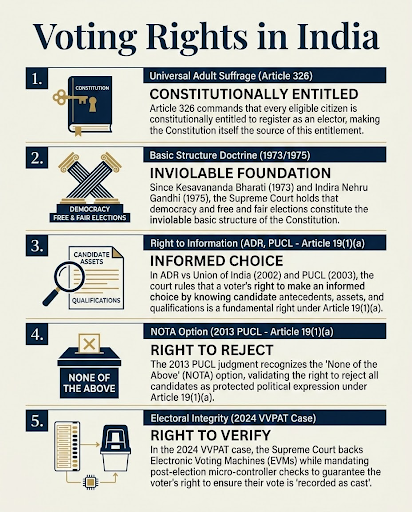
Article 326: The Constitution mandates that elections to the Lok Sabha and State Legislative Assemblies occur based on universal adult suffrage for citizens aged 18 years and above.
Article 325: This article strictly prohibits the exclusion of any citizen from the electoral roll on grounds of religion, race, caste, or sex.
Statutory Classification: Historically, the Supreme Court classifies voting as a purely statutory right governed by the Representation of the People Acts (RPA), as established in N.P. Ponnuswami (1952) and Kuldip Nayar (2006).
Evolving Jurisprudence: The Supreme Court in PUCL vs Union of India (2003) elevates this stance, ruling that if voting is not a fundamental right, it is "certainly a constitutional right".
Significance of Voting in Democratic Framework
Popular Sovereignty: Voting acts as the supreme tool through which "We, the People" renew the legitimacy of the state and transfer power from citizens to the government.
Representative Democracy: Broad electoral participation prevents the monopolization of power, historically integrating 552 princely states and forging a unified national identity post-partition.
Government Accountability: The ballot holds ruling governments accountable for their actions. Sustained political enfranchisement leads to tangible policy changes.
Political Participation: Voting translates marginal voices into electoral power, preventing the political erasure of marginalized groups.
Democratic Legitimacy: Free and fair elections form part of the Basic Structure of the Constitution, ensuring the state operates with absolute constitutional legitimacy.
The Debate: Elevating Voting to a Fundamental Right
Democratic Paradox: A paradox exists where the right to reject (NOTA) and the right to know candidate details are fundamental rights, yet the actual act of voting remains a mere statutory right.
Electoral Inclusion: A statutory right allows easy legislative exclusion, such as Section 62(5) of the RPA which strips prisoners of political agency based solely on physical confinement, bypassing the presumption of innocence.
Arbitrary Disenfranchisement: Nearly 70% of prisoners in India are undertrials who cannot afford bail . Disenfranchisement disproportionately targets marginalized groups, stripping them of their political voice.
Deepening Democracy: Treating the ballot as a fundamental right prevents ruling governments from using voting laws to politically erase vulnerable populations.
State Accountability: Constitutionalizing the ballot forces the state to prove proportionality and necessity before denying any citizen the right to vote.
Challenges Affecting Voting Rights
Voter Apathy: Despite a historic 66.95% turnout in the 2024 Lok Sabha polls, a significant portion of urban and youth demographics remains unengaged.
Electoral Disinformation: The proliferation of fake news compromises the fundamental "right to make an informed choice" and threatens electoral purity.
Migration Barriers: Millions of domestic migrants face disenfranchisement due to non-portable voter IDs, while Non-Resident Indians (NRIs) face logistical hurdles due to unimplemented absentee/e-postal voting.
Money and Muscle Power: The criminalization of politics and lack of expenditure caps on political parties dilute financial transparency, prompting the Supreme Court to strike down Electoral Bonds to protect the voter's right to information.
Structural Exclusion: Physical accessibility barriers affect Persons with Disabilities (PwDs), while Dalit, Adivasi, and minority undertrials face systemic democratic exclusion.
Way Forward
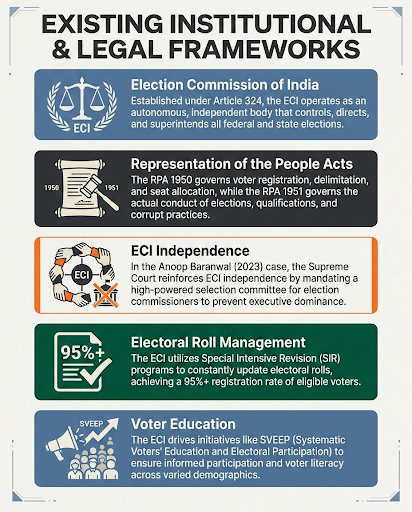
Improving Accessibility: The ECI rolls out home voting for citizens aged 85+ and Persons with Disabilities (PwDs) via postal ballots, alongside ramps and braille-enabled voting machines.
Digital Voter Services: Leveraging digital platforms like the National Voter Service Portal ensures seamless voter registration for mobile populations.
Migrant Voting Solutions: The ECI must expedite the implementation of the Electronically Transmitted Postal Ballot System (ETPBS) and proxy voting for domestic migrants and NRIs, similar to the framework used by service voters.
Electoral Literacy: Grassroots awareness campaigns combat vote-buying and disinformation, ensuring voters exercise their Article 19(1)(a) freedom to make independent choices.
Electoral Reforms: Implementing graded disenfranchisement for prisoners (instead of absolute bans), removing financial cap loopholes for political parties, and adhering to strict post-election VVPAT checks restore institutional trust.
Conclusion
Elevating the right to vote from a statutory provision to a fundamental right is a vital evolutionary step for Indian democracy. This constitutional upgrade protects the electoral process from arbitrary disenfranchisement while ensuring total political equality for every citizen.
Source: THEHINDU
|
PRACTICE QUESTION Q. With reference to the electoral system in India, consider the following statements: 1. The right to vote is explicitly enshrined as a Fundamental Right under Part III of the Indian Constitution. 2. The Supreme Court of India has recognized the voter's right to know candidate antecedents as a fundamental right. 3. The Representation of the People Act, 1951 disenfranchises all undertrial prisoners in India. Which of the statements given above is/are correct? (a) 1 and 2 only (b) 2 and 3 only (c) 3 only (d) 1, 2, and 3 Answer: (b) Explanation: Statement 1 is incorrect: The right to vote is not a Fundamental Right under Part III of the Constitution. Instead, it is a constitutional right (or legal right) granted under Article 326 of Part XV of the Constitution, which establishes adult suffrage. The Supreme Court of India has reiterated in multiple judgments that the right to vote is a statutory or constitutional right, not a fundamental one. Statement 2 is correct: In the case Union of India vs Association for Democratic Reforms (2002), the Supreme Court ruled that a voter's right to know about a candidate’s criminal, financial, and educational background is a part of the fundamental right to freedom of speech and expression under Article 19(1)(a). The court noted that a well-informed voter is essential for a vibrant democracy. Statement 3 is correct: Under Section 62(5) of the Representation of the People Act, 1951, no person can vote if they are confined in a prison, whether under a sentence of imprisonment or transportation or otherwise, or if they are in the lawful custody of the police. This explicitly means that both convicted prisoners and undertrial prisoners are disenfranchised (cannot vote). |
Supreme Court classifies the right to vote as a statutory right (derived from the Representation of the People Act, 1951) and a constitutional right (under Article 326), but it is not explicitly listed as a Fundamental Right under Part III of the Constitution. However, facets like the right to make an informed choice and the right to reject (NOTA) are protected as fundamental rights under Article 19(1)(a).
Voting rights in India are primarily governed by Article 326 of the Constitution, which guarantees that elections to the House of the People (Lok Sabha) and State Legislative Assemblies shall be based on universal adult suffrage.
Universal adult suffrage refers to the right of all adult citizens (in India, aged 18 and above) to vote in elections, regardless of their wealth, income, gender, social status, race, or ethnicity. It forms the foundational basis of India's representative democracy.
Voting is the primary instrument through which popular sovereignty is exercised. It allows citizens to participate in government decision-making, holds elected representatives accountable, prevents the monopolization of power, and renews the political legitimacy of the democratic state.





© 2026 iasgyan. All right reserved