The Right to be Forgotten (RTBF) allows individuals to de-index outdated personal data from digital platforms. Emerging from Article 21 and the Puttaswamy judgment, it balances informational privacy against the public’s right to know, demanding careful judicial and legislative oversight.

Why In News?
The Delhi High Court has affirmed the right to be forgotten as part of the fundamental right to privacy under Article 21 of the Indian Constitution.
What is the Right to be Forgotten (RTBF)?
RTBF empowers an individual to request the removal, masking, or de-indexing of personal information from the public digital domain when the data causes disproportionate harm and becomes outdated or irrelevant.
Origin: The concept gained global prominence following the 2014 Google Spain vs AEPD case before the Court of Justice of the European Union (CJEU).
Core Principle: RTBF operates on the principle of informational self-determination, allowing individuals to reclaim control over their digital narrative rather than remaining permanently bound to their past.
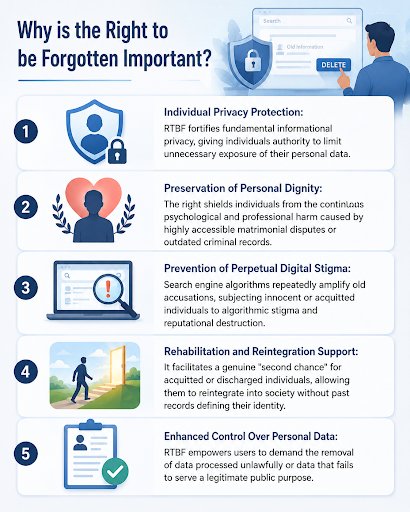
What is the Constitutional Basis of RTBF in India?
Article 21: The Constitution of India guarantees the right to life and personal liberty under Article 21, establishing the foundational bedrock for claiming RTBF.
Puttaswamy Judgment: The 2017 K.S. Puttaswamy v. Union of India judgment unanimously declares the Right to Privacy a fundamental right under Article 21.
Informational Privacy: Courts recognize RTBF as an essential facet of informational privacy, enabling individuals to erase data that no longer serves a legitimate purpose.
Protection of Human Dignity: Article 21 inherently protects the right to live with dignity and reputation, shielding individuals from extra-judicial punishment caused by continuous online exposure of resolved criminal records.
Informational Self-Determination: Individuals possess the autonomy to control how their personal data appears online, forming a core component of modern privacy jurisprudence.
What is the Current Legal Position in India?
Lack of Dedicated Statute: India currently lacks a comprehensive, dedicated law that explicitly governs RTBF and the complete erasure of judicial records.
Fragmented Judicial Recognition: Courts apply the concept inconsistently; the Delhi High Court in Jorawar Singh Mundy vs Union of India (2021) grants interim relief to de-index an acquitted person's judgment, whereas the Gujarat High Court in Dharamraj Bhanushankar Dave (2017) refuses to remove a judgment to uphold the open justice principle.
Data Protection Framework: The Digital Personal Data Protection (DPDP) Act, 2023 provides a limited statutory framework through Section 12(3), which grants Data Principals the right to erase if the data is no longer necessary or consent is withdrawn.
What are the Major Challenges Associated with RTBF?
Conflict with Freedom of Expression: RTBF directly collides with Article 19(1)(a), which guarantees the freedom of speech and expression, including the public's fundamental right to know.
Public Interest and Accountability: Removing records involving public servants, elected officials, or severe corruption drastically limits democratic accountability and transparency.
Transparency of Judicial Records: The principle of open justice mandates that court records remain public to guarantee fairness and maintain public trust in the legal administration.
Media Freedom Concerns: Aggressive de-indexing orders act as prior restraint on the media, risking the sanitization of historical records and weakening investigative journalism.
Technical Erasure Challenges: Artificial Intelligence (AI) and large machine learning models internalize data patterns, making absolute data extraction and exact machine unlearning technically unviable.
Persistent Digital Footprints: Information permanently exists via archives, mirrors, screenshots, and decentralized blockchain networks, complicating complete erasure.
|
What is the Central Debate Surrounding RTBF? Privacy vs Right to Know: The core constitutional tension pits the individual's right to dignity (Article 21) against the public's right to information (Article 19). Algorithmic Stigma vs Historical Interest: Courts must evaluate whether preserving an outdated news report serves a legitimate historical interest or merely perpetuates unwarranted algorithmic stigma. |
What Measures Can Create a Balanced RTBF Framework in India?
Clear Legislative Guidelines: Parliament must enact a detailed statutory framework defining the exact scope, boundaries, and exceptions for RTBF regarding judicial and media records.
Case-by-Case Judicial Assessment: Courts must implement a structured proportionality test to weigh the harm to privacy against the necessity of preserving public records.
Protection of Public Interest Records: Legislation must explicitly exempt cases involving serious crimes, economic offenses, and matters of public trust from RTBF applicability.
Strong Data Governance Mechanisms: Authorities must adopt de-indexing (restricting name-based searchability) and masking instead of complete deletion, strictly preserving the judgment's facts and legal reasoning.
Independent Oversight and Review: The government must empower the Data Protection Board of India (DPBI) to handle non-judicial RTBF requests through a tiered system to avoid overburdening the courts.
Conclusion
A balanced RTBF framework must legally protect individual dignity from perpetual digital stigma while safeguarding the constitutional imperatives of open justice and media freedom.
Source: THEHINDU
|
PRACTICE QUESTION Q. Evaluate the technical and legal challenges in enforcing the Right to be Forgotten in an era dominated by Artificial Intelligence, decentralized networks, and global search engines. Suggest a balanced policy framework for India. (250 words) |
The Right to be Forgotten is the legal right of an individual to request the removal, masking, or de-indexing of personal information from the public digital environment (like search engines) when the data is no longer relevant, causes disproportionate harm, or serves no legitimate public interest.
Though not explicitly written in the Constitution, the Supreme Court in the K.S. Puttaswamy (2017) judgment recognized the right to privacy as a fundamental right under Article 21. RTBF is interpreted by courts as an essential facet of this informational privacy and human dignity.
India does not have a dedicated, standalone RTBF law. However, Section 12(3) of the Digital Personal Data Protection (DPDP) Act, 2023, provides a limited statutory "right to erasure" allowing Data Principals to request the deletion of their personal data when it is no longer necessary or when consent is withdrawn.
RTBF often results in "de-indexing" or "masking" rather than absolute deletion. For instance, in court records, the judgment's legal reasoning and facts remain publicly accessible to uphold the principle of open justice, but the individual's name is removed from search engine indexing so a simple name search does not bring up the case.



© 2026 iasgyan. All right reserved