India's National One Health Mission integrates human, animal, and environmental health to combat emerging zoonotic threats like Nipah virus. Supported by a new multi-tiered State/UT governance framework, it prioritizes integrated surveillance, decentralized outbreak response, and robust pandemic preparedness.
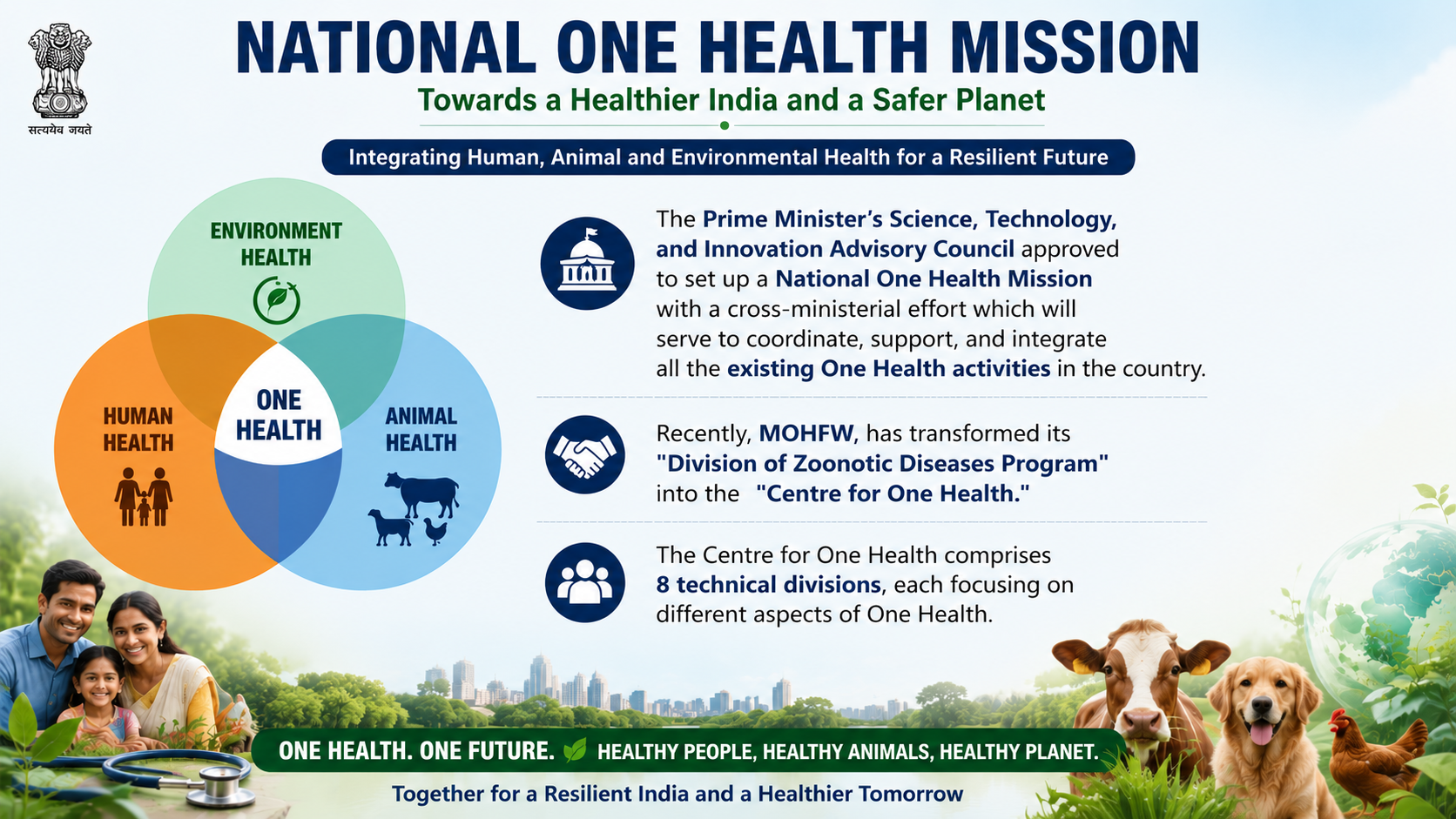
The Fifth Meeting of the Scientific Steering Committee on One Health released the Model Governance Framework to strengthen decentralized One Health governance.
What is One Health Approach?
The One Health approach represents a multisectoral, collaborative, and multidisciplinary strategy that integrates human, animal, and environmental health to optimize overall health outcomes.
It recognizes the interconnectedness and interdependence of the Human-Animal-Environment to prevent and control emerging infectious threats, particularly zoonotic diseases (diseases transmitted between animals and humans).
Global organizations like the World Health Organization (WHO), Food and Agriculture Organization (FAO), World Organisation for Animal Health (WOAH), and UNEP form the Quadripartite Alliance to advocate this approach and align health policies with Sustainable Development Goals (SDGs).
The strategy addresses major global threats such as Antimicrobial Resistance (AMR), climate change impacts, and biodiversity loss by breaking down institutional silos.
It operates as a cross-ministerial initiative involving over 13 government departments to coordinate, integrate, and support all One Health activities across India.
The Office of the Principal Scientific Adviser (PSA) conceptualizes the mission, while the Indian Council of Medical Research (ICMR) and the Department of Health Research (DHR) implement and coordinate the core activities.
The government established the National Institute for One Health (NIOH) in Nagpur to act as the central anchor and research hub for the mission.
The mission establishes a two-tiered governance framework:
The mission aims to achieve pandemic preparedness, build integrated disease surveillance systems, and develop medical countermeasures like vaccines, diagnostics, and therapeutics.
Weak intersectoral collaboration and strict institutional silos hinder unified action among human, animal, and environmental health sectors.
Governance fragmentation and disjointed governance frameworks complicate timely decision-making and cross-departmental responses.
Financial constraints, high execution costs, and inadequate regulatory enforcement restrict the scalability of integrated health responses in low- and middle-income settings.
Limited data infrastructure, rigid data sharing constraints, and irregular reporting systems prevent real-time disease tracking and analysis.
Surveillance gaps, fragmented genomic surveillance, and delayed sample transport from remote areas reduce early detection capabilities for emerging pathogens.
A deficit in local expertise and a lack of operational Bio-Safety Level (BSL)-3 facilities in outbreak hotspots limit effective diagnostic capabilities during emergencies.
Low public awareness regarding zoonotic risks and cultural practices (e.g. animal sacrifice) increases the likelihood of human-animal spillover events.
Executes nationwide One Health awareness campaigns to educate vulnerable populations, promote safe practices, and fosters long-term community engagement.
Institutionalizes climate-informed surveillance, bat ecology monitoring, and strict land-use governance to address ecological spillover drivers like deforestation and urban expansion.
Develops indigenous vaccines and therapeutics by utilizing local manufacturing partnerships, collecting survivor convalescent sera, and utilizing adaptive trial designs.
Enhances laboratory capacity by constructing additional BSL-3/4 facilities and decentralizes rapid diagnostic tools (such as Truenat micro-PCR) in under-resourced and remote regions.
Deploys advanced digital health tools, including cloud-based surveillance, AI-enabled pathogen detection, and mobile reporting applications, to bridge resource gaps.
Establishes regular communication platforms and interdisciplinary training programs to align methodologies among ecologists, veterinarians, and medical professionals.
Translates governance frameworks into measurable action by conducting regular mock drills (like the Vishanu Yuddh Abhyas) to test, evaluate, and refine real-world outbreak responses.
Conclusion
India secures long-term global health and pandemic resilience by shifting from reactive disease containment to proactive, climate-integrated, and multisectoral One Health strategies backed by sustained investments and robust grassroots coordination.
Source: NEWSONAIR
|
PRACTICE QUESTION Q. "Effective management of emerging public health threats requires a shift from reactive outbreak control to a proactive, integrated framework." Discuss. 150 words |
One Health is a collaborative, multidisciplinary approach that unites human, animal, and environmental health sectors. It recognizes the interconnectedness of these domains to optimize health outcomes and address challenges like zoonotic diseases.
The National Institute for One Health (NIOH) is established in Nagpur. It serves as the anchor institution for coordinating the mission's activities in the country.
Climate change alters bat migration and fruiting phenology, while habitat fragmentation forces bats into human-dominated habitats, thereby increasing human-bat interactions and elevating the risk of Nipah virus spillover.




© 2026 iasgyan. All right reserved