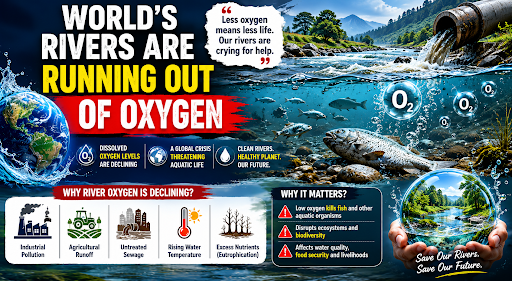
Climate warming and anthropogenic pressures drive rapid, sustained dissolved oxygen loss across global rivers, severely threatening aquatic biodiversity. Implementing process-based restoration and strict nutrient regulations remains critical to mitigating this escalating ecological crisis.
Why In News?
A study published in Science Advances, reveals that globally river ecosystems face severe threats as climate change drives rapid water warming and sustained oxygen depletion.
Why is Dissolved Oxygen Important for River Ecosystems?
Dissolved oxygen acts as the lifeline that sustains the survival, growth, and reproduction of all aquatic organisms.
Healthy fish populations require oxygen levels between 7 and 9 milligrams per liter, and levels dropping below 3 milligrams per liter induce acute death.
Adequate oxygen levels prevent the formation of dead zones where aquatic life struggles to breathe and eventually dies.
Oxygen regulates biogeochemical cycles and maintains overall water quality in freshwater ecosystems.
High oxygen levels suppress the emission of potent greenhouse gases, such as nitrous oxide, and prevent the dangerous mobilization of toxic metals.
Why Are Rivers Losing Oxygen?
Climate warming reduces oxygen solubility, as warmer water physically holds less dissolved oxygen than colder water.
Rising water temperatures currently account for 62.7% of the observed decline in river oxygen globally.
Nutrient pollution from agricultural and urban runoff results in algal blooms, and bacteria rapidly consume vital oxygen when they decompose this dead plant matter.
Heatwave events accelerate oxygen depletion and drive 22.7% of global river deoxygenation.
Human land-use expansion, including cropland and urban development, increases inputs of labile carbon and nitrogen that raise the biochemical oxygen demand.
Shallow dam impoundments and low-gradient river flows limit water turbulence, which reduces reaeration rates and accelerates the loss of oxygen.
Tropical rivers located between 20°S and 20°N, including those in India, experience the most severe oxygen losses.
How Does Deoxygenation Affect Ecosystems?
Destroys Aquatic Biodiversity: Severe oxygen loss directly kills sensitive fish species, damages early developmental stages like larvae and eggs, and reduces macroinvertebrate richness.
Creates Dead Zones: Hypoxia forms uninhabitable dead zones where marine and freshwater organisms suffocate, completely disrupting local food webs and driving mass extirpations.
Drives Greenhouse Gas Emissions: Anoxic environments force bacteria to switch their metabolisms, which stimulates the continuous emission of potent greenhouse gases like methane and nitrous oxide into the atmosphere.
Mobilizes Toxic Metals: Extreme anoxia alters water chemistry and triggers the dangerous release of toxic heavy metals, such as arsenic, into the flowing water.
Favors Invasive Species: Depleted oxygen environments preferentially support highly tolerant invasive species (such as common carp), which displace native species and further degrade water quality through bottom-foraging bioturbation.
Accelerates Eutrophication: Oxygen-deprived conditions reduce the sediment's ability to retain nutrients, releasing stored phosphate back into the water column to fuel continuous, harmful algal blooms .
Way Forward to Reverse River Deoxygenation?
Establish Strict Nutrient Limits
Enforce strict Total Maximum Daily Loads (TMDLs) to restrict nitrogen and phosphorus pollution from agricultural runoff and urban wastewater.
Implement Process-Based Restoration
Target the root causes of habitat degradation by reconnecting rivers to natural floodplains and replanting riparian forests to provide cooling shade.
Deploy Physical Aeration
Install mechanical aerators, paddle wheels, and pumps to inject oxygen into rivers and create temporary, life-saving refuge zones for fish.
Execute Flow Augmentation
Release well-oxygenated water from upstream regulatory structures to dilute and flush out localized hypoxic river channels.
Integrate Advanced Forecasting
Deploy machine learning and artificial intelligence models fed by real-time sensor data to proactively forecast dissolved oxygen drops and initiate early mitigation actions.
Conclusion
To protect global aquatic biodiversity, all stakeholders must implement climate-resilient water management that eliminates nutrient pollution and restores natural riverine processes.
Source: SCIENCEDAILY
|
PRACTICE QUESTION Q. Which of the following best describes the primary objective of "Process-Based Restoration" in aquatic ecosystems? (a) Creating artificial, static habitat structures to ensure the immediate survival of specific commercial fish species. (b) Targeting the root causes of habitat degradation by reestablishing normative physical, chemical, and biological processes. (c) Constructing continuous levees and continually removing beaver dams to facilitate unobstructed river navigation. (d) Relying entirely on mechanical aeration pumps to maintain baseline oxygen levels in urban rivers. Answer: (b) Explanation: Process-based restoration focuses on repairing the ecological processes (such as sediment transport, hydrological cycles, and floodplain connectivity) that sustain river ecosystems over time. Instead of just fixing a local symptom, it allows the ecosystem to dynamically self-heal and adapt. |
River deoxygenation is the rapid and sustained depletion of dissolved oxygen in flowing waters, primarily driven by climate warming that reduces oxygen solubility, causing global rivers to lose oxygen at an average rate of 0.045 mg/L per decade.
Tropical rivers (between 20°S and 20°N) naturally possess lower baseline oxygen levels, which makes them highly vulnerable to rapid deoxygenation and extreme hypoxia events that suffocate fish.
Warmer water physically holds less dissolved oxygen than colder water; this direct temperature-driven decline in oxygen solubility accounts for exactly 62.7% of the observed river deoxygenation worldwide.



© 2026 iasgyan. All right reserved