Why In News?
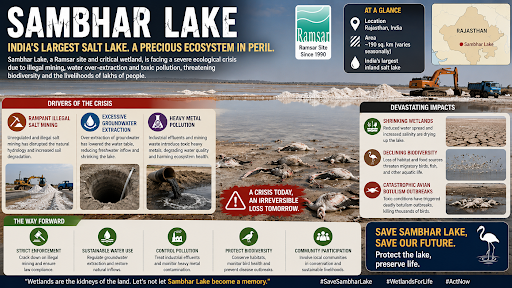
Research indicates that rapid growth in industrial and illegal salt pans is damaging Sambhar Lake's hydrology and biodiversity, threatening the survival of this globally important wetland.
About Sambhar Lake
Sambhar Lake is India's largest inland salt lake, it is located 80 km southwest of Jaipur, Rajasthan.
The wetland spreads across Jaipur, Nagaur, and Ajmer districts, located within the Aravalli Range.
Fed by six monsoon-dependent rivers (Mentha, Rupangarh, Khari, Khandela, Medtha, Samod), its area fluctuates between 190–230 sq km.
The lake drives a massive local economy, producing roughly 196,000 tonnes of clean salt annually, which constitutes about 9% of India's total salt production.
Designated as a Ramsar Site of International Importance in 1990 and recognized as a Key Biodiversity Area in 2004.
Avian Habitat: A vital wintering area for Northern Asian migratory birds and India's second-largest flamingo breeding ground.
Saline Ecosystem: Its hypersaline niche supports halophilic microbes and spirulina, while surrounding vegetation shelters fauna like desert foxes and saw-scaled vipers.
What are Industrial Salt Pans?
Industrial salt pans consist of artificially constructed, shallow depressions designed to extract, evaporate, and harvest salt from sub-soil brine (saline groundwater) on a massive commercial scale.
Traditional vs Industrial Salt Production
How are Salt Pans Threatening Sambhar Lake?
Hydrological Alteration
Encroachment of Wetland Area
Habitat Degradation
Environmental Consequences
Decline in Biodiversity
Increased Bird Mortality
Shrinking Wetland Area
Loss of Ecosystem Services
Source: THEHINDU
|
PRACTICE QUESTION Q. Consider the following statements regarding Sambhar Lake:
Which of the statements given above is/are correct? A) 1 and 2 only B) 2 and 3 only C) 1 and 3 only D) 1, 2, and 3 Answer: A Explanation: Statement 1 is correct: Sambhar Lake is indeed India's largest inland saline water body and was designated as a Wetland of International Importance (Ramsar Site) in 1990. Statement 2 is correct: The lake receives its water primarily from six seasonal/ephemeral rivers: Samaod, Khari, Mantha, Khandela, Medtha, and Roopangarh. Statement 3 is incorrect: The catastrophic mortality of thousands of migratory birds in 2019 was caused by Avian Botulism (a neuro-muscular illness produced by the bacteria Clostridium botulinum), not heavy metal poisoning from Lead (Pb). |
Sambhar Lake is critical because it is India’s largest inland saline wetland, a designated Ramsar site, and a globally recognized wintering sanctuary for migratory waterfowl.
Encroaching industrial salt pans devastate wetlands by fragmenting natural water flow channels, destroying native bird feeding grounds, and radically altering the delicate water salinity levels.
Excessive tubewell pumping rapidly depletes the surrounding water table, starving the lake of underground brine seepage and accelerating the dry-up of the wetland bed.
The ecosystem faces severe destruction from unauthorized institutional salt mining, illegal groundwater pumping, plastic pollution, and recurring outbreaks of avian botulism.


© 2026 iasgyan. All right reserved