Shekha Jheel, a perennial freshwater wetland in Aligarh, Uttar Pradesh, was designated as India's 99th Ramsar Site in 2026. Formed by the Upper Ganges Canal, it supports 249 bird species along the Central Asian Flyway.
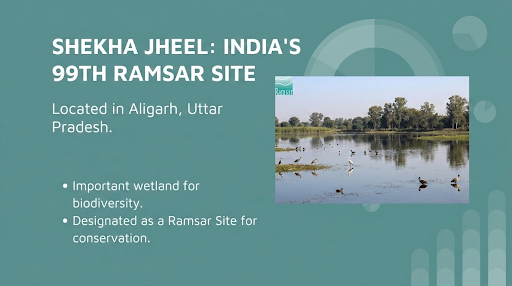
Shekha Jheel in Aligarh, Uttar Pradesh, has been officially designated as India’s 99th Ramsar Site.
Location: Situated near Shekha village within the Indo-Gangetic plains, the wetland is approximately 17 km from Aligarh, Uttar Pradesh.
Formation: Created after the 1852 construction of the Upper Ganges Canal, this perennial freshwater body relies on the adjacent canal to maintain water levels.
Ecological Significance
Shekha Jheel is a biodiversity hotspot, acting as a vital refuge in a human-dominated agricultural landscape.
Conservation Challenges
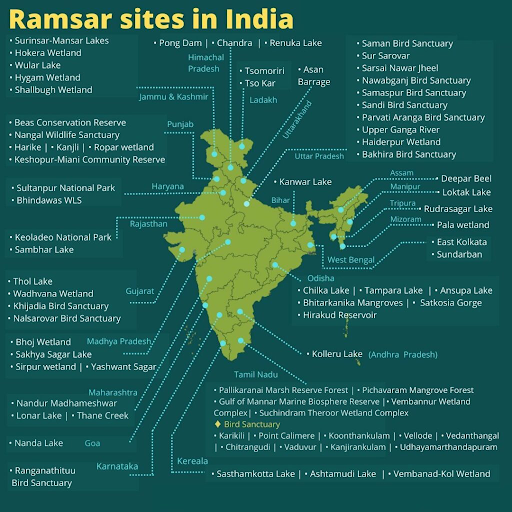
Source: timesofindia
|
PRACTICE QUESTION Q. Consider the following statements regarding the "Montreux Record":
Which of the statements given above are correct? A. 1 and 2 only B. 2 and 3 only C. 1 and 3 only D. 1, 2, and 3 Answer: D Explanation: Statement 1 is correct: The Montreux Record is a register of wetland sites on the List of Wetlands of International Importance (Ramsar sites) where changes in ecological character have occurred, are occurring, or are likely to occur as a result of technological developments, pollution, or other human interference. Statement 2 is correct: As of the current date, Keoladeo National Park (Rajasthan) and Loktak Lake (Manipur) are the only two Indian sites included in the Montreux Record. Statement 3 is correct: Chilika Lake (Odisha) was placed on the Montreux Record in 1993 due to siltation and other ecological problems but was removed in 2002 following successful restoration efforts by the Chilika Development Authority. |
Shekha Jheel is a bird sanctuary and a semi-natural freshwater wetland located 17 km from Aligarh in Uttar Pradesh. It was formed as a perennial freshwater body following the construction of the Upper Ganges Canal in 1852.
The wetland is a crucial node in the Central Asian Flyway (CAF), serving as a wintering ground and mandatory stopover for over 249 bird species. It hosts globally recognized migratory birds like the Bar-headed Goose and the Near Threatened Painted Stork.
Amrit Dharohar is a government scheme launched in the Union Budget 2023-24 aimed at promoting the "wise use" of wetlands. It incentivizes local communities to engage in eco-tourism, sustainable fisheries, and carbon sequestration, turning conservation into an income-generating asset.




© 2026 iasgyan. All right reserved