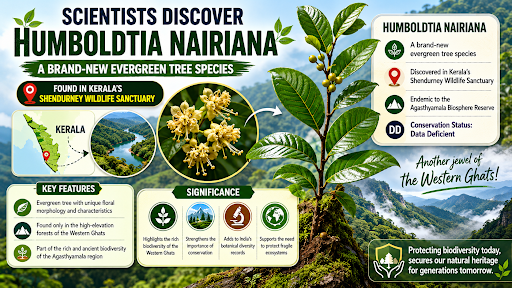
Scientists recently discovered Humboldtia nairiana, a brand-new evergreen tree species located in Kerala's Shendurney Wildlife Sanctuary. Endemic to the Agasthyamala Biosphere Reserve, this Data Deficient species highlights the rich biodiversity of the Western Ghats
Why In News?
Scientists discovered a new evergreen tree species named Humboldtia nairiana in Kerala's Shendurney Wildlife Sanctuary.
About Humboldtia nairiana
Researchers discovered the species along the Cheenikkala-Pandimotta forest trail within the Shendurney Wildlife Sanctuary, located in the Agasthyamala Biosphere Reserve, Kerala.
Named in honor of Prof. (Dr.) G.M. Nair, a plant biotechnologist and former Director of the Jawaharlal Nehru Tropical Botanic Garden and Research Institute (JNTBGRI).
The genus Humboldtia comprises 11 recognized taxa. Ten species are strictly confined to the Western Ghats, while one (H. laurifolia) is endemic to Sri Lanka.
Morphological Characteristics
Geographical Distribution
Habitat: Strictly resides in riparian forests (forests adjacent to rivers and streams) at elevations of approximately 300 meters.
Geographic Range: Strictly endemic to Kerala, specifically known only from the Kollam and Thiruvananthapuram districts within the Agasthyamala region.
Associated Species: Often grows alongside Antidesma montanum, Vateria indica, Syzygium stocksii, and other Humboldtia species like H. vahliana and H. decurrens.
Conservation Status
IUCN Status: Categorized as "Data Deficient" (DD). The known wild population is extremely limited, consisting of fewer than 10 mature trees occupying an area of less than 2 km².
Source: THEHINDU
|
PRACTICE QUESTION Q. Consider the following statements regarding 'Humboldtia nairiana':
Which of the statements given above is/are correct? A) 1 only B) 2 only C) Both 1 and 2 D) Neither 1 nor 2 Answer: A Explanation: Statement 1 is correct: Humboldtia nairiana is a recently discovered medium-sized evergreen tree species belonging to the genus Humboldtia (family Fabaceae). It is strictly endemic to Kerala. Statement 2 is incorrect: Although discovered in the riparian forests of the Shendurney Wildlife Sanctuary, the sanctuary (and consequently this tree) falls under the jurisdiction of the Agasthyamala Biosphere Reserve, not the Nilgiri Biosphere Reserve. |
Humboldtia nairiana is a newly discovered evergreen tree species belonging to the genus Humboldtia (Fabaceae family) found in the riparian forests of the southern Western Ghats.
It was discovered in the Shendurney Wildlife Sanctuary, which is a part of the Agasthyamala Biosphere Reserve located in Kerala, India.
Currently, the species is categorized as “Data Deficient” under IUCN criteria because its wild population is highly limited and fragile, highlighting an urgent need for habitat protection.





© 2026 iasgyan. All right reserved