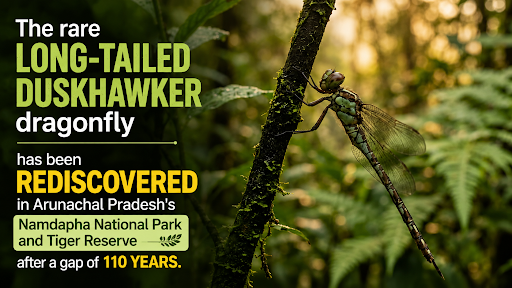
The rare Long-tailed Duskhawker dragonfly (Gynacantha khasiaca) was rediscovered in Arunachal Pradesh’s Namdapha National Park after 110 years. Its IUCN status is Data Deficient.
Why In News?
The rare Long-tailed Duskhawker dragonfly has been rediscovered in Arunachal Pradesh's Namdapha National Park and Tiger Reserve after a gap of 110 years.
About Gynacantha Khasiaca Dragonfly
The Gynacantha khasiaca, commonly known as the Long-tailed Duskhawker, is a rare and distinct dragonfly species within the family Aeshnidae.
Identified for its unique morphology and crepuscular habits, the species serves as a biological indicator of ecosystem health in South-eastern Asia.
Robert McLachlan first described the species in 1896 based on specimens from the Khasi Hills in Meghalaya.
Habitat: The Long-tailed Duskhawker primarily inhabits South-eastern Asia, often found near forest edges and dense vegetation.
Morphological Characteristics
The species exhibits color changes based on age and sexual dimorphism.
Ecology and Behavior
Conservation Status and Threats
Source: THEHINDU
|
PRACTICE QUESTION Q. Consider the following statements regarding the recently in-news Gynacantha khasiaca:
Which of the statements given above are correct? A) 1 and 2 only B) 2 and 3 only C) 1 and 3 only D) 1, 2, and 3 Answer: B Explanation: Statement 1 is incorrect: Gynacantha khasiaca (commonly known as the Long-tailed Duskhawker) is a rare dragonfly species, not a butterfly. It is well-known in parts of Northeast and Eastern India, though it made recent headlines for being rediscovered in Arunachal Pradesh's Namdapha National Park after 110 years. Statement 2 is correct: It is currently categorized as Data Deficient on the IUCN Red List, as scientists currently possess very little data regarding its population trends, breeding ecology, and exact habitat ranges. Statement 3 is correct: The genus Gynacantha consists of large dragonflies known for their pale brown and green coloration and crepuscular behaviour, meaning they are most highly active during the low-light twilight hours (dawn and dusk). |
It is a rare and elusive dragonfly species belonging to the family Aeshnidae, commonly known as the Long-tailed Duskhawker.
It was rediscovered in the Namdapha National Park and Tiger Reserve in Changlang district, Arunachal Pradesh, 110 years after its last confirmed sighting during the 1914 Abor Expedition.
The species is currently classified as "Data Deficient" by the International Union for Conservation of Nature (IUCN) because very little information is available about its population and distribution.





© 2026 iasgyan. All right reserved