Description
Why In News?
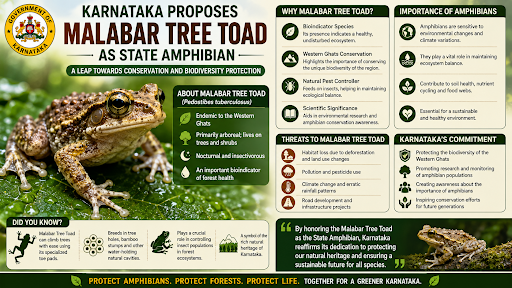
The Karnataka government announced proposals to declare the Malabar Tree Toad as the State Amphibian.
About Malabar Tree Toad
The Malabar Tree Toad (Pedostibes tuberculosus), also known as the Warty Asian Tree Toad, is a rare, arboreal amphibian endemic to the Western Ghats.
- Scientific Name: Pedostibes tuberculosus.
- Family: Bufonidae (True toads).
- Etymology: The specific name tuberculosus refers to the tubercules (bumps) on its skin. The common name reflects its historical discovery in the Malabar region.
- First documented in 1875–76, the species "disappeared" from records for over a century before rediscovery in Kerala in 1980.
Geographical Distribution and Habitat
- Endemism: Exclusively inhabits the Western Ghats biodiversity hotspot, stretching from Maharashtra to Tamil Nadu.
- Elevation: Occurs at altitudes ranging from 250 m to over 1000 m.
- Specific Habitats:
- Found in moist evergreen forests, often beside perennial streams.
- Utilizes phytotelmatous habitats, living in wet tree hollows or leaf bases containing water.
- While primarily arboreal, adults reside in leaf litter on the forest floor and climb into trees at night.
Physical Characteristics
- Appearance: Small and slender with a pointed snout and vertical lores.
- Skin: Rough and tubercular (warty); brownish-grey above with darker sides.
- Markings: Features a white band from below the eye to the axil and another white longitudinal band in the lumbar region.
- Dimensions: Adults grow to approximately 3.6–3.85 cm in length.
- Appendages: Fingers and toes feature broad, truncated disks for climbing. The first finger is half the length of the second. Toes are almost entirely webbed.
- Vocal Sac: Males possess a subgular vocal sac and produce a call described as "shirrrr shirr shirr."
Breeding
- Breeding Season: The toad breeds during a very short window at the start of the monsoon rains.
- Males aggregate (often 10–15 individuals) and call from vegetation approximately 1 meter above ground.
- They engage in axillary amplexus (a mating position).
- Pairs perform pelvic thrusts during spawning to increase fertilization success in semi-aquatic conditions.
- Oviposition: Females choose shallow, stagnant pools, tree bark cavities, or wet ground at stream edges to deposit their eggs.
- Tadpoles are exotrophous (feed on external sources) and develop rapidly, metamorphosing in about one month.
- They possess suckers to adhere to stream bottoms and are initially clear before turning brown.
Threats
IUCN Status: Currently listed as Endangered.
Primary Threats:
- Habitat Loss and Fragmentation: Encroachment for farms, roads, and dams.
- Climate Change: Changes in monsoon timing directly affect its restricted breeding window.
- Fungal Disease: Potential vulnerability to Batrachochytrium dendrobatidis (a deadly fungus affecting amphibians globally), though recent tests on this specific toad were negative.
Source: THEHINDU
|
PRACTICE QUESTION
Q. Consider the following statements regarding the Malabar Tree Toad:
- It is a rare amphibian endemic exclusively to the Western Ghats biodiversity hotspot.
- The Karnataka governmn arboreal (tree-dwelling) species. It spends the majority of its life in tree canopies, hollows, or leaf bases, rather than in deep, fast-flowing rivers.
- ent has recently initiated steps to declare it as the official state frog.
- It spends the majority of its adult life in deep, fast-flowing rivers and avoids tree canopies.
Which of the statements given above is/are correct?
(a) 1 and 2 only
(b) 2 and 3 only
(c) 1 and 3 only
(d) 1, 2, and 3
Answer: (a)
Explanation:
Statement 1 is correct: The Malabar Tree Toad (Pedostibes tuberculosus) is a rare and endangered amphibian that is endemic exclusively to the Western Ghats biodiversity hotspot.
Statement 2 is correct: The Karnataka state government recently took formal steps to officially declare it as the state's official amphibian, alongside the honey bee (Apis cerana) as the state insect.
Statement 3 is incorrect: Although it relies on moisture for breeding, the Malabar Tree Toad is primarily a
|
Frequently Asked Questions (FAQs)
The Malabar Tree Toad (Pedostibes tuberculosus) is a rare, small, nocturnal amphibian known for its rough skin and ability to climb. It is the only species in its monotypic genus and is endemic to the tropical rainforests of the Western Ghats.
It is strictly endemic to the Western Ghats of India, with populations primarily documented across the states of Kerala, Karnataka, and Maharashtra.
It is a highly arboreal toad that spends most of its life in the trees, descending to the forest floor only during the first monsoon showers to breed rapidly in shallow, ephemeral pools or tree cavities.