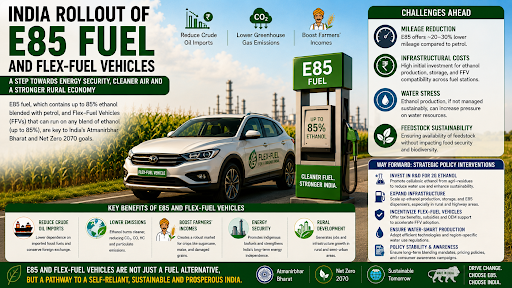
India rolled out E85 fuel and Flex-Fuel Vehicles to cut crude oil imports, reduce greenhouse gas emissions, and boost farmers' incomes. Despite lower retail prices, challenges like mileage reduction, infrastructural costs, and water stress require strategic policy interventions.
Why In News?
The Indian Government launched E85 fuel and the country's first mass-market flex-fuel vehicles to enhance energy security and promote low-carbon mobility.
What is E85 Fuel?
E85 is a renewable biofuel blend of 80-85% ethanol and 14-19% petrol. It is produced from agricultural biomass like maize, sugarcane molasses, and damaged grains.
Flex-Fuel Vehicles (FFVs) are engineered with advanced sensors to optimize engine performance based on the fuel mix. The government has restricted E85 use specifically to these specialized FFVs, excluding standard petrol cars.
FFVs utilize upgraded internal combustion engines and corrosion-resistant systems to run on any ethanol-petrol blend from E20 to E100, allowing consumers to use various fuel mixes rather than relying on a single blend.
Objectives Behind Launching E85
Reduce Dependence on Imported Crude Oil: India imports 85-88.5% of its crude oil. Homegrown E85 slashes this import burden and saves foreign exchange.
Improve Energy Security: E85 shields the economy from geopolitical disruptions and addresses the "Energy Trilemma" of availability, affordability, and sustainability.
Promote Cleaner Transport: Classified as zero-emission by NITI Aayog, ethanol-based FFVs combat air pollution and support India's net-zero 2070 goal.
Support Domestic Biofuel Industry: The program creates demand for ethanol from sugarcane and grain feedstocks, stimulating infrastructure and engineering investments.
Increase Farmers' Income: Initiative shifts farmers from "Annadatas" to "Urjadatas." A 50% FFV transition could channel ₹12,403 crore to the rural economy.
Key Features of E85 Fuel
Economic Pricing: Priced at ₹82.12/litre in Delhi, E85 is ₹20 cheaper than E20 petrol, passing domestic production savings to consumers.
Performance Benefits: A high Research Octane Number (RON) of 108 provides superior knock resistance over standard petrol (84.4–95), optimizing ignition and compression.
Self-Reliant Supply: Sourced from indigenous crops like sugarcane and maize, E85 supports a completely Atmanirbhar supply chain.
Significance for India
Energy Security: Replacing imported fossil fuels with domestic E85 immunizes the Indian economy against global oil price volatility.
Climate Change Mitigation: E85 directly supports the Global Biofuels Alliance (GBA) objectives and secures India's commitment to the UN Sustainable Development Goals (SDGs).
Rural Development: E85 transforms agricultural surplus into liquid fuel, creating profitable miller-farmer partnerships and eradicating rural poverty.
Atmanirbhar Bharat: Every single drop of E85 replaces imported crude, embodying the true spirit of self-reliance (Atmanirbhar Bharat).
Green Mobility Transition: The E85 launch successfully transitions India from experimental pilot projects into a structured, commercial national flex-fuel ecosystem.
Source: PIB
|
PRACTICE QUESTION Q. "India's transition towards E85 and E100 ethanol blends is a crucial tool for achieving long-term energy security and rural economic empowerment." Discuss. (150 words) |
E85 is a high-blend biofuel consisting of 85% ethanol and 15% petrol, introduced as a cost-effective and cleaner alternative to conventional gasoline.
Flex-Fuel Vehicles are automobiles equipped with modified engines and fuel systems that can run on any blend of petrol and ethanol, ranging from E20 up to E100.
The government launched E85 to reduce crude oil import dependency, support the domestic agricultural sector, and accelerate the transition to low-carbon mobility.
After achieving the 20% blending (E20) target ahead of schedule in 2025, India now aims to expand E85 availability to 5,000 retail outlets by 2027.




© 2026 iasgyan. All right reserved