Researchers discovered a rare Yellow Puffball Mushroom (Bovista colorata) in Arunachal Pradesh. These unique fungi lack traditional gills, producing internal spores. They serve as vital decomposers, breaking down organic matter, recycling nutrients, and maintaining the Eastern Himalayan ecosystem.
Why In News?
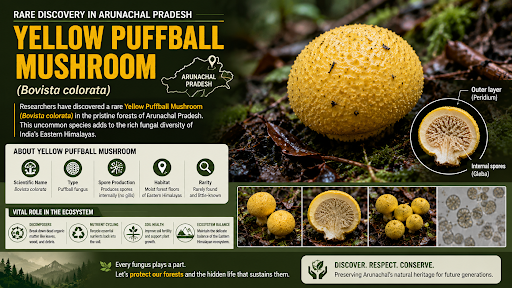
Researchers from Krishi Vigyan Kendra (KVK) documented a rare Yellow Puffball Mushroom (Bovista colorata) in Arunachal Pradesh.
What is a Puffball Mushroom?
A puffball mushroom belongs to the phylum Basidiomycota and represents a globose, spore-producing fungal fruiting body.
Unlike typical mushrooms, puffballs lack a distinct cap, gills, or stalk; instead, they form a closed, round structure that encloses millions of spores internally.
The outer wall, called the peridium, protects the inner gleba—a mass of basidiospores that matures into a powdery, olive-brown dust.
When raindrops, animals, or wind strike the mature puffball, the peridium ruptures, and the spores "puff" out in visible clouds—hence the name.
Young, white puffballs remain edible and taste similar to tofu or scrambled eggs, but once the gleba turns yellow or brown, the fungus becomes toxic or unpalatable.
Puffballs thrive in grasslands, meadows, forests, and even lawns across temperate and tropical regions globally.
Medicinal & Nutritional Value: Traditional cultures utilize puffball spores as natural wound dressings because they possess exceptional haemostatic and moisture-absorbing properties. Certain species provide high protein and essential amino acids when consumed young.
Yellow Puffball Mushroom Discovery
Recent Sighting: Researchers record a striking yellow puffball specimen in Zedua village, Longding district, Arunachal Pradesh.
The Yellow Puffball (Lycoperdon flavotinctum or related species) displays a bright yellow to ochre-colored peridium that distinguishes it from white or brown relatives.
This species prefers sandy soils, open woodlands, and coastal dunes, often fruiting after late summer rains.
The yellow pigmentation derives from carotenoid compounds that shield the fungus from UV radiation and attract specific spore-dispersing insects.
Mature yellow puffballs release spores through an apical pore (ostiole) rather than full rupture, allowing controlled, repeated dispersal.
Mycologists value the yellow puffball as a bioindicator species; its presence signals low soil acidity and healthy mycorrhizal networks.
Caution: The yellow coloration confuses foragers with toxic earthballs (Scleroderma species) or immature Amanita mushrooms—mistaken identity kills.
In traditional medicine, extracts from yellow puffballs show antimicrobial and anti-inflammatory properties in preliminary pharmacological studies.
Importance of Fungi in Ecosystems
Decomposition & Nutrient Cycling: Fungi secrete extracellular enzymes that break down lignin, cellulose, and chitin—nature's recyclers return carbon, nitrogen, and phosphorus to the soil.
Mycorrhizal Symbiosis: Over 90% of vascular plants form partnerships with fungi; arbuscular mycorrhizae (AM) and ectomycorrhizae extend root surfaces by 100x, boosting water and mineral uptake.
Soil Aggregation: Fungal hyphae bind soil particles into stable aggregates, preventing erosion and improving water infiltration.
Food Web Foundation: Fungi serve as primary food sources for springtails, nematodes, beetles, and small mammals, sustaining higher trophic levels.
Carbon Sequestration: Mycorrhizal fungi transfer atmospheric carbon into soil organic matter and glomalin—a glycoprotein that locks carbon underground for decades.
Bioremediation: Certain fungi hyperaccumulate heavy metals and degrade petroleum hydrocarbons, pesticides, and dyes through mycoremediation.
Medical & Industrial Value: Fungi produce penicillin, cyclosporine, and statins; Aspergillus species ferment citric acid and industrial enzymes at massive scales.
Pioneer Species: Lichen-forming fungi and mycorrhizal networks colonize bare rock and post-glacial terrain, initiating primary succession.
Source: TIMESOFINDIA
|
PRACTICE QUESTION Q. Consider the following statements regarding Puffball Mushrooms:
Which of the statements given above is/are correct? A) 1 only B) 2 only C) Both 1 and 2 D) Neither 1 nor 2 Answer: B Explanation: Statement 1 is incorrect: Unlike most conventional mushrooms (which release spores from specialized bladelike gills or pores situated beneath their cap), puffball fungi produce their spores internally within a closed, spherical fruiting body. When they mature, the interior becomes a powdery mass that is released through an aperture or by the rupture of the outer wall. Statement 2 is correct: Certain puffball species (such as Calvatia gigantea or giant puffballs) have been used in traditional folk medicine as natural wound-dressing materials. The dried spores are highly effective at absorbing moisture and possess haemostatic properties that cause blood to clot rapidly. Scientific studies have investigated their powders as biological alternatives to commercial clotting agents. |
A puffball mushroom is a unique fungus that produces microscopic reproductive spores inside a closed, spherical or pear-shaped fruiting body rather than on exposed gills beneath an open cap.
Unlike conventional mushrooms, it produces spores inside a closed, spherical fruiting body rather than on exposed gills.
Fungi act as essential saprotrophic decomposers that break down complex lignocellulosic plant debris, which actively drives global carbon cycling, mineralizes nutrients, and enriches soil organic matter fertility.
Arunachal Pradesh thrives as a global biodiversity hotspot due to its drastic altitudinal variations, unique geographical isolation in the Eastern Himalayas, and vast, undisturbed tracts of sub-tropical to alpine forest ecosystems.



© 2026 iasgyan. All right reserved