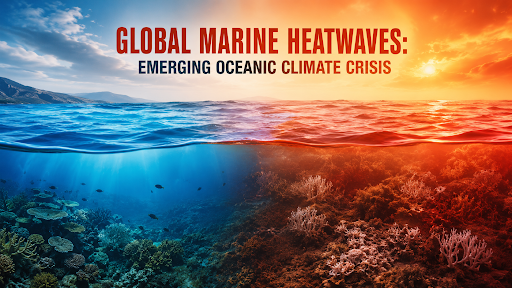
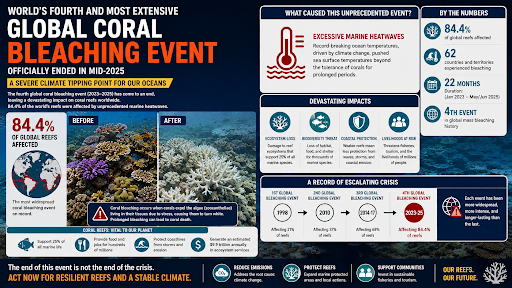
The 2023–2025 global coral bleaching event, the most extensive ever recorded, impacted 84.4% of reefs worldwide. Driven by extreme marine heatwaves, it highlights the urgent need for resilience-based management, emission reductions, and adaptive global conservation strategies.
Why In News?
Researchers from the National Oceanic and Atmospheric Administration (NOAA) reported that the world's fourth global coral bleaching event, which began in 2023, likely concluded in mid-2025.
What is Coral Bleaching?
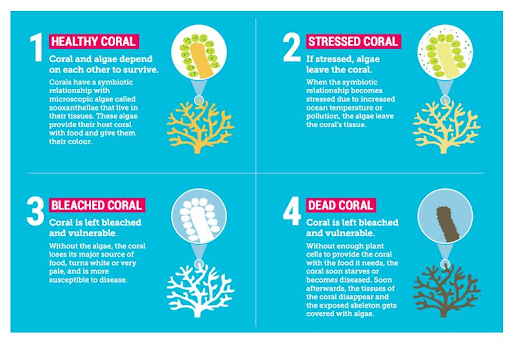
Coral bleaching represents a physiological stress response where coral polyps expel their symbiotic algae due to extreme environmental stressors, losing their vibrant pigments.
This expulsion exposes the bright white calcium carbonate limestone skeleton, leaving the organism weakened, vulnerable to disease, and at high risk of starvation and mass mortality.
Role of Zooxanthellae Algae
Microscopic zooxanthellae algae reside within the tissues of coral polyps in a mutually beneficial symbiotic relationship.
These algae perform photosynthesis to provide corals with essential nutrients and food, remove waste products, and give the reefs their vibrant, distinct colors.
Why Corals Turn White
Spikes in ocean temperatures, increased UV radiation, and poor water quality place immense thermal stress on corals.
Corals expel the algae as a defensive measure against toxic compounds released during prolonged heat stress, turning the colony completely white.
What is a Global Coral Bleaching Event?
A Global Coral Bleaching Event occurs when unprecedented, large-scale marine heatwaves trigger severe and widespread coral bleaching and mortality across multiple ocean basins worldwide.
The National Oceanic and Atmospheric Administration (NOAA) and the International Coral Reef Initiative (ICRI) declare a global event when massive bleaching-level heat stress impacts coral reef areas simultaneously across the Pacific, Atlantic, and Indian Oceans.
Timeline of Global Coral Bleaching Events
Major Causes of the Bleaching Event
Climate Change: Anthropogenic climate change acts as the root driver, escalating baseline ocean temperatures and pushing earth toward catastrophic climate tipping points.
Rising Ocean Temperatures: Unrelenting greenhouse gas emissions continually trap heat, directly elevating ocean temperatures far beyond historic seasonal averages.
Marine Heatwaves: Intense, prolonged marine heatwaves create compounding stress that disrupts the coral-algal symbiosis, killing even the most robust coral species.
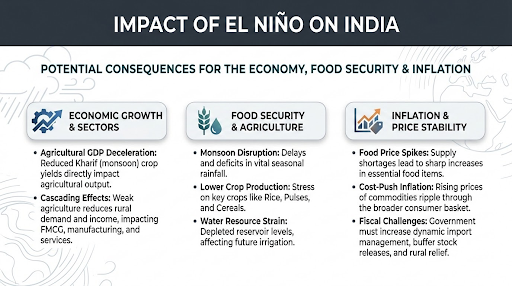
El Niño Conditions: The natural El Niño climate pattern intensifies global heating, supercharging ocean temperatures and triggering the onset of the worst global bleaching periods.
Ocean Acidification: Oceans absorb excess CO2, shifting ocean chemistry. Ocean acidification significantly hinders coral calcification, weakening limestone skeletons and eroding reefs.
Global Impact of Coral Bleaching
Coral Mortality: Heat stress triggered mass die-offs, killing 93% of corals in parts of Mexico and creating "coral graveyards" in the Great Barrier Reef.
Loss of Marine Biodiversity: Reef destruction eliminates habitats for 25% of marine species, causing widespread ecological collapse.
Decline in Fish Populations: Structureless reefs lose nursery and spawning grounds, leading to sharp declines in fish biomass and species abundance.
Reduced Coastal Protection: Eroding reefs fail as natural breakwaters, which normally cut wave energy by 97%, leaving coasts vulnerable to storms and floods.
Threat to Tourism and Fisheries: Bleaching ruins reef aesthetics and ecology, causing heavy revenue losses for global tourism and seafood industries.
Impact on Human Communities
Fisheries Livelihoods: Reef degradation directly threatens the income and survival of fishing communities.
Coastal Economies: Bleaching jeopardizes billions in global revenue, including $3.4 billion annually in the US alone.
Food Security: Habitat collapse endangers the primary protein source for nearly one billion people globally.
Disaster Risk Reduction: Losing reefs removes $2.6 billion in US flood protection, increasing coastal vulnerability to disasters.
Way Forward
Rapid Reduction of Greenhouse Gas Emissions
Humanity must take aggressive international action to drastically curb fossil fuel reliance and limit global warming to below 1.5°C to give corals a fighting chance.
Marine Protected Areas
Expanding and strictly enforcing Marine Protected Areas (MPAs) provides vital refuges that limit local human interference, allowing reefs to build natural resilience.
Coral Restoration Programs
Scale up coral restoration by deploying genetically resilient coral strains, rebuilding 3D structural complexity, and utilizing coral nurseries to replenish degraded zones.
Sustainable Coastal Development
Implement adaptive watershed management to strictly reduce land-based pollution, agricultural runoff, and destructive coastal infrastructure.
Strengthening Climate Adaptation
Utilizes resilience-based management to combine satellite forecasting, vulnerability assessments, and local/indigenous knowledge to proactively defend reefs.
Source: DOWNTOEARTH
|
PRACTICE QUESTION Q. With reference to "Resilience-Based Management" and depth-resolved thermal stress on coral reefs, consider the following statements:
Which of the statements given above is/are correct? (a) 1 only (b) 2 only (c) Both 1 and 2 (d) Neither 1 nor 2 Answer: (a) 1 only Explanation: Statement 1 is correct: Resilience-based management focuses on utilizing knowledge of changing ocean conditions to manage and prioritize actions. It helps reduce local stressors (e.g., pollution, overfishing) so that corals have a higher baseline ability to resist and recover from climate-induced threats like thermal stress and bleaching. Statement 2 is incorrect: Depth-resolved profiles reveal that subsurface corals do not always experience the same degree of thermal stress as surface corals. Subsurface waters are often insulated from extreme surface temperatures (e.g., through oceanic mixing or thermoclines). Therefore, deep-water or subsurface coral communities often experience less thermal stress than surface corals, occasionally acting as thermal refugia. |
Coral bleaching is a severe stress response where marine invertebrates expel their internal symbiotic algae, leaving their translucent limestone skeletons completely exposed.
Corals turn bone-white because the loss of photosynthetic zooxanthellae algae strips away the vibrant pigments that give the reef structures their natural coloration.
Reef ecosystems are critical because they support 25% of all marine life, buffer coastal communities against destructive storm surges, and sustain global fishing economies.
Climate change devastates reefs by causing prolonged marine heatwaves and driving ocean acidification, which stops corals from building their calcium carbonate skeletons.


© 2026 iasgyan. All right reserved