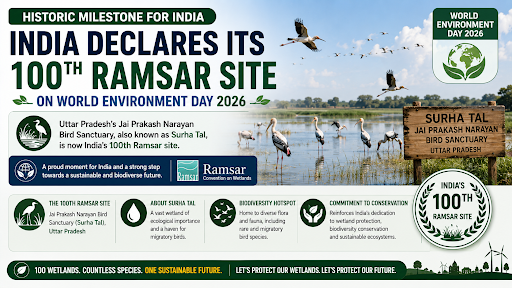
India achieved a historic environmental milestone on World Environment Day 2026 by declaring Uttar Pradesh’s Jai Prakash Narayan Bird Sanctuary, also known as Surha Tal, as its 100th Ramsar site, highlighting the nation's commitment to biodiversity conservation and wetland protection.
Why In News?
On World Environment Day 2026, Prime Minister Narendra Modi announced the designation of Uttar Pradesh's Jai Prakash Narayan Bird Sanctuary, also known as Surha Tal, as India's 100th Ramsar site
What is a Ramsar Site?
The Ramsar Convention designates specific wetlands as Wetlands of International Importance under a global environmental treaty established in 1971 in Ramsar, Iran.
Countries select these sites based on their international significance regarding ecology, botany, zoology, limnology, or hydrology.
Designation obligates member nations to build and enforce strict management frameworks to actively conserve the wetland's ecological character.
Jai Prakash Narayan Bird Sanctuary
The government officially declared the Jai Prakash Narayan Bird Sanctuary (Surha Tal) in Ballia, Uttar Pradesh, as India’s 100th Ramsar Site. This makes Surha Tal Uttar Pradesh’s 13th Ramsar site.
The site encompasses a natural, rain-fed oxbow lake spanning 3,432.93 hectares, which expands massively during the monsoon season.
Positioned directly on the Central Asian Flyway, the sanctuary serves as a vital stopover point for traveling migratory birds.
The wetland sustains over 310 bird species (including 125 waterbirds) and hosts up to 200,000 individual migratory birds during the winter.
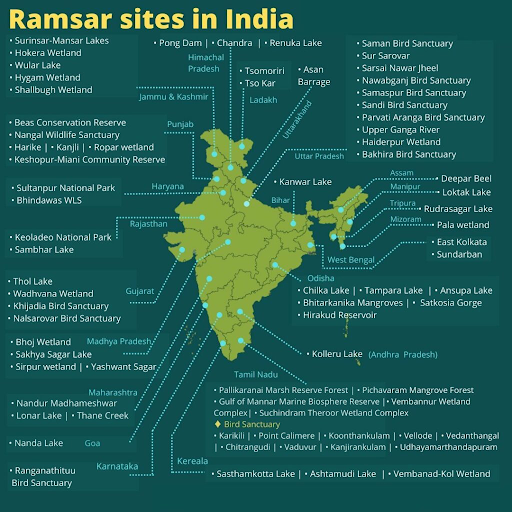
|
State-wise Leaders in Ramsar Site Conservation
|
Ecological Importance of Wetlands
Wetlands function as the "kidneys of the landscape", purifying water by filtering out harmful pollutants.
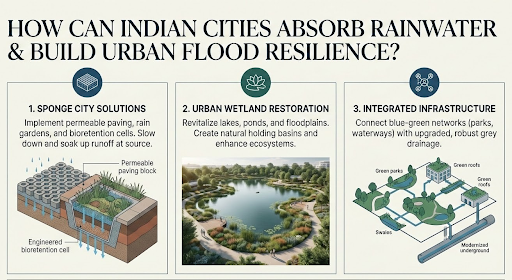
They act as natural sponges, absorbing excess rainfall and significantly reducing the destructive impact of floods.
These ecosystems operate as highly effective carbon sinks, storing vast amounts of carbon in both soil and biomass to mitigate climate change.
Despite covering only 6% of the Earth's land, wetlands provide critical breeding grounds for nearly 40% of all global plant and animal species.
They directly support human livelihoods by recharging groundwater, providing food (like fish and rice), and buffering coastal populations against storm surges and tsunamis.
Threats to Wetlands in India
Urbanization and industrialization drive rapid land conversion, permanently destroying natural wetland habitats.
Agricultural expansion and unsustainable farming practices severely disrupt natural hydrology and deplete groundwater.
Untreated industrial effluents and domestic waste heavily pollute water bodies, poisoning aquatic flora and fauna.
Climate change alters rainfall patterns, intensifies extreme weather events, and accelerates the degradation of these fragile ecosystems.
Government Initiatives for Wetland Conservation
The Amrit Dharohar initiative enhances Ramsar site conservation while promoting eco-tourism and sustainable wetland-based economies.
The MISHTI (Mangrove Initiative for Shoreline Habitats & Tangible Incomes) program restores degraded mangrove ecosystems along India's coastline to act as natural bio-shields.
The Wetlands (Conservation and Management) Rules, 2017 empower authorities to legally protect and systematically govern wetland areas.
The Green Credit Programme incentivizes voluntary environmental actions, rewarding communities and organizations for the eco-restoration of degraded lands.
Way Forward
Enforce environmental regulations and implement continuous ecological monitoring to halt further habitat degradation.
Scale up nature-based solutions, such as agroforestry and artificial reef deployments, to build robust climate resilience.
Integrate community participation and grassroots innovation to balance ambitious development goals with mandatory ecological preservation.
Source: PIB
|
PRACTICE QUESTION Q. Consider the following statements regarding the Jai Prakash Narayan Bird Sanctuary (Surha Tal):
Which of the statements given above is/are correct? A) 1 and 2 only B) 2 and 3 only C) 1 and 3 only D) 1, 2, and 3 Answer: D Explanation: Statement 1 is correct: The Jai Prakash Narayan Bird Sanctuary is centered around Surha Tal, which is a large, natural, rain-fed, perennial oxbow lake formed by the meandering of the Ganga River. It is located in the Ballia district of eastern Uttar Pradesh. Statement 2 is correct: Prime Minister Narendra Modi announced that the sanctuary was officially designated as India's landmark 100th Ramsar site on World Environment Day (June 5, 2026). Statement 3 is correct: The sanctuary acts as an international refueling station and vital wintering stopover point for countless long-distance migratory waterbirds traveling along the Central Asian Flyway. |
The Jai Prakash Narayan Bird Sanctuary, popularly called Surha Tal, achieved the historic milestone of becoming India's 100th Ramsar Site on World Environment Day (June 5, 2026).
The sanctuary is located along the margins of the River Ganga in the Ballia district of Uttar Pradesh, within the Middle Gangetic Plains.
A Ramsar Site is a globally protected wetland zone formally designated under an international treaty to preserve its ecological character and prevent habitat degradation.



© 2026 iasgyan. All right reserved