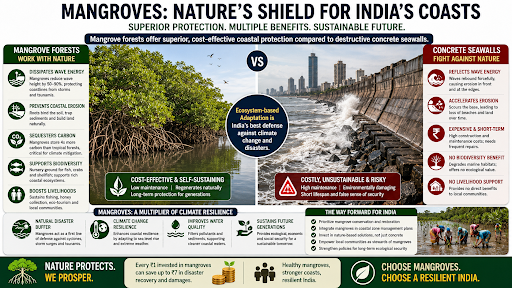
Mangrove forests offer superior, cost-effective coastal protection compared to destructive concrete seawalls. They dissipate wave energy, halt coastal erosion, sequester carbon, and boost local livelihoods, making Ecosystem-based Adaptation essential for India's long-term climate resilience and effective disaster mitigation.
Why In News?
Government assessments prioritize Ecosystem-based Adaptation (EbA), citing mangroves as India’s superior, dynamic defense against coastal climate threats over ecologically harmful concrete seawalls.
What are Mangroves?
Mangroves grow as highly productive and biodiverse marine tidal forests located primarily in the intertidal zones of tropical and subtropical regions.
They function as an excellent natural buffer between land and sea.
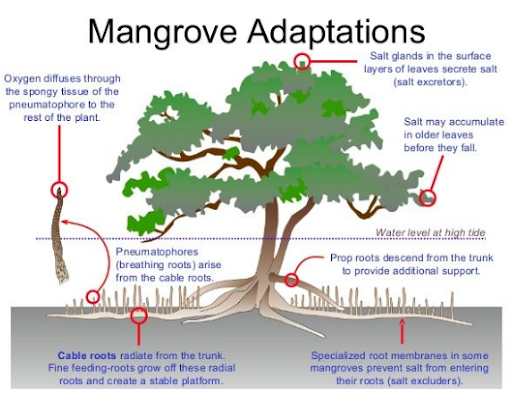
These plants possess unique adaptive features, such as aerial roots (pneumatophores) or breathing roots, which allow them to grow in highly saline and oxygen-depleted soils.
They stabilize highly variable environmental factors like temperature, tidal currents, and sedimentation, providing a vital habitat for diverse plant and animal species.
How do Mangroves Reduce Storm Surges and Coastal Erosion?
Dissipate Wave Energy: The dense network of aerial root systems helps to minimize wave action and dissipate wave energy effectively.
Stabilize Sediment: Mangroves capture and stabilize sediment, promoting soil build-up that counters coastal erosion.
Act as Live Seawalls: A mangrove forest of 100 meters in width significantly reduces wave heights and forms a cost-effective "live seawall".
Mitigate Disasters: Mangroves reduce the impact of extreme weather events; for example, they shielded villages during the 2004 Tsunami and the 1999 Odisha super cyclone.
Prevent Salinization: They block seawater from moving inland, thereby protecting groundwater reserves from drastic salt concentration and salinization.
Why do Engineered Seawalls Deliver Limited Protection?
Accelerate Adjacent Erosion: Hard engineering structures like seawalls, groynes, and breakwaters obstruct the natural littoral drift (sand and sediment flow), transferring severe erosion to adjacent northern coastlines.
Increase Wave Impact: Waves reflect off hard structures and grow 2 to 4 times larger, which undercuts the base of the seawall and ultimately leads to its collapse.
Magnify Disaster Damage: During extreme events like tsunamis, seawalls can magnify damage by turning broken stones and rubble into dangerous projectiles.
Hinder Livelihoods: Walled coastlines permanently destroy beach spaces required for local fishing communities to land boats, dry fish, and repair nets.
Require High Maintenance: Grey infrastructure demands continuous, expensive rebuilding and maintenance, treating the symptom rather than the underlying coastal risk.
How can Mangroves Strengthen Climate Adaptation Strategies?
Drive Ecosystem-based Adaptation (EbA): Mangroves utilize biodiversity and natural ecosystem services to help coastal communities adapt to climate change, protecting more people per hectare in India than almost any other country.
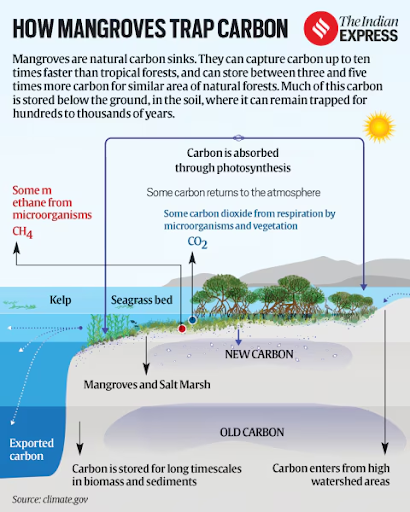
Provide Carbon Sequestration: Mangrove sediments provide anaerobic conditions that capture and store atmospheric carbon dioxide, mitigating global warming.
Adapt to Rising Seas: Unlike static concrete walls, healthy mangrove ecosystems dynamically respond to sea-level rise by continuously building up soils.
Build Resilience: They protect vulnerable populations against intensifying cyclones, saline intrusion, and climate-induced storm surges.
What Economic Benefits do Mangrove Ecosystems Generate?
Support Fisheries: Mangroves serve as crucial nursery habitats for commercially valuable shrimp, shellfish, and fish.
Generate Tangible Livelihoods: They provide harvestable resources like timber, charcoal, dyes, and honey. In the Sundarbans, honey extraction alone employs 2,000 people and accounts for 90% of India's mangrove honey production.
Deliver Cost Savings: Mangroves offer massive financial savings over hard structures. In Vietnam, a US $ 1.1 million mangrove plantation reduced sea dyke maintenance costs by US7.3 million annually.
Promote Eco-Tourism: Mangroves attract recreational activities like bird watching, boating, and sport fishing.
Provide Medicinal Value: Communities extract indigenous medicines from mangrove species to treat blood pressure, leprosy, and viral pathogens.
What are the Challenges Faced by the Mangrove Ecosystem?
Human Encroachment: Communities clear vast tracts of mangroves for shrimp farming, agriculture (rice cultivation), and developmental activities.
High Artificial Mortality: Artificial mangrove plantation and restoration efforts often fail completely due to the death of planted seedlings when hydrologic conditions are ignored.
Extreme Weather Damage: While they protect against storms, unprecedented high-impact extreme events can physically uproot and destroy mangrove forests.
Natural Limiting Factors: High salinity, lack of oxygen, and continuous diurnal tidal inundations constantly challenge mangrove survival and growth.
How can India Integrate Nature-Based Solutions into Coastal Planning?
Mainstream EbA Classification: Classify and track biological interventions like the MISHTI (Mangrove Initiative for Shoreline Habitats & Tangible Incomes) program as core Ecosystem-based Adaptation (EbA) strategies.
Prioritize Soft Engineering: Mandate that hard engineering options act only as a last resort, prioritizing bioshields, beach nourishment, and coastal vegetation.
Enforce Environmental Impact Assessments (EIAs): Make EIAs and Environmental Management Plans (EMPs) mandatory before approving any hard coastal engineering projects.
Implement Ecological Restoration: Shift from artificial planting to Ecological Restoration, which focuses on restoring natural hydrology to let mangroves grow back naturally.
Establish Preservation Centers: Identify rich biodiverse zones and manage them as Mangrove Germplasm Preservation Centers to protect rare and endangered species.
Conclusion
India must shift from expensive, ecologically destructive engineered seawalls to dynamic Ecosystem-based Adaptation strategies like mangroves to secure long-term coastal resilience and community livelihoods.
Source: THEHINDU
|
PRACTICE QUESTION Q. Critically evaluate the economic and ecological benefits mangroves generate while mitigating the impacts of climate-induced extreme weather events. 150 words |
Ecosystem-based Adaptation (EbA) uses biodiversity and natural ecosystem services to help communities adapt to climate change. It relies on natural buffers like mangroves, seagrasses, and coral reefs instead of engineered structures to mitigate coastal risks.
Hard structures like seawalls obstruct the natural littoral drift of sand and sediment. This transfers the erosion problem to adjacent coastlines, causing severe damage further down the shore and ultimately requiring more seawalls.
The Mangrove Initiative for Shoreline Habitats & Tangible Incomes (MISHTI) restores 540 square kilometers of mangroves across nine Indian States. The program designs these biological interventions to protect coastal communities from the impacts of climate change.



© 2026 iasgyan. All right reserved