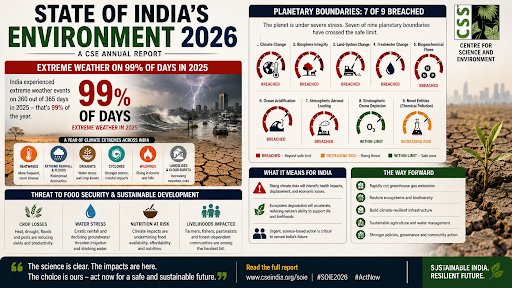
Released by CSE, the State of India's Environment 2026 report warns of seven breached planetary boundaries, extreme weather on 99% of days, escalating human-wildlife conflicts, and massive air-quality monitoring blind spots, urging immediate policy interventions for sustainable development.
Why In News?
The State of India's Environment 2026 report reveals that India faced extreme weather on 99% of days in 2025 and that seven of nine planetary boundaries are now breached, threatening national food security and sustainable development.
What is the State of India’s Environment (SOE) Report?
Centre for Science and Environment (CSE) and Down To Earth magazine release this annual report to compile data and analysis covering climate change, extreme weather events, air pollution, and biodiversity loss.
The report evaluates the performance of Indian states across four critical themes: environment, agriculture and land, public health, and human development/public infrastructure.
Key Findings of SOE 2026
Five Most Populous States Perform Poorly
Environmental Degradation Impacts Development
Regional Disparities Remain Significant
Parameters Used in Assessment
Environmental Indicators: Measure forest and biodiversity, climate, waste management, and water resources to rank states.
Development Indicators: Track agricultural economy, agriculture input, farmer welfare, and sustainable land use to determine economic resilience.
Governance Indicators: Scrutinizes public infrastructure (roadways, power, housing) and public health infrastructure (like hospital beds per 1,000 population) to measure governance effectiveness.
Major Environmental Challenges Identified
Air Pollution
Water Stress
Land Degradation
Biodiversity Loss
Why Do Highly Populous States Face Greater Challenges?
Population Pressure
Massive populations strain limited natural resources and reduce per capita infrastructure availability, keeping states like UP and Bihar at the bottom of rankings.
Rapid Urbanization
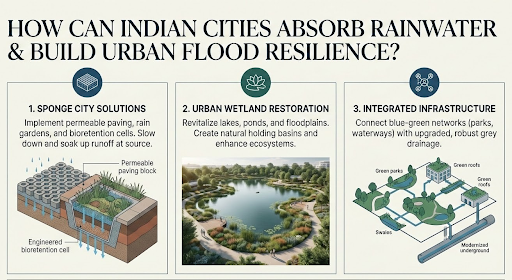
Urban flooding emerges as a major governance challenge due to severe concretization and inadequate drainage planning.
Increased Demand for Resources
High agricultural dependence on chemical fertilizers weakens farming sustainability and depletes soil health.
Infrastructure Deficits
Thirty-two out of 36 states and UTs fall below the halfway mark in the public infrastructure category.
Waste Management Challenges
Waste management stands out as the biggest state-level challenge; states like West Bengal and Mizoram leave over 90% of municipal solid waste untreated.
Way Forward
Strengthen Environmental Governance
Establish an actionable health response system that triggers specific medical protocols when the Air Quality Index (AQI) rises, moving beyond simple data dashboards like the Sameer app.
Promote Green Urbanization
Implement decentralized waste management systems, ensuring mandatory segregation and shifting completely away from centralized dumping.
Sustainable Agriculture Practices
Farmers must reduce dependence on chemical inputs and shift toward sustainable cropping (e.g., turmeric, ginger) to withstand extreme weather and wildlife raids.
Improve Waste Management Systems
Local bodies must prioritize waste prevention at the source and accelerate bio-mining to clear the remaining ongoing legacy waste.
Enhance Climate Adaptation Strategies
Governments need to factor environmental and ecological carrying capacities directly into development planning stages rather than treating them as external issues.
Increase Community Participation
Empower local Adivasi and forest-dependent communities using tools like the Forest Rights Act, acknowledging that community-led conservation effectively prevents forest fires and biodiversity loss.
Conclusion
India must shift from passive environmental monitoring to robust, decentralized, and community-led ecological governance to secure a sustainable development trajectory.
Source: DOWNTOEARTH
|
PRACTICE QUESTION Q. Consider the following statements regarding the findings of the 'State of India's Environment 2026' report:
Which of the statements given above is/are correct? A) 1 only B) 2 only C) Both 1 and 2 D) Neither 1 nor 2 Answer: A Explanation: Statement 1 is CORRECT: The report confirms that humanity has officially breached seven of the nine planetary boundaries. The newest addition to this "danger zone" is ocean acidification, which has increased by roughly 30–40% since the beginning of the industrial era. Statement 2 is INCORRECT: The report notes that India's five most populous states (Uttar Pradesh, Maharashtra, Bihar, Madhya Pradesh, and West Bengal) actually rank poorly across several environmental, agricultural, and developmental metrics. Smaller states like Goa and Himachal Pradesh generally top these charts. |
The State of India’s Environment Report is an authoritative, annual data-driven assessment published by the Centre for Science and Environment (CSE) and Down To Earth magazine to evaluate the country’s climate, biodiversity, health, and sustainable development metrics.
Environmental indicators provide objective, measurable benchmarks that track ecological health and ensure economic planning translates into long-term resource availability rather than rapid, short-sighted depletion.
India faces severe, escalating crises including an unprecedented 99% of days with extreme weather events in 2025, a highly urban-centric air quality monitoring gap leaving 85% of people unmonitored, expanding human-wildlife conflicts, and systemic groundwater depletion.
The environment-development nexus is the inescapable, interdependent relationship where economic progression relies directly on ecological health, reinforcing the core policy truth that a collapsing environment can never sustain a robust economy.

© 2026 iasgyan. All right reserved