India's waste crisis requires a shift from rigid centralized policies to empowered, decentralized local governance. The Solid Waste Management Rules 2026 aim for a circular economy but must embrace the subsidiarity principle and strengthen Urban Local Bodies for effective implementation.
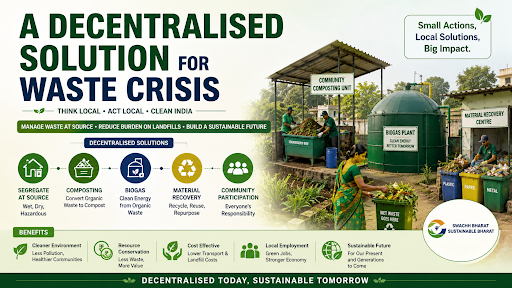
Effective waste management requires a decentralised, state-led approach where local bodies are empowered with financial autonomy and community-level initiatives like household composting.
|
Read all about: RURAL WASTE MANAGEMENT IN INDIA l SOLID WASTE MANAGEMENT l PLASTIC WASTE MANAGEMENT l CIRCULAR ECONOMY FOR URBAN WASTE |
India faces a national ecological emergency, generating over 620 lakh tonnes of waste annually, with nearly 40,000 tonnes dumped unscientifically into landfills every day. (Source: PIB)
Landfills act as mountains of methane, resulting in fire hazards (e.g., Kochi and Delhi) and producing toxic leachate that destroys local water bodies.
Plastic-clogged arterial drains block urban drainage networks, triggering urban flooding during monsoons in cities like Bengaluru and Mumbai.
Authorities fail to process waste scientifically, leading to the open burning of garbage that deteriorates the air quality in Tier-2 and Tier-3 cities.
Rural and peri-urban landscapes struggle to manage the rapid accumulation of sanitary waste, pesticide containers, and e-waste due to a complete absence of basic collection infrastructure.
The Union Government notified the Solid Waste Management Rules, 2026 under the Environment (Protection) Act, 1986, using Article 253 of the Constitution to enact national standards.
The government operationalises the Polluter Pays Principle, authorizing officials to levy strict financial penalties, demand environmental compensation, and charge higher fees for dumping unsegregated waste.
A centralized online portal, managed by the Central Pollution Control Board (CPCB), tracks the entire waste lifecycle digitally to improve regulatory oversight.
Centralized policies violate the principle of subsidiarity, ignoring the fact that local entities (like Ward Committees and Gram Sabhas) possess the contextual, on-the-ground knowledge necessary to govern waste effectively.
The Union government pushes a "one-size-fits-all" model, forcing a fragile Himalayan town or a low-density rural hamlet to adopt the exact same technocratic blueprint as a resource-rich megacity like Mumbai.
The Centre imposes underfunded mandates, expanding the infrastructure and reporting duties of Urban Local Bodies (ULBs) without backing them with the predictable, formula-based financing they require.
Rigid digital monitoring forces unproductive compliance, making sanitation officials prioritize feeding data into centralized CPCB portals over actual street-level waste collection.
A top-down structure blurs accountability; central officials blame local bodies for poor implementation, while local officials blame New Delhi for complex rules and a lack of funds.
Capital-intensive Waste-to-Energy (WtE) plants consistently fail because Indian municipal waste contains low-calorie, poorly segregated material, leading to financial debts and toxic emissions.
Applies the Principle of Subsidiarity: Decentralisation shifts operational control to Urban Local Bodies (ULBs) and Gram Panchayats, ensuring officials manage waste closest to its source.
Solves the "Knowledge Problem": It utilizes dispersed, local knowledge to create contextual solutions, avoiding rigid, top-down policies that fail across diverse geographies.
Empowers Policy Laboratories: It allows States to act as testing grounds for indigenous innovations—like local composting—rather than forcing them to blindly execute central mandates.
Eliminates Toxic Landfills: Processing garbage at the source completely prevents legacy dumpsites, helping cities like Thiruvananthapuram achieve zero landfill dependence.
Saves Municipal Funds: Localized processing drastically cuts the massive logistics costs of secondary waste transportation, preventing severe fiscal leakages.
Drives a Circular Economy: Decentralisation directly converts wet waste into valuable resources, such as biogas for cooking and organic manure for farming.
Generates Green Livelihoods: Community models empower informal waste workers, creating profitable micro-enterprises like Kerala’s women-led Haritha Karma Sena.
Builds Citizen Accountability: Grassroots involvement shifts the public mindset from "Not in My Backyard" to "My Waste, My Responsibility", ensuring active participation in source segregation.
Severe Capacity & Funding Deficits: Urban Local Bodies (ULBs) and Gram Panchayats lack the trained personnel, infrastructure, and predictable financial transfers to manage complex waste mandates.
Behavioral & Cultural Barriers: Public apathy, cultural superstitions, and a lack of space for home composting in urban areas hinder effective waste segregation.
Over-Centralisation: Top-down mandates force local officials to focus on unproductive data-entry for central portals rather than managing waste on the ground.
Corruption & Logistics: Political nexus obstructs policy implementation, and door-to-door collection frequently fails for residents in high-rise buildings.
Empower Local Bodies: Delegate authority to Ward Committees and Gram Sabhas, and back every new mandate with statutory, formula-based financing.
Treat States as Policy Laboratories: Give States a five-year window to experiment with localized innovations (like women's self-help group composting) before enforcing rigid national standards.
Phased Rollout & Strong Urban Institutions: Implement strict rules in megacities first by creating dedicated Metropolitan Waste Management Authorities, while permitting highly simplified models for rural panchayats.
Foster Citizen Engagement: Institutionalize Behavior Change Communication (BCC) to overcome public resistance and build community accountability.
Shared Digital Platforms: Transform rigid central monitoring portals into flexible, shared data platforms that local bodies can customize for transparent governance.
Solving India's waste crisis requires replacing top-down mandates with decentralized, community-driven governance based on subsidiarity, federalism, and the circular economy.
Source: THEHINDU
|
PRACTICE QUESTION Q. Evaluate the socio-economic and environmental implications of poor waste management in Indian megacities. 150 words |
The principle of subsidiarity states that governance functions should be performed at the lowest, most effective local level that is closest to the citizens. In waste management, this means empowering Ward Committees, Gram Sabhas, and Urban Local Bodies rather than relying on top-down, centralized mandates from the Union government.
The 2026 Rules introduce mandatory four-stream segregation at source (wet, dry, sanitary, and special-care). They emphasize Extended Bulk Waste Generator Responsibility (EBWGR), restrict landfills to non-recyclable inert waste, enforce the "Polluter Pays Principle," and mandate digital tracking via a centralized portal.
WtE plants consistently fail in India because the municipal waste generated is typically low-calorie and poorly segregated. Additionally, these plants are highly expensive, lock municipalities into long-term debt, emit toxic pollutants, and undermine local recycling and composting efforts.



© 2026 iasgyan. All right reserved