Copyright infringement not intended
Picture Courtesy: THEHINDU
Context
Urban waste management is shifting from a "collect-and-dump" linear model to a sustainable, circular economy approach emphasizing resource recovery, driven by national policies, technology, and community participation.
Urban Waste Management in India
Rapid urbanization has led to an escalating crisis of Municipal Solid Waste (MSW). Managing this waste is no longer just a civic issue but a critical developmental, environmental, and public health imperative.
 Scale of India's Urban Waste Crisis
Waste Generation: Urban India generates approximately 1.6 lakh metric tonnes of solid waste per day. The per capita waste generation ranges from 0.2 to 0.6 kg per day (Source: MoHUA).
Projected Growth: With continued economic growth and urbanization, this is projected to reach 3.8 lakh tonnes per day by 2030 and 5.4 lakh tonnes per day by 2050 (Source: World Bank).
Collection & Processing Gaps: As of late 2023, approximately 76% of the collected waste is processed, a major jump from 18% in 2014. However, the rest is often dumped in unsanitary landfills or open dumpsites (Source: PIB).
Legacy Dumpsites: Over 3,000 legacy dumpsites across the country hold millions of tonnes of untreated old waste, continuously polluting air, water, and soil. (Source: CSEIndia)
Consequences of Inefficient Waste Management
Environmental
- Air Pollution: Landfill fires and decomposition release harmful gases like methane (a potent GHG) and dioxins.
- Water Pollution: Leachate from dumpsites contaminates groundwater and surface water bodies.
- Soil Degradation: Contamination of soil with heavy metals and plastics reduces its fertility and usability.
Public Health
Uncollected waste becomes a breeding ground for vectors like mosquitoes and flies, leading to diseases such as dengue, malaria, cholera, and typhoid. Respiratory illnesses are common near dumpsites.
Economic
- Deters tourism and investment, impacting urban aesthetics and liveability.
- Represents a loss of valuable resources that could be recovered through recycling and reuse (a "waste-to-wealth" opportunity).
- High costs associated with health issues and environmental remediation.
Social Equity
Vulnerable communities and low-income groups are disproportionately affected as they often live near dumpsites, bearing the brunt of environmental and health impacts.
Root Causes of the Waste Management Crisis
Policy and Governance Issues
- Implementation Gaps: The Solid Waste Management (SWM) Rules, 2016, provide a robust framework, but its enforcement is weak. Key mandates like 100% source segregation and setting up processing facilities are not fully implemented by many Urban Local Bodies (ULBs).
- Fragmented Governance: Lack of coordination between ULBs, state pollution control boards, and other agencies creates operational silos and hinders integrated planning.
- Financial Constraints: ULBs lack the financial autonomy and capacity to invest in modern waste management infrastructure, relying heavily on state and central grants.
Infrastructural and Technological Deficits
- Inadequate Infrastructure: Low number of scientifically engineered landfills, composting plants, bio-methanation facilities, and Material Recovery Facilities (MRFs).
- Technology Adoption: Lack of advanced technologies for recycling complex materials (e.g., multi-layered plastics) and for real-time monitoring of waste collection (e.g., IoT-based systems).
- Focus on Landfilling: Historically, the approach has been to "collect and dump," with landfilling being the default, cheapest option rather than the last resort.
Societal and Economic Factors
- Behavioral Challenges: A 'throwaway' culture fueled by consumerism and the widespread use of single-use plastics has led to a surge in waste volumes. Public participation in source segregation remains low despite awareness campaigns.
- Rapid Urbanization: Unplanned urbanization and migration put immense pressure on existing civic infrastructure, which is often unable to cope with the increasing waste load.
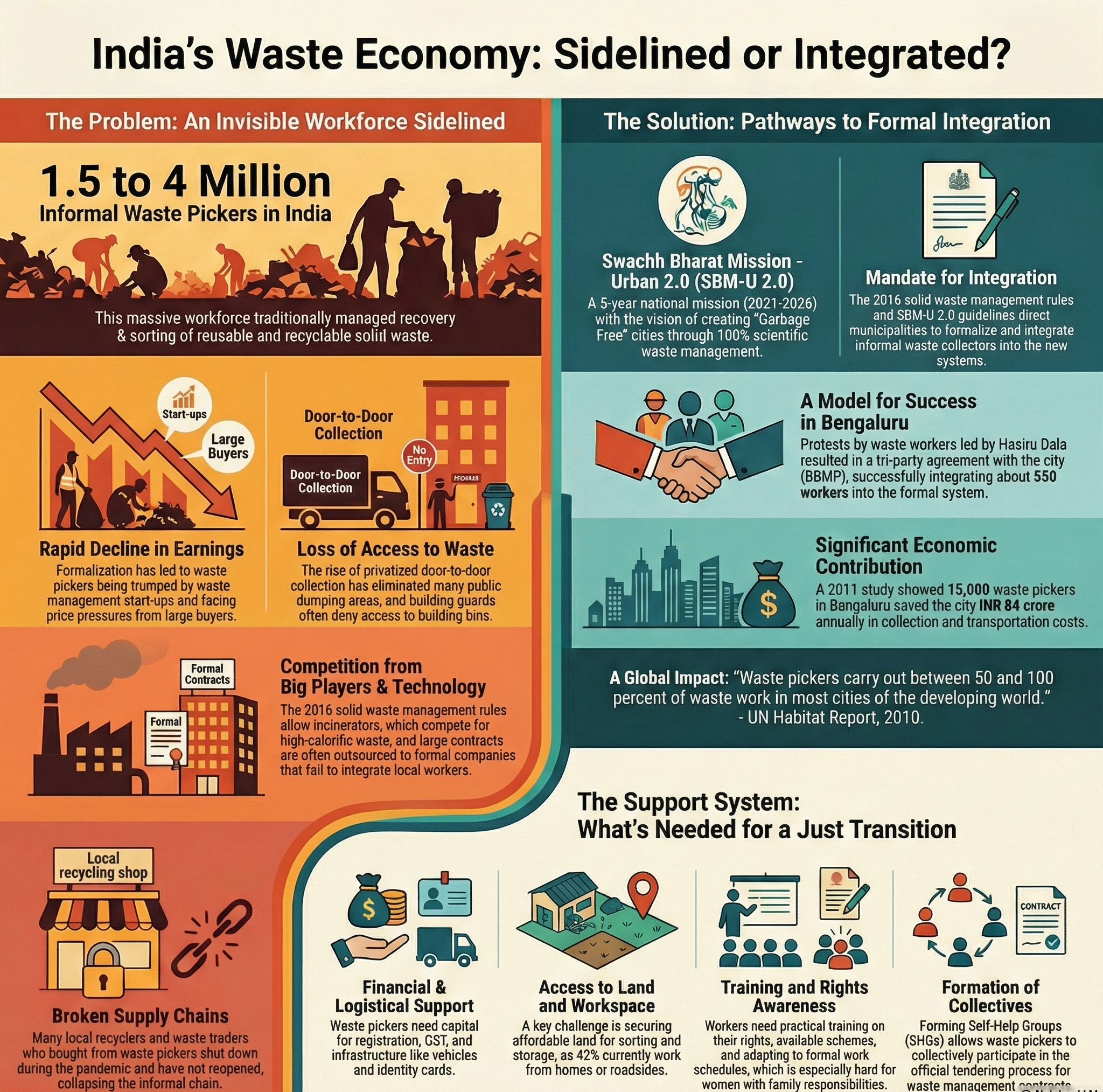
- Informal Sector: While the informal sector (waste pickers) plays a crucial role in recycling, their work is not formally integrated into the system, leaving them vulnerable and their contribution unmonitored.
Key Government Initiatives
Swachh Bharat Mission - Urban (SBM-U 2.0)
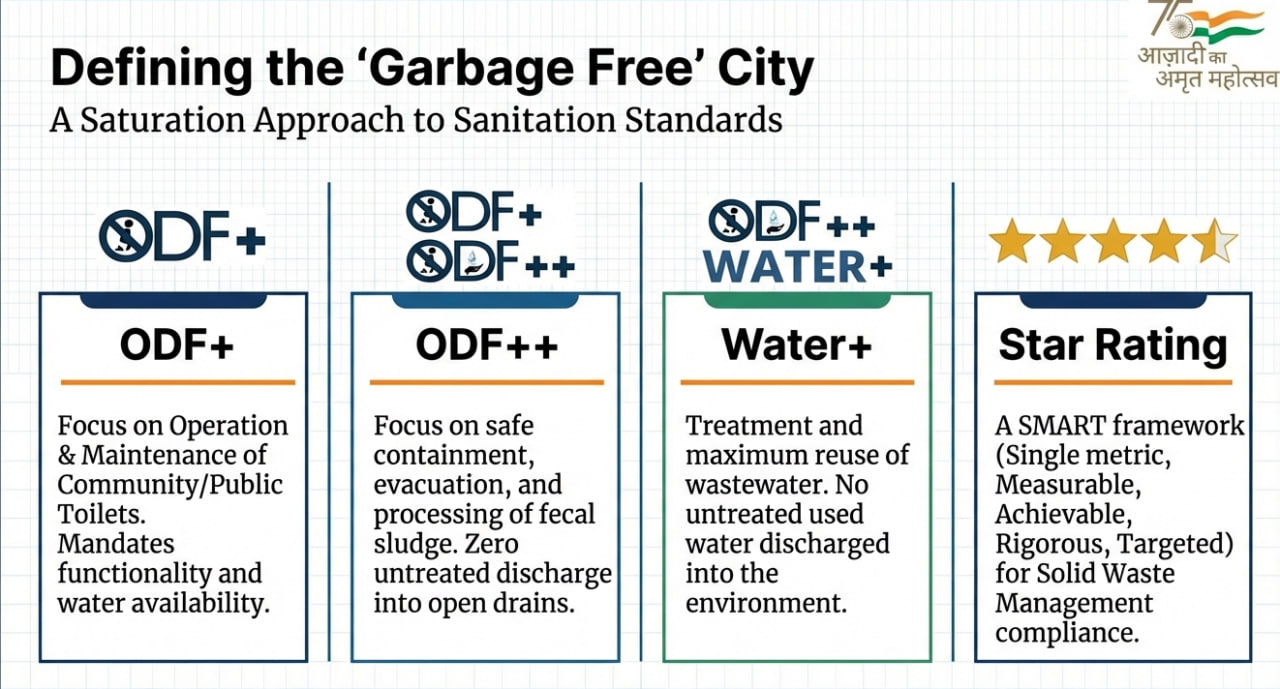
Launched in 2021 for a five-year period, SBM-U 2.0 is aimed at creating "Garbage-Free Cities". Its key objectives include:
- Ensuring 100% source segregation of waste.
- Achieving 100% scientific processing of all municipal solid waste.
- Remediation of all legacy dumpsites to reclaim valuable urban land.
- Focus on a Circular Economy approach, promoting the 3Rs (Reduce, Reuse, Recycle).
|
Circular Economy: Shift from Waste to Resource
The circular economy is a production and consumption model focused on sharing, leasing, reusing, repairing, refurbishing, and recycling materials and products to extend their life cycle and minimize waste.
Core Pillars of a Circular Waste System
- Source Segregation: This is the foundational step, mandating the separation of waste into three streams at the source of generation: wet (biodegradable), dry (non-biodegradable), and domestic hazardous waste.
- Resource Recovery & Processing:
- Composting/Biogas: Wet waste is processed to create compost or bio-methanated to generate biogas and electricity.
- Material Recovery Facilities (MRFs): Dry waste is sorted to recover recyclables like plastic, paper, metal, and glass, which are then sent to recyclers.
- Waste-to-Energy (WtE): Non-recyclable waste with high calorific value is used to generate energy through controlled incineration.
- Legacy Dumpsite Remediation: Old dumpsites are reclaimed through biomining, where decades-old waste is excavated and processed to recover resources and free up urban land.
|
 Key Legislations and Principles
- Solid Waste Management (SWM) Rules, 2016: Mandates source segregation, user fees for waste collection, and makes producers responsible for sanitary and packaging waste.
- Plastic Waste Management (Amendment) Rules, 2022: Phased out specific single-use plastic items and mandated increased thickness for plastic carry bags.
- Extended Producer Responsibility (EPR): A core principle where producers are made financially and/or physically responsible for the treatment or disposal of post-consumer products. The EPR portal by CPCB tracks compliance for plastic packaging, e-waste, and tires.
- Polluter Pays Principle: This principle encourage the SWM Rules, making waste generators responsible for the cost of managing their waste.
Way Forward
Technological & Infrastructural Solutions
- Decentralized Processing: Promoting smaller, localized waste processing units like composting pits and bio-methanation plants to reduce transportation costs and landfill burden.
- Waste-to-Energy (WtE) Plants: For processing non-biodegradable, high-calorific waste. However, this requires careful planning to manage emissions and ash disposal.
- Smart Technology: Using GIS mapping for route optimization, IoT sensors on bins to signal fill levels, and AI-powered sorters at MRFs to improve efficiency.
Community Engagement & Behavioral Change
- Information, Education, and Communication (IEC): Sustained awareness campaigns to institutionalize habits like source segregation.
- Citizen Participation: Encouraging active participation through Resident Welfare Associations (RWAs) and making citizens partners in the waste management process.
- School Curricula: Integrating concepts of circular economy and responsible waste management in education to develop long-term behavioral change.
Financing and Partnership Models
- Public-Private Partnerships (PPPs): Leveraging private sector efficiency, investment, and expertise for collection, transportation, and processing projects.
- Innovative Financing: Exploring models like Green Bonds and viability gap funding for waste management projects.
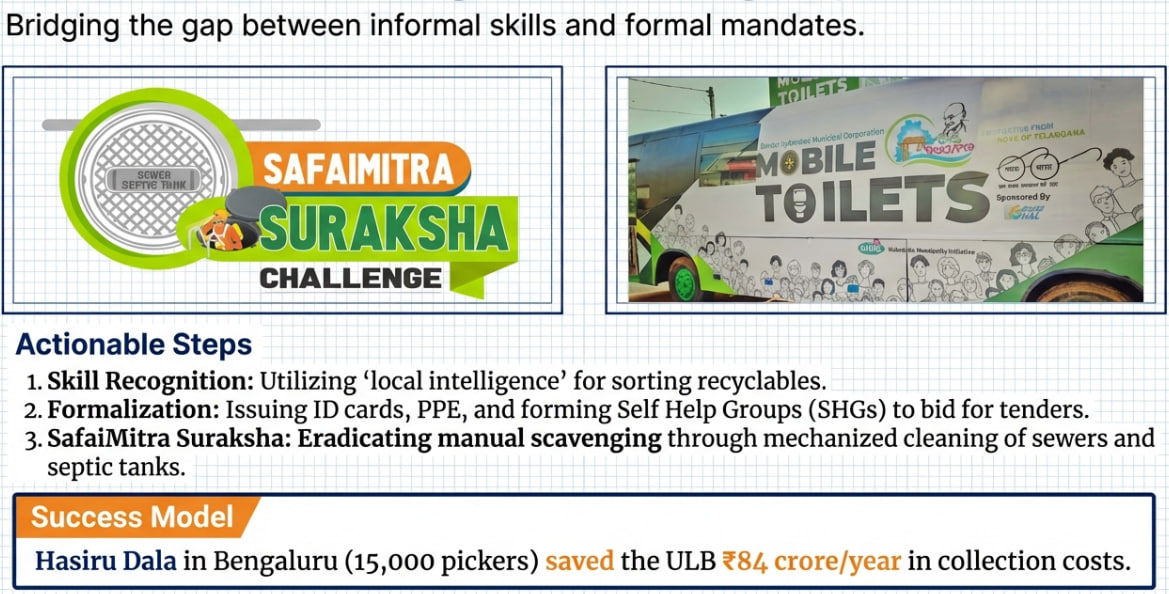
- Formalizing the Informal Sector: Integrating waste pickers into the formal waste management chain by providing them with ID cards, safety gear, and linking them to MRFs.
 Case Studies: Models of Success
|
City
|
Key Features of the Model
|
|
Indore, Madhya Pradesh
|
Consistently ranked India's cleanest city. Success is built on 6-bin source segregation, 100% door-to-door collection, a robust PPP model for processing (including a Bio-CNG plant), and strong political will.
|
|
Alappuzha, Kerala
|
A successful decentralized waste management model ("Nirmala Bhavanam Nirmala Nagaram"). It promotes household-level aerobic composting and biogas plants, reducing the waste sent to centralized landfills.
|
|
Surat, Gujarat
|
Known for its efficient primary collection, real-time monitoring through a command-and-control center, and an effective grievance redressal system.
|
Conclusion
Transforming India's urban waste landscape requires a paradigm shift to a circular economy, integrating policy, technology, financing, and behavioral change to empower ULBs, formalize the informal sector, and foster responsibility among stakeholders for cleaner cities and economic value.
Source: THE HINDU
|
PRACTICE QUESTION
Q. "Waste is not a liability but a misplaced resource." In light of the Circular Economy model, suggest measures to tackle India's urban waste crisis. 250 words
|
Frequently Asked Questions (FAQs)
A linear economy follows a 'take-make-dispose' model, where resources are extracted, used to make products, and then thrown away as waste. A circular economy, in contrast, aims to eliminate waste by treating it as a resource, keeping materials in use for as long as possible through recycling, reusing, and regenerating natural systems.
Extended Producer Responsibility (EPR) is a policy principle that makes producers, importers, and brand-owners financially and/or physically responsible for the treatment or disposal of their products post-consumer use. In India, it is a key component of the Plastic Waste Management Rules, requiring companies to meet annual recycling targets for their packaging.
The Atal Mission for Rejuvenation and Urban Transformation 2.0 (AMRUT 2.0) focuses on making cities 'water secure'. It promotes a circular water economy by ensuring universal water supply, managing sewerage and septage, rejuvenating water bodies, and encouraging the reuse of treated wastewater for industrial and other non-potable purposes.