Copyright infringement not intended
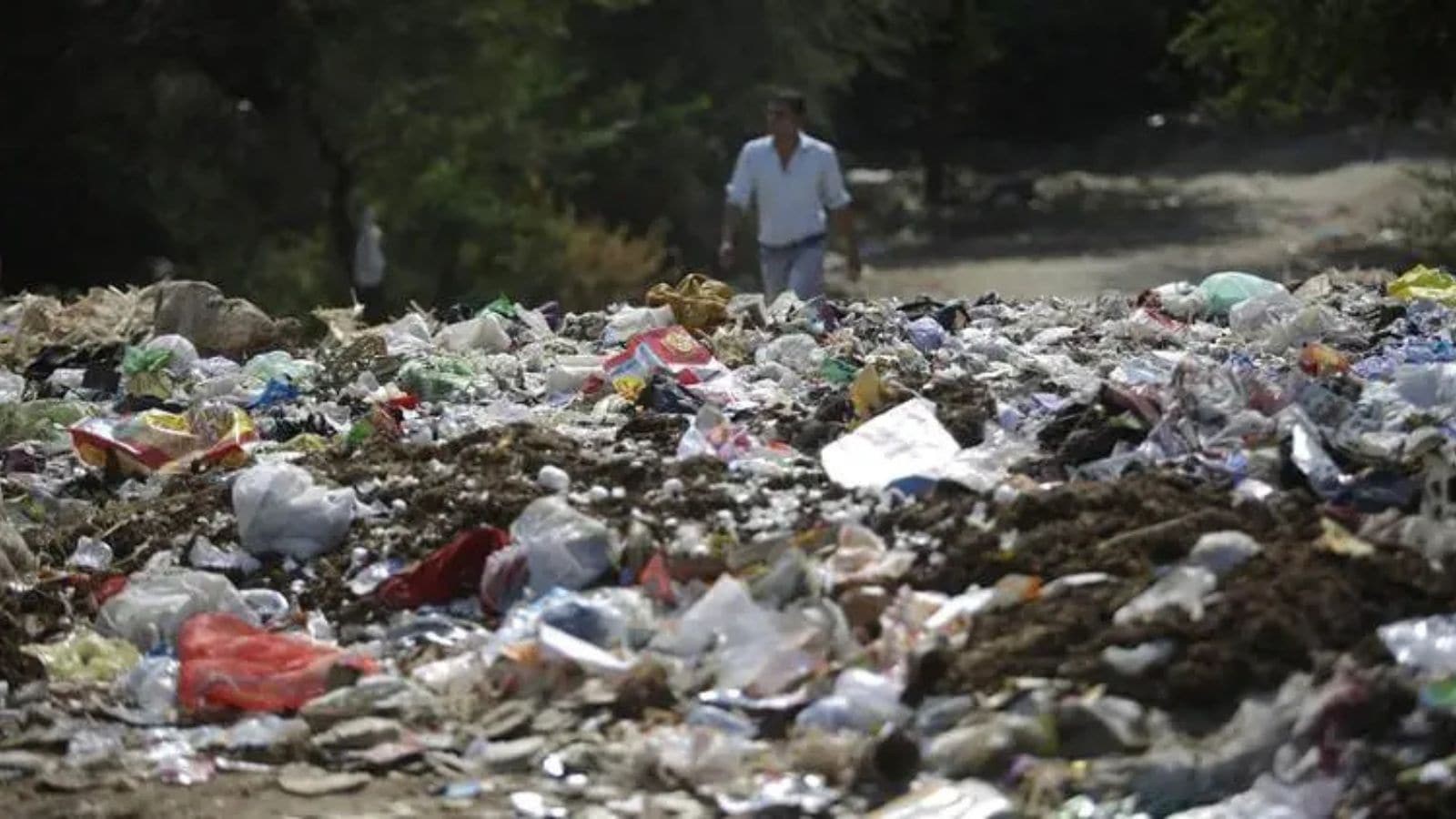
Picture Courtesy: Indian Express
Context:
The Ministry of Environment, Forest and Climate Change has officially notified the Solid Waste Management (SWM) Rules, 2026 to replace the existing decade-old framework.
Key highlights of the Solid Waste Management (SWM) rules, 2026:
- Stronger responsibility for bulk waste generators: The new rules place a primary responsibility on bulk waste generators such as residential societies, government buildings, universities, hotels, and commercial complexes to manage and process the waste they generate. Any entity with a floor area of 20,000 square metres or more, water consumption of 40,000 litres per day or more, or waste generation of 100 kg per day or more is classified as a bulk generator and must ensure processing of wet waste at source or obtain an Extended Bulk Waste Generator Responsibility certificate.
- Mandatory segregation of waste into four streams: The framework makes it compulsory for households and institutions to segregate waste at source into four categories i.e. wet waste, dry waste, sanitary waste, and special care waste, covering biodegradable material, recyclables, personal hygiene waste, and domestic hazardous waste such as batteries and tube lights.
- Promotion of circular economy practices: The rules encourage reuse and recovery of waste by linking waste streams to productive uses, including the use of processed waste as fuel in industrial boilers and cement kilns, thereby promoting a circular economy approach.
- Adoption of the waste hierarchy principle: The SWM Rules, 2026 are structured around the waste hierarchy, which prioritises prevention and reduction of waste generation, followed by reuse, recycling, recovery, and finally disposal, making landfilling the least preferred option.
- Financial disincentives for landfilling unsegregated waste: To discourage poor segregation, higher landfill fees will be imposed on local bodies for sending unsegregated waste to landfills, and the cost of dumping mixed waste will be higher than the cost of segregation and processing.
- Special provisions for hilly and island regions: For the first time, local authorities in hilly and island areas are empowered to levy user fees on tourists and visitors for waste management and to regulate visitor numbers according to their waste-handling capacity in order to protect fragile ecosystems.
- Centralised monitoring and digital tracking: The new framework introduces a centralised online portal to enable real-time monitoring of waste generation, segregation, transportation, and processing, thereby strengthening transparency and accountability.
- Reduced burden on urban and rural local bodies: By making bulk generators responsible for processing a significant share of waste at source, the rules aim to reduce the operational burden on local bodies and improve overall efficiency in municipal solid waste management.
- Restriction on use of landfills: Landfills will now be reserved only for non-recyclable, non-energy recoverable, and inert waste, with the broader objective of gradually reducing India’s dependence on dumping grounds.
Significance of the Solid Waste Management (SWM) Rules, 2026:
- Shift from dumping to waste prevention: India generates about 85 lakh tonnes of solid waste per day, but a large share still ends up in landfills. By placing prevention and reduction at the top of the waste hierarchy, the new rules move India away from a disposal-centric model toward resource efficiency, in line with global sustainable waste practices.
- Strengthening source-level waste management: Bulk waste generators, which account for around 30% of urban waste, are now required to process waste at source. With entities generating 100 kg/day or more mandated to act, a significant portion of India’s waste stream will now be managed before it even reaches municipal systems, reducing transport and processing burdens.
- Improving waste processing rates: As per CPCB 2023–24 data, India collects about 79 lakh tonnes/day of waste but processes only 1.14 lakh tonnes/day, leaving a large treatment gap. By enforcing segregation into four streams and on-site processing of wet waste, the rules aim to bridge this processing gap and reduce untreated waste.
- Reducing landfill pressure and pollution: Currently, nearly 40,000 tonnes/day of waste is still landfilled. Landfills are major sources of methane, a greenhouse gas about 28 times more potent than CO₂ over 100 years. By restricting landfills to only inert and non-recoverable waste, the framework supports both climate mitigation and reduction of groundwater contamination.
- Boost to circular economy: India imports large quantities of raw materials for industry, while recyclable waste often goes unused. By linking waste to cement kilns and industrial boilers as fuel, the rules promote energy recovery and material reuse, reducing dependence on fossil fuels and virgin resources.
Challenges in implementation of the Solid Waste Management (SWM) rules, 2026:
- Low levels of source segregation: Although segregation is mandatory, CPCB data and urban audits show that in many cities less than half of households consistently segregate waste, leading to contamination of recyclable and compostable waste streams and reducing the efficiency of processing facilities.
- Infrastructure deficit in urban local bodies: India generates 85 lakh tonnes of solid waste per day, but only 1.14 lakh tonnes/day is processed (CPCB 2023–24). This gap highlights the shortage of composting plants, material recovery facilities (MRFs), and waste-to-energy plants needed to handle properly segregated waste.
- Financial stress on municipal bodies: ULBs spend 20–50% of their total municipal budgets on waste management, yet many still rely on open dumping. Upgrading to decentralised composting, biomethanation, and scientific landfills requires substantial capital investment, which smaller towns may struggle to mobilise.
- Burden on bulk generators: Bulk generators (who produce 30% of urban waste) must now process wet waste on-site. However, installing composting or biogas units involves capital costs, operation and maintenance expenses, and technical know-how, which many residential societies and institutions lack.
- Weak monitoring and enforcement capacity: State Pollution Control Boards (SPCBs) and local bodies often face staff shortages and limited inspection capacity, making it difficult to verify compliance, especially among thousands of bulk generators across cities.
- Integration of the informal waste sector: India has an estimated 15–20 lakh informal waste pickers who recover recyclables worth crores of rupees annually. Without formal inclusion in the new system, stricter rules could disrupt their livelihoods and reduce recycling efficiency.
- Limited market for compost and recyclables: Composting and recycling are viable only if markets exist. However, compost from municipal waste often struggles to compete with chemical fertilisers due to price and quality perceptions, reducing the financial sustainability of composting plants.
Key measures for effective implementation of Solid Waste Management Rules, 2026:
Improve source segregation through behavioural change: Since wet waste constitutes nearly 50–55% of India’s municipal solid waste, improving segregation at the household level is essential. Cities like Indore (Madhya Pradesh), repeatedly ranked the cleanest under the Swachh Survekshan survey, achieved near 100% door-to-door segregated collection through continuous Information, Education and Communication campaigns (IEC campaigns) and strict monitoring.
Scale up decentralised waste processing: India currently processes only about 60% of the 1.85 lakh tonnes per day of waste generated, leaving a significant treatment gap. Ambikapur (Chhattisgarh) addressed this challenge through decentralised resource recovery centres run by women Self-Help Groups (SHGs), achieving zero landfill status while also generating local livelihoods.
Provide financial and technical support to bulk generators: Bulk waste generators contribute roughly 30% of urban waste, yet many housing societies and institutions lack technical know-how. Governments can support them with capital subsidies, standard composting designs, and technical assistance, especially where space and cost constraints exist.
Strengthen municipal infrastructure: Bridging the gap between waste generated (1.85 lakh tonnes per day) and waste processed (1.14 lakh tonnes per day) requires investment in Material Recovery Facilities (MRFs), composting plants, and bio-methanation units under the Swachh Bharat Mission (Urban) 2.0 (SBM-U 2.0) and Atal Mission for Rejuvenation and Urban Transformation (AMRUT).
Integrate the informal waste sector: India has an estimated 15–20 lakh informal waste pickers who recover large volumes of recyclable waste. The Pune SWaCH model (Solid Waste Collection and Handling cooperative) shows how integrating waste pickers into formal municipal systems improves recycling efficiency while ensuring livelihood security and social dignity.
Develop markets for compost and recyclables: India produces large quantities of compost from municipal waste, but demand remains weak. Linking compost use with the Promotion of Alternate Nutrients for Agriculture Management Yojana (PM-PRANAM scheme), organic farming initiatives, and mandating government procurement of compost can strengthen market viability.
Conclusion:
The Solid Waste Management Rules, 2026 mark a significant shift in India’s waste governance by moving the focus from mere collection and dumping to segregation at source, decentralised processing, and circular economy practices. By placing greater responsibility on bulk waste generators, strengthening monitoring systems, and discouraging landfill dependence through economic disincentives, the framework aims to reduce environmental pollution, improve resource recovery, and support climate goals. If effectively implemented with strong local capacity and citizen participation, the new rules can transform India’s waste management system into a more sustainable, accountable, and resource-efficient model.
Source: Indian Express
|
Practice Question
Q. The Solid Waste Management Rules, 2026 represent a paradigm shift in India’s waste governance framework. Discuss. (250 words)
|
Frequently Asked Questions (FAQs)
They are the latest regulations notified by the Ministry of Environment, Forest and Climate Change to strengthen India’s waste management system by promoting segregation at source, decentralised processing, and reduced dependence on landfills.
The rules are scheduled to be implemented from 1 April 2026 across both urban and rural areas.
Bulk waste generators include residential societies, government buildings, universities, hotels, and commercial establishments that have a floor area of 20,000 square metres or more, water consumption of 40,000 litres per day or more, or generate 100 kilograms of waste per day or more.