An Oxford study warns that with 2°C warming, nearly half the world, especially India, will face extreme heat by 2050. Despite Heat Action Plans, ICAP, and judicial recognition of climate rights, weak implementation, urban heat stress, and cooling demands call for a stronger, integrated response.

Copyright infringement not intended
Picture Courtesy: DOWNTOEARTH
Context
A study published in Nature Sustainability by the University of Oxford highlights a severe global challenge: nearly half the world's population will face extreme heat by 2050 if global warming reaches 2°C.
What is Global Warming?
Global warming refers to the long-term rise in Earth's average surface temperature. While the planet has natural warming and cooling cycles, the current period is unusually rapid, primarily driven by human activities.
How Does It Works?
The Earth's atmosphere contains gases like carbon dioxide (CO2) and methane (CH4) that trap heat radiating from the surface, a process called the greenhouse effect, which human activities are intensifying.
Primary Causes
Burning Fossil Fuels: Using coal, oil, and natural gas for electricity, heat, and transportation is the largest source of emissions.
Deforestation: Cutting down forests reduces the number of trees that can absorb CO2 from the air.
Agriculture: Livestock farming (which releases methane) and the use of certain fertilizers contribute significantly to atmospheric gases.
Industrial Processes: Manufacturing goods like cement and chemicals releases various potent greenhouse gases.
Major Effects
Rising Sea Levels: Melting glaciers and ice sheets, combined with the fact that warmer water expands, are causing sea levels to rise and threaten coastal cities.
Extreme Weather: Higher temperatures fuel more intense heatwaves, severe droughts, and more powerful storms or floods.
Loss of Biodiversity: Many plant and animal species cannot adapt fast enough to the changing climate, leading to shifts in habitats and increased extinction rates.
Human Impact: Global warming affects food security by damaging crops, increases health risks through heat-related illnesses, and displaces communities due to weather disasters.
Highlights of the Oxford Study
Massive Population Exposure
By 2050, an estimated 4.1% of the world's population (3.79 billion people) will live in extreme heat conditions, an increase from 23% in 2010.
Most Vulnerable Nations
Developing countries, particularly India, Nigeria, Indonesia, Pakistan, and Bangladesh, are projected to have the largest populations exposed to dangerous temperatures.
Early Impact Threshold
Study warns that most severe impacts and shifts in cooling demand will be felt even before the world breaches the 1.5°C warming target of the Paris Agreement.
Challenge for Colder Climate
Even traditionally colder countries are unprepared. With 2°C warming, uncomfortably hot days are projected to increase by 150% in the United Kingdom and 200% in Norway.
Impacts of Extreme Heat on India
Economic and Livelihood Impacts
Labour Productivity Loss
About 75% of India's workforce (about 380 million people) works in heat-exposed sectors like agriculture and construction. (Source: World Bank)
Heat stress is projected to cause India to lose 5.8% of its working hours by 2030, equivalent to 34 million full-time jobs, the highest among all countries. (Source: ILO)
Agricultural Distress
Heatwaves impact crop yields, threatening food security. The 2022 heatwave, for example, led to a 10-20% reduction in wheat yields in key agricultural states like Punjab and Haryana. (Source: Ministry of Agriculture & Farmers' Welfare).
Energy Sector Strain
Increased cooling demand, especially during heatwaves, strains the power grid, causing outages and intensifying a vicious cycle of high energy use and GHG emissions.
Public Health Crisis
Increased Mortality and Morbidity
According to the National Heat-Related Illness and Death Surveillance (NHRIDS), in 2024, there were 48,156 suspected heatstroke cases, 269 suspected heatstroke deaths.
Between 1992 and 2015, official estimates recorded 24,223 deaths caused by heatwaves, earning it the labels of a “silent killer” or an “invisible disaster.”
Disproportionate Impact
The most vulnerable populations—outdoor labourers, slum dwellers, the elderly, and children—are disproportionately affected due to poor housing, lack of access to cooling, and occupational exposure.
Environmental Degradation
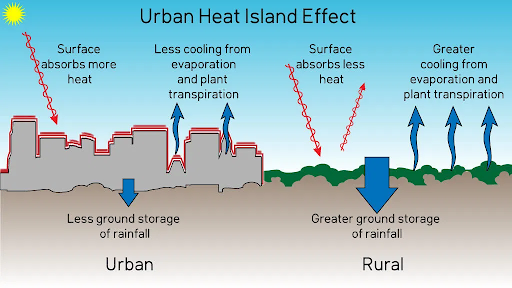
Urban Heat Island (UHI) Effect
Urban Heat Island (UHI) effect is a phenomenon where cities become warmer than surrounding rural areas due to heat-trapping buildings, dark pavement, and a lack of vegetation.
Water Scarcity
Extreme heat accelerates evaporation from water bodies and soil, worsening water stress and impacting its availability for drinking and irrigation.
How is India Preparing to Combat Extreme Heat?
Policy and Governance Framework
Heat Action Plans (HAPs): Mandated by the National Disaster Management Authority (NDMA), require states to implement three core elements: early warning systems, training for healthcare workers, and public awareness campaigns.
India Cooling Action Plan (ICAP): Launched in 2019, ICAP is a globally recognized long-term strategy to provide sustainable cooling.
|
Goal |
Target for 2037-38 |
|
Reduction in Cooling Demand |
20-25% |
|
Reduction in Cooling Energy Requirements |
25-40% |
|
Reduction in Refrigerant Demand |
25-30% |
Judicial Intervention
In the M.K. Ranjitsinh & Ors. vs Union of India & Ors. (2024) case, the Supreme Court declared that the "right to be free from the adverse effects of climate change" is a fundamental right within the Right to Life (Article 21) and the Right to Equality (Article 14).
|
Ahmedabad's Heat Action Plan (HAP) Ahmedabad was the first South Asian city to develop a HAP in 2013. Its successful model is built on four pillars: an early warning system, public awareness campaigns, inter-agency coordination, and capacity building for healthcare workers. It has served as a template for over 100 cities in India. |
Challenges and Implementation Gaps
Implementation Deficiencies
Many HAPs are mere advisories, lacking legal enforceability, adequate funding, and localized context, leading to a gap between planning and execution.
Poor Urban Planning
Unplanned, rapid urbanization, using heat-retaining materials and lacking green spaces, worsens the Urban Heat Island (UHI) effect. Passive cooling is not standard in building codes.
The Cooling Dilemma
Over-reliance on energy-intensive air conditioners strains the power grid and releases potent greenhouse gases like hydrofluorocarbons (HFCs), creating a negative feedback loop.
Way Forward For India
Mandate and Fund HAPs
Transition Heat Action Plans from advisories to legally enforceable, fully-funded mandates for all vulnerable districts, with clear accountability frameworks.
Mainstream Passive Cooling
Integrate and incentivize passive cooling designs (e.g., cool roofs, better ventilation, sustainable materials) into national building codes and urban planning missions like the Smart Cities Mission and AMRUT.
Invest in Green and Blue Infrastructure
Launch a program to increase green cover, protect urban water bodies (lakes, ponds), and create shaded public spaces to combat the UHI effect effectively.
Promote Sustainable Cooling
Invest in R&D and promote the adoption of energy-efficient cooling appliances and non-refrigerant-based technologies, aligning with the goals of ICAP.
Empower Local Bodies
Equip city and district administrations with the financial resources and technical capacity to implement localized heat resilience measures, ensuring community participation to protect the most vulnerable.
Learn from Global Best Practices in Heat Management
|
Strategy |
City |
Details |
|
Green Corridors |
Medellín, Colombia |
A network of 30 "green corridors" (shady routes) connecting parks and waterways. This initiative has reduced local temperatures by up to 4.5°C. |
|
"Policy of Shade" |
Seville, Spain |
Massive installation of street awnings and traditional qanat cooling (1,000-year-old underground water tunnels) to keep public squares walkable. |
|
Blue Infrastructure |
Seoul, South Korea |
The Cheonggyecheon Stream restoration replaced a highway with a 10km waterfront, lowering temperatures by 3.3°C to 5.9°C compared to nearby streets. |
|
Vertical Forests |
Milan, Italy |
High-rise "Bosco Verticale" buildings use thousands of trees on façades to provide natural insulation and reduce wall temperatures by up to 20°C. |
Conclusion
India is experiencing an escalating, year-round national extreme heat crisis, demanding an integrated strategy—combining top-down policy with bottom-up community efforts—to build resilience via stronger heat action plans, urban redesign, and sustainable technology investment.
Source: DOWNTOEARTH
|
PRACTICE QUESTION Q. Explain the factors contributing to the disproportionate impact of extreme heat on Global South countries compared to the Global North. 150 words |
The study projects that if global warming reaches 2°C, 41% of the world's population (3.79 billion people) will face extreme heat by 2050. It identifies developing nations like India, Nigeria, and Indonesia as having the largest exposed populations and notes that severe impacts will be felt even before the 1.5°C warming target is breached.
The Urban Heat Island (UHI) effect is a phenomenon where metropolitan areas are significantly warmer than their surrounding rural areas. It's caused by urban infrastructure like buildings and roads absorbing and retaining heat. It is a major concern for India's rapidly expanding cities as it intensifies heatwaves, increases energy consumption for cooling, and worsens air and water quality.
Heat Action Plans (HAPs) are comprehensive strategies designed to address and mitigate the health impacts of extreme heat. Guided by the National Disaster Management Authority (NDMA), they typically include early warning systems, public awareness campaigns, capacity building for healthcare professionals, and inter-agency coordination to manage heatwaves effectively.


© 2026 iasgyan. All right reserved