The Ramsar Convention is an international treaty adopted in 1971 for the conservation and wise use of wetlands, recognizing their importance for biodiversity, water security, climate regulation, and human livelihoods. Wetlands designated as Ramsar Sites receive global recognition for their ecological value, including support for migratory birds, flood control, groundwater recharge, and carbon storage. In India, the addition of new sites such as Patna Bird Sanctuary in Uttar Pradesh and Chhari-Dhand Wetland in Gujarat reflects the country’s growing commitment to wetland conservation. These designations strengthen scientific management, international cooperation, and sustainable use while balancing ecological protection with community livelihoods.

Copyright infringement not intended
Picture Courtesy: PIB
Context:
Prime Minister, has welcomed the addition of Patna Bird Sanctuary in Etah (Uttar Pradesh) and Chhari-Dhand in Kutch (Gujarat) as Ramsar sites.
|
Must Read: RAMSAR SITES IN INDIA | |
What are Ramsar sites?
Ramsar Sites are wetlands of international importance designated under the Ramsar Convention, an intergovernmental treaty focused on the conservation and wise use of wetlands worldwide.
The convention was adopted in 1971 in the city of Ramsar in Iran.
Under the convention, wetlands include a wide range of ecosystems:
Importance of the Ramsar Convention:
New Ramsar sites of India:
Patna Bird Sanctuary (Uttar Pradesh):
Patna Bird Sanctuary is a freshwater wetland recently added to India’s list of Ramsar Sites
Location: Patna Bird Sanctuary is located in the Etah district of Uttar Pradesh within the fertile Gangetic plains, and it is surrounded by agricultural fields that contrast with its wetland ecosystem.
Habitat Characteristics: The sanctuary consists of freshwater marshes interspersed with grasslands, woodland patches, and seasonal wetlands, creating a diverse mosaic of habitats that support rich biodiversity.
Faunal Diversity: The wetland provides habitat to nearly 178 bird species, including both resident and migratory waterbirds, making it an important stopover and breeding ground along regional migratory routes.
Floral Diversity: With around 252 plant species recorded, the aquatic and semi-aquatic vegetation plays a crucial role in nutrient cycling, water purification, and sustaining the food web of the ecosystem.
International Recognition: The site has been recognised as an Important Bird and Biodiversity Area by Birdlife international, and its ecological importance led to its designation as a Ramsar Site, highlighting its global wetland value.
Ecosystem Services: Beyond biodiversity, the sanctuary helps regulate floods, recharge groundwater, and maintain local climatic balance, while also supporting livelihoods dependent on wetland resources.
Concerns: The wetland faces pressures from agricultural runoff, encroachment, and changing land-use patterns, making sustained conservation management essential to preserve its ecological character.
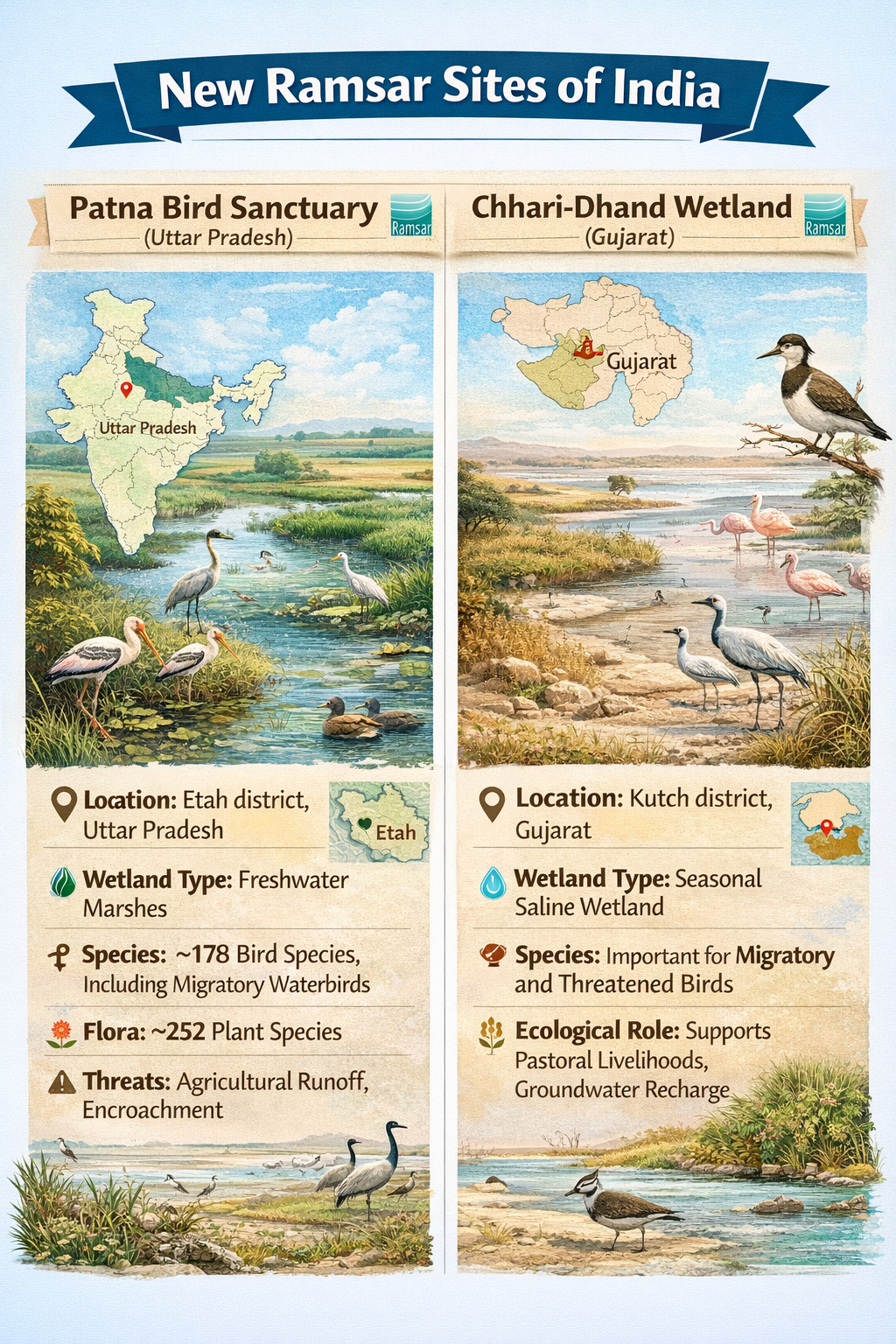
Chhari-Dhand Wetland:
Location: Chhari-Dhand Wetland is located in the Kutch district of Gujarat and lies between the Banni grasslands and the salt flats of the Rann of Kutch, forming part of a unique arid-zone wetland system.
Wetland Type: It is a seasonal saline wetland, meaning that water accumulates during the monsoon and gradually recedes, creating dynamic habitats that change through the year.
Faunal importance: The wetland serves as an important wintering and stopover site for migratory waterbirds along the Central Asian Flyway, supporting large congregations of cranes, flamingos, pelicans, and other waterfowl.
Threatened species: It provides habitat for globally threatened birds such as the sociable lapwing (critically endangered) and the common pochard (vulnerable), underlining its international conservation value.
Ecological Characteristics: The wetland supports saline-tolerant vegetation and aquatic organisms adapted to fluctuating salinity levels, which in turn sustain a rich food web for birds and other wildlife.
Ramsar Significance: Chhari-Dhand has been designated a Ramsar Site because of its importance as a representative saline wetland ecosystem in an arid region and its critical role in supporting migratory and threatened bird species.
Ecosystem Services: Despite its seasonal nature, the wetland contributes to groundwater recharge, supports pastoral livelihoods in surrounding grasslands, and maintains regional ecological balance.
Conclusion:
The recent addition of new Ramsar Sites highlights India’s growing recognition of wetlands as vital ecological assets rather than wastelands, strengthening the country’s commitment to global wetland conservation under the Ramsar Convention. These newly designated wetlands, such as Patna Bird Sanctuary and Chhari-Dhand Wetland, not only support rich biodiversity and migratory bird populations but also provide crucial ecosystem services like flood regulation, groundwater recharge, and climate resilience. Their inclusion in the Ramsar network enhances international cooperation, scientific management, and sustainable use, ensuring that conservation and community livelihoods move forward together.
Source: PIB
|
Practice Question With reference to newly added Ramsar Sites in India, consider the following pairs:
Which of the pairs given above is/are correctly matched? A. 1 and 2 only Answer: A Explanation: Pair 1: Patna Bird Sanctuary — Uttar Pradesh is correct. Pair 2: Chhari-Dhand Wetland — Gujarat is correct Chhari-Dhand Wetland is situated in the Kutch region of Gujarat. It is a seasonal saline wetland between the Banni grasslands and the salt flats of Kutch, and is an important habitat for migratory and threatened bird species. Pair 3: Loktak Lake — Assam is incorrect. |
A Ramsar Site is a wetland designated as being of international importance under the Ramsar Convention, aimed at conserving wetlands and promoting their wise use.
It provides a global framework for wetland conservation, supports biodiversity protection, enhances water security, and helps countries manage wetlands sustainably.
Both natural and human-made wetlands qualify, including marshes, lakes, rivers, mangroves, coral reefs, peatlands, reservoirs, and even rice paddies.




© 2026 iasgyan. All right reserved