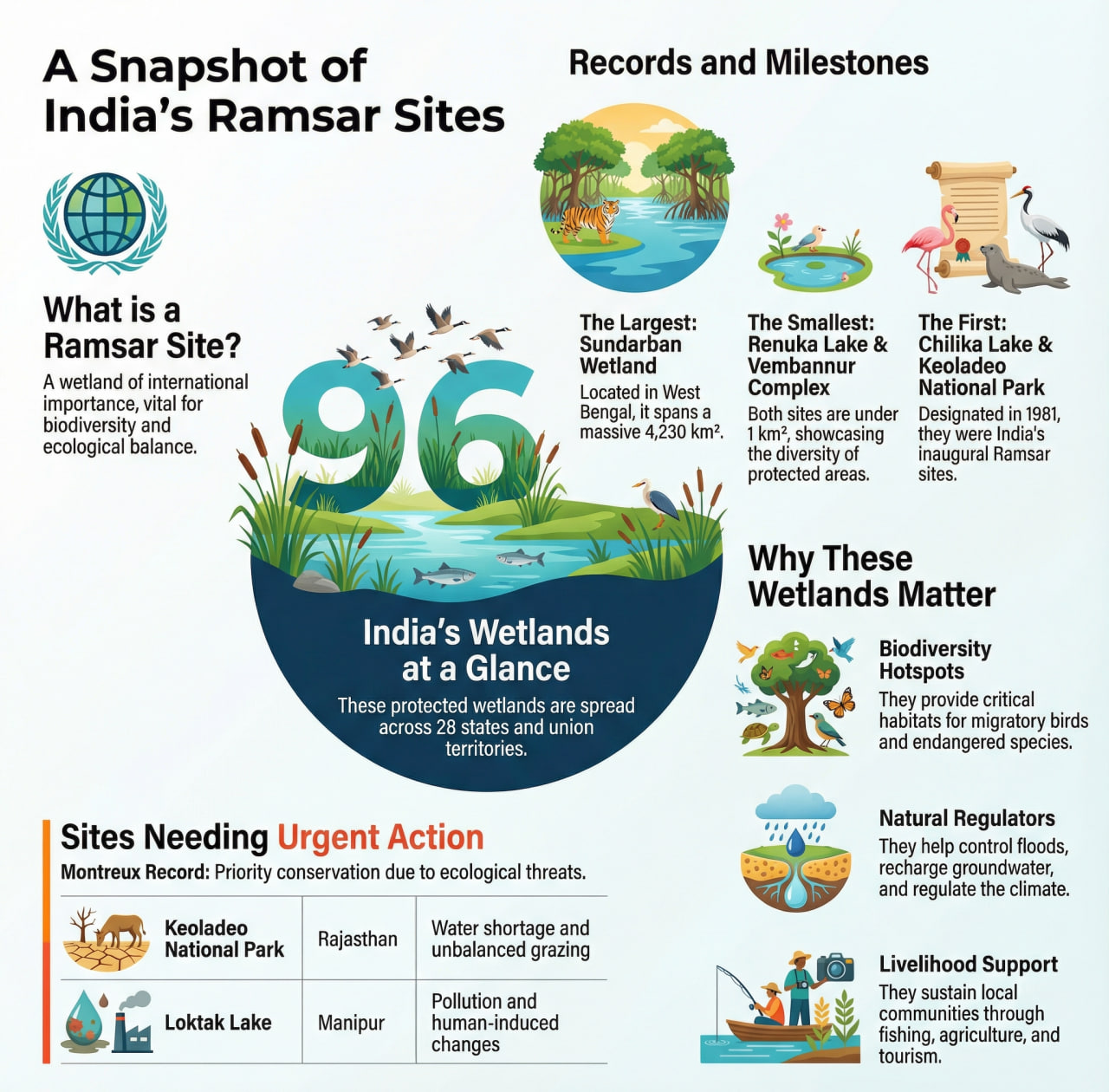
India has expanded its network to 96 Ramsar sites, reinforcing its commitment to wetland conservation. These vital ecosystems provide biodiversity havens, flood control, climate mitigation, and livelihoods. However, they face severe threats from urbanization, pollution, and encroachment.

Copyright infringement not intended
Picture Courtesy: TIMESOFINDIA
India's Ramsar sites now total 96, with the addition of Siliserh Lake (Alwar, Rajasthan) to the List of Wetlands of International Importance.
These sites are designated as 'Wetlands of International Importance' under the Ramsar Convention, an intergovernmental treaty adopted on February 2, 1971, in the Iranian city of Ramsar.
The Convention provides the framework for national action and international cooperation for the conservation and "wise use" of wetlands and their resources.
India became a signatory to the convention on February 1, 1982.
The Ramsar Convention convention defines wetlands as "areas of marsh, fen, peatland or water, whether natural or artificial, permanent or temporary, with water that is static or flowing, fresh, brackish or salt, including areas of marine water the depth of which at low tide does not exceed six metres."
This includes mangroves, coral reefs, rivers, lakes, and even human-made sites like reservoirs and rice paddies.
Total Number of Sites: 96.
State with Most Sites: Tamil Nadu with 20 sites.
First Ramsar Sites in India (designated 1981): Chilika Lake (Odisha) and Keoladeo National Park (Rajasthan).
Largest Ramsar Site in India: Sundarban Wetland (West Bengal), covering 423,000 hectares.
Smallest Ramsar Site in India: Renuka Wetland (Himachal Pradesh), covering just 20 hectares.
 Latest Additions to the Ramsar List
In December 2025, India designated two new wetlands as Ramsar Sites, increasing the total count from 94 to 96. These are:
Two Indian Ramsar Sites are currently listed on the Montreux Record, which highlights wetlands facing or likely to face negative ecological change:
|
Ramsar Site |
State |
Reason for Inclusion |
Year Listed |
|
Keoladeo Ghana National Park |
Rajasthan |
Water shortage and unbalanced grazing |
1990 |
|
Loktak Lake |
Manipur |
Human-induced changes and pollution |
1993 |
Chilika Lake (Odisha) was placed on the Record in 1993 but was removed in 2002 following successful restoration efforts by the Chilika Development Authority, becoming the first site in Asia to be removed from the Record.
Source: TIMESOFINDIA
|
PRACTICE QUESTION Q. Consider the following statements about the latest Ramsar Sites in India:
Which of the statements given above is/are correct? (a) 1 and 2 only (b) 2 and 3 only (c) 1 and 3 only (d) 1, 2 and 3 Answer: B Explanation: Statement 1 is Incorrect: Siliserh Lake is a human-made freshwater lake, not a natural one. Statement 2 is Correct: Kopra Jalashay is a reservoir in Chhattisgarh, located in the Mahanadi River's upper catchments, and designated as a Ramsar site in 2025. Statement 3 is Correct: Tamil Nadu has the highest number of Ramsar sites (20) as of the latest update. |
As of December 2025, India has a total of 96 Ramsar sites.
Tamil Nadu has the highest number of Ramsar sites in India, with a total of 20 sites.
The Montreux Record is a register of Ramsar sites where significant negative ecological changes are occurring. It highlights sites that need priority conservation attention. Currently, two Indian sites are on this record: Keoladeo National Park in Rajasthan and Loktak Lake in Manipur.



© 2026 iasgyan. All right reserved