The appearance of Bactrian camels Galwan and Nubra at the Republic Day Parade reflects their journey from Silk Road trade carriers to strategic assets for the Indian Army in Ladakh. Their revival highlights the value of indigenous biodiversity for heritage, livelihoods, and national security.
Copyright infringement not intended
Picture Courtesy: DOWNTOEARTH
Context
The appearance of two Bactrian camels, named 'Galwan' and 'Nubra', at the Republic Day 2026 Parade highlights their unique place in Indian history and modern-day strategy.
What is Bactrian Camels?
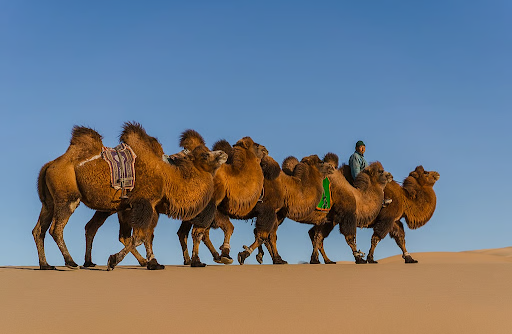
The Bactrian camel (Camelus bactrianus) evolved for the harsh conditions of Central Asia.
In India, its only natural habitat is the Nubra Valley in Ladakh.
Distinctive Feature: They are known for their two humps, which store fat, not water. This fat serves as a vital energy reserve during long, arduous journeys in barren landscapes.
Cold-Weather Adaptation: A long, shaggy coat provides excellent insulation against temperatures that can drop as low as -30°C. They shed this coat in the summer to regulate body temperature.
Survival Skills: They can consume thorny, bitter, and saline plants that other animals avoid. They are also capable of hydrating by eating snow.
Physical Protection: Long eyelashes and a third eyelid shield their eyes from sandstorms, while their wide, padded hooves prevent them from sinking into sand or snow.
|
Domestic vs. Wild Species Domestic Bactrian Camel (Camelus bactrianus): The common variety with roughly 2 million individuals. They are vital "beasts of burden," used for transport, wool, milk, and meat. Wild Bactrian Camel (Camelus ferus): A genetically distinct sister species that was never domesticated. It is Critically Endangered, with fewer than 1,000 remaining in the Gobi Desert of Mongolia and China. |
The "Ship of the Silk Road"
For centuries, Bactrian camels were the backbone of trans-continental trade and cultural exchange between India, Central Asia, and China.
Engine of Trade
As the primary pack animals on the Silk Road, they could carry heavy loads of 180-250 kgs and travel up to 50 kilometers a day. They transported silk, tea, and porcelain from China, and carried spices, textiles, and jade from India.
Conduit for Culture: The most significant cultural transmission facilitated by these camel caravans was the spread of Buddhism from India to Central Asia and China.
Historical Accounts: The journeys of Chinese monks like Faxian (5th Century CE) and Xuanzang (7th Century CE) document the desert crossings made possible only by Bactrian camels.
Contemporary Relevance in India
Economic Revival through Tourism
Tourism in Ladakh has given the Bactrian camel a new economic role. Camel safaris at the Hunder sand dunes of the Nubra Valley are a major tourist draw, directly contributing to the revival of their population, which is now nearly 300.
A Strategic Asset for the Indian Army
The Defence Institute of High-Altitude Research (DIHAR), a DRDO lab in Leh, has identified the strategic potential of these animals.
Source: DOWNTOEARTH
|
PRACTICE QUESTION Q. Consider the following statements regarding the Bactrian camel: 1. They are native to the cold deserts and steppes of Central Asia, such as the Gobi Desert. 2. Unlike dromedary camels, they have two humps used for storing water directly. Which of the statements given above is/are correct? A) 1 only B) 2 only C) Both 1 and 2 D) Neither 1 nor 2 Answer: A Explanation: Statement 1 is correct: Bactrian camels are native to the cold deserts and steppes of Central Asia, including the Gobi Desert. They have specific adaptations, such as a shaggy coat, to survive the extreme temperature variations in these regions, from freezing winters to hot summers. Statement 2 is incorrect: The humps of all camels, including Bactrian camels, store fat, not water. This fat is a source of energy and metabolic water, which helps them survive long periods without food or water. The fat storage in humps (instead of all over the body) also helps them reduce heat loss in cold desert climates. |
Their presence was symbolic, highlighting India's rich biodiversity, their historical connection to the Silk Road, and their contemporary strategic importance as a logistical asset for the Indian Army in the high-altitude regions of Ladakh, including the Galwan and Nubra valleys.
The most visible difference is that the Bactrian camel has two humps, while the Dromedary camel has one. The Bactrian camel is adapted for cold, high-altitude deserts with a shaggy coat, whereas the Dromedary is adapted for hot deserts.
In India, the only natural habitat of the Bactrian camel is the Nubra Valley in Ladakh. Their population has seen a revival primarily due to their use in tourism for camel safaris.





© 2026 iasgyan. All right reserved