The Himalayan cryosphere, Asia’s Third Pole, is melting rapidly due to global warming, threatening water security, increasing GLOFs, and disrupting food, energy, and stability. Despite initiatives like NMSHE, gaps remain. Strong monitoring, regional cooperation, resilient infrastructure, and deep emission cuts are essential.
Copyright infringement not intended
Picture Courtesy: DOWNTOEARTH
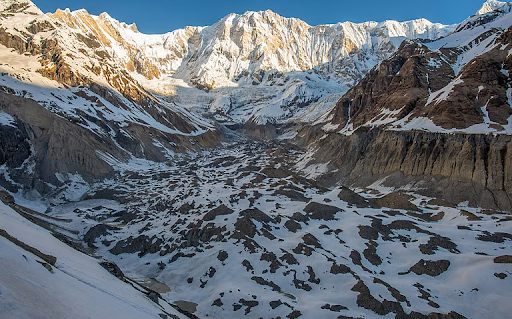
The International Centre for Integrated Mountain Development (ICIMOD) revealed that the Himalayan cryosphere —the vast expanse of snow and ice often called the 'Third Pole'—is shrinking at an alarming rate.
The cryosphere includes all frozen water on Earth. The Hindu Kush Himalaya (HKH) region contains the largest volume of ice outside the polar regions.
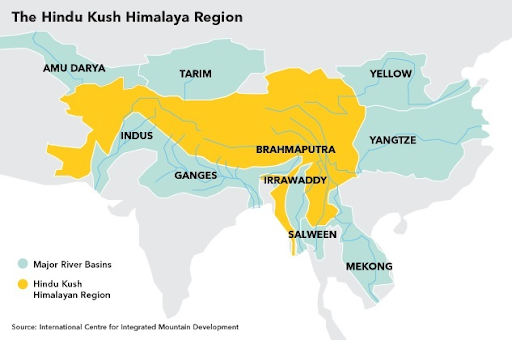
Asia's Water Tower: Himalayan cryosphere is the source of 12 major river systems, including the Indus, Ganga, and Brahmaputra. These rivers supply fresh water to over 1.6 billion people downstream.
Natural Reservoir: Interconnected system of glaciers and snow functions as a natural water reservoir, regulating river flows and guaranteeing continuous water supply through the release of meltwater during the dry pre-monsoon periods.
Extent of Cryosphere Loss
According to the International Centre for Integrated Mountain Development (ICIMOD), the HKH region is warming faster than the global average, leading to "unprecedented and largely irreversible" changes.
Accelerated Glacier Melt: Glaciers in the HKH region disappeared 65% faster in the 2010s compared to the previous decade. On the current trajectory, they could lose up to 80% of their volume by 2100. (Source: ICIMOD)
Vanishing Snow Cover: The region is experiencing more frequent "snow droughts." The winter of 2024-25 saw snow persistence fall to a 23-year low, nearly 24% below normal. (Source: ICIMOD)
Thawing Permafrost: The decline in permanently frozen ground destabilizes mountain slopes, increasing landslide risks and threatening high-altitude infrastructure.
The thawing of the 'Third Pole' creates a cascade of severe environmental, socio-economic, and geopolitical consequences.
Environmental
Increased Frequency of Disasters:
Altered River Flows & 'Peak Water'
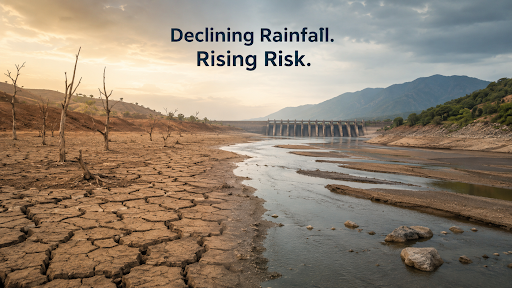
In the short term, river flows increase due to faster melting. However, once 'peak water' is reached, meltwater supply will irreversibly decline, leading to severe water scarcity in dry seasons.
Socio-Economic
Water & Food Insecurity: Threatens irrigation for nearly 1 billion people in the Ganga, Indus, and Brahmaputra basins, impacting crop yields and farmer livelihoods (Source: World Bank).
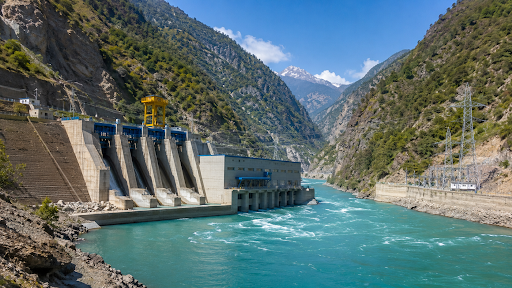
Energy Insecurity: Erratic river flows—initial floods followed by long-term decline—jeopardize the viability of the region's extensive hydropower infrastructure.
Geopolitical
Transboundary Water Tensions: Altered river flows can worsen existing disputes over water sharing among India, China, and Pakistan, turning shared resources into sources of conflict.
|
National Mission for Sustaining the Himalayan Ecosystem (NMSHE) It is a mission under the National Action Plan on Climate Change (NAPCC) to protect the fragile Himalayan region. Coverage and Administration
Key Objectives
|
Data Gaps: Vast, remote, and difficult terrain makes comprehensive, real-time climate and glaciological monitoring extremely challenging.
Lack of Transboundary Cooperation: Effective management of shared rivers requires data-sharing and collaboration with neighboring countries, which is hindered by geopolitical mistrust.
Implementation Deficits: Gap exists between policy formulation and effective on-ground implementation, due to funding and capacity constraints.
Enhance Scientific Monitoring: Invest in high-altitude weather stations and advanced remote sensing technology to improve predictive modeling for disasters like GLOFs.
Strengthen Transboundary Cooperation: Promote 'hydro-diplomacy' with neighboring countries to establish protocols for transparent data sharing on river flows and climate hazards.
Invest in Climate-Resilient Infrastructure: Mandate rigorous climate risk assessments for all new projects (especially hydropower) and retrofit existing structures to withstand extreme events.
Empower Local Communities: Integrate traditional knowledge into adaptation strategies and support community-led initiatives in water conservation and disaster preparedness.
Focus on Mitigation: Aggressive global efforts to cut greenhouse gas emissions and limit warming to 1.5°C are the ultimate solution for preserving the Himalayan cryosphere.
Global Best Practices and Lessons for India
Other mountain regions offer valuable models for adaptation and risk management.
|
Country |
Approach |
Key Learnings |
|
Switzerland |
Employs an integrated hazard management system combining scientific monitoring (GLAMOS network), robust early warning systems, and strategic land-use planning. |
Provides a template for a science-based Disaster Risk Reduction (DRR) framework. |
|
Peru |
Focuses on community-based adaptation by reviving ancient water management systems ('amunas') to capture and store meltwater, blending indigenous knowledge with modern science. |
Highlights the importance of empowering local communities and leveraging traditional ecological knowledge for climate resilience. |
The shrinking Himalayan cryosphere threatens Asia's water, food, and energy security. While immediate relief requires regional adaptation and hydro-diplomacy, the "Third Pole's" long-term survival depends entirely on global climate mitigation.
Source: DOWNTOEARTH
|
PRACTICE QUESTION Q. Discuss the socio-economic implications of 'Snow Droughts' on the downstream riparian states of South Asia. (150 Words) |
The cryosphere refers to the portions of the Earth's surface where water is in a solid, frozen form, including all ice and snow. It is a crucial part of the global climate system, playing a significant role in regulating the planet's temperature, sea levels, and water cycles.
The Himalayan cryosphere is the source of major Indian rivers like the Indus, Ganga, and Brahmaputra. Its loss will disrupt river flows, initially causing floods but eventually leading to a severe decline in water availability during dry seasons. This threatens drinking water, irrigation for agriculture, and the livelihoods of over a billion people.
A GLOF is a type of flash flood that occurs when the dam containing a glacial lake fails. As glaciers melt and retreat, they often leave behind large lakes dammed by unstable moraine (rock and debris). These dams can breach suddenly, releasing huge volumes of water and causing catastrophic downstream flooding, as seen in the 2023 Sikkim disaster.

© 2026 iasgyan. All right reserved