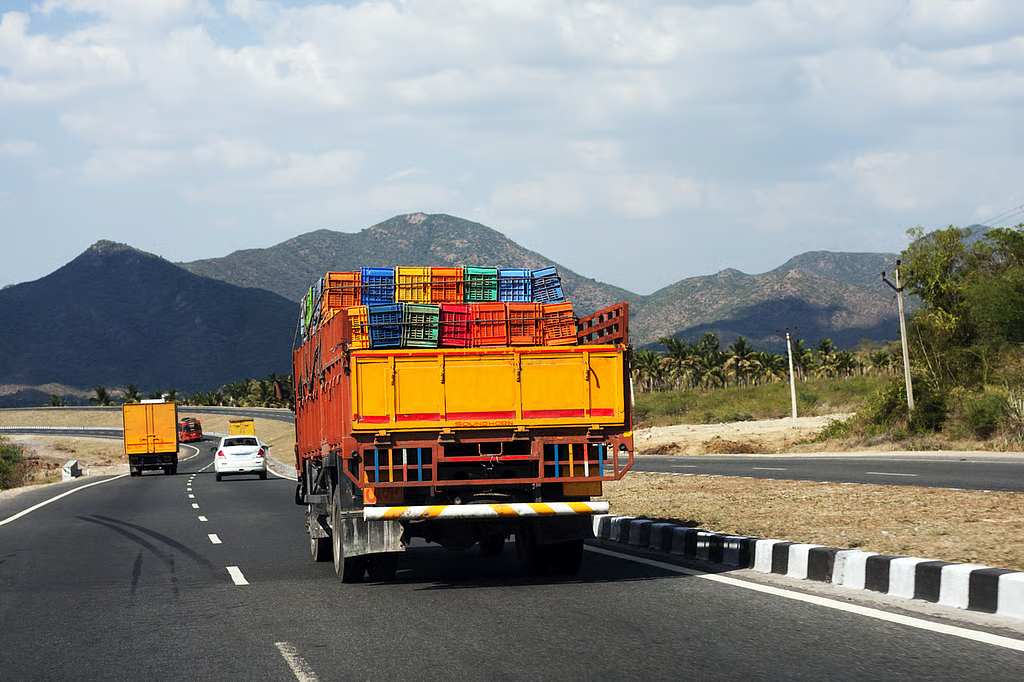
The Sustainable Freight Coalition and TERI warn road freight emissions could rise 400 percent by 2047, as trucks move 71% of cargo. Fragmented operators and weak charging networks hinder reform. Shifting freight to rail corridors and scaling zero emission trucks are crucial for net zero goals.
Copyright infringement not intended
Picture Courtesy: DOWNTOEARTH
A report by the Sustainable Freight Coalition (SFC) and TERI, "Zero Emission Trucking: Pathway to 2047," warns that road freight emissions could increase fivefold by 2047 without a strategic shift, threatening India's Net Zero goal.
Surging Demand: Driven by economic expansion, India’s demand for trucking is projected to increase by 5 times by 2050 compared to 2020 levels. (Source: NITI Aayog)
Emission Explosion: Under a ‘Business-as-Usual’ scenario, CO2 emissions from road freight are projected to increase by nearly 400% by 2047 compared to 2022 levels.
Impact of Heavy-Duty Vehicles (HDVs): Though constituting only about 2% of the total vehicle fleet, HDVs are responsible for over 60% of road freight emissions and 40% of total on-road fuel consumption (Source: NITI Aayog).
Decarbonization Dividend: A swift transition to Zero Emission Trucks (ZETs) could prevent a cumulative 800 million tonnes of CO2 emissions by 2047.
Skewed Modal Mix
India's freight is heavily reliant on road transport (65%), despite rail being a more efficient and less carbon-intensive alternative (27%). (Source: Economic Survey)
High Logistics Cost
The Economic Survey 2022-23 pointed out that logistics costs in India have been in the range of 14-18% of GDP against the global benchmark of 8%.
Energy Security
India's heavy reliance on imported crude oil (over 87%) for its transport sector, particularly heavy-duty trucks, creates economic vulnerability.
Air Pollution & Health
The transport sector is a major contributor to air pollution, accounting for about 14% of India's total energy-related CO2 emissions.
Fragmented Industry: The largely unorganized trucking sector (75% small operators with <5 trucks) struggles to afford expensive ZETs due to lack of capital and finance access.
Technological Hurdles:
Infrastructure Deficit: Lack of charging infrastructure for heavy vehicles along highways. By early 2026, India had over 29,151 public charging stations, but most cater to passenger cars and are located in cities. (Source: Bureau of Energy Efficiency)
Financing Barriers: Financial institutions hesitant to fund ZETs due to concerns over the high upfront cost, uncertain resale value (residual value) of batteries, and the lack of a mature secondary market.
National Logistics Policy (NLP) 2022: A comprehensive policy framework for an efficient, cost-effective, and integrated logistics ecosystem, emphasizing digitization via the Unified Logistics Interface Platform (ULIP).
PM GatiShakti National Master Plan: An integrated infrastructure planning platform to ensure multimodal connectivity, reduce logistical gaps, and promote a shift from road to rail and waterways.
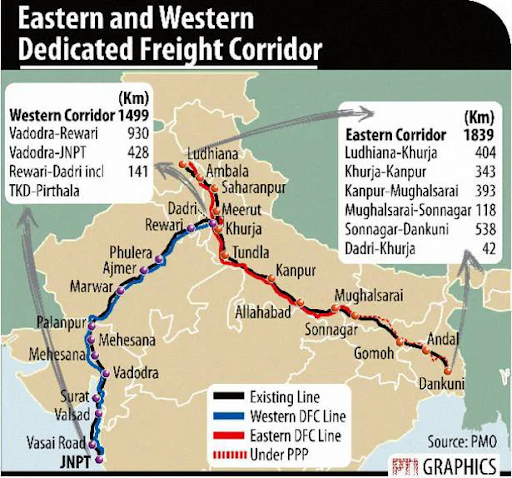
Dedicated Freight Corridors (DFCs): The Eastern and Western DFCs segregate freight and passenger traffic to boost freight train average speed from 25 kmph to 70 kmph, moving cargo from road to rail.
 E-FAST India Initiative: The 'Electric Freight Accelerator for Sustainable Transport – India' is a NITI Aayog-led platform to facilitate stakeholder collaboration for accelerating the deployment of electric freight vehicles.
Implement a ZET Mandate: Introduce a time-bound mandate requiring a certain percentage of new truck sales to be zero-emission, providing a clear roadmap for manufacturers and fleet owners.
Bridge the Financing Gap: Establish a First Loss Default Guarantee (FLDG) fund to encourage banks and NBFCs to lend for ZETs by mitigating their risk. This has been a key recommendation from NITI Aayog.
Develop "Green Freight Corridors": Prioritize the development of high-capacity charging and hydrogen refueling infrastructure along high-density freight routes like the Delhi-Mumbai and Chennai-Bengaluru highways.
Strengthen Scrappage Policy: Provide higher financial incentives and rebates under the Vehicle Scrappage Policy for replacing old diesel trucks with new ZETs, linking pollution control with fleet modernization.
Introduce Differential Tolling: Offer discounted toll charges for ZETs on national highways. This will reduce their operational costs and improve the Total Cost of Ownership (TCO) parity with diesel trucks.
Conclusion
To achieve 'Viksit Bharat @ 2047' and meet climate goals, India must employ a dual-pronged strategy for freight: aggressively shift long-distance transport to Dedicated Freight Corridors ("High Rail") and rapidly transition last-mile/medium-haul road freight to Zero Emission Trucks.
Source: DOWNTOEARTH
|
PRACTICE QUESTION Q. With reference to the Indian freight sector, consider the following statements: 1. Road transport currently accounts for more than 70% of freight movement in India. 2. Rail transport emits approximately 4.5 times more CO2 per ton-km compared to road transport. 3. The "E-FAST India" initiative is spearheaded by NITI Aayog to accelerate the transition to electric freight. Which of the statements given above is/are correct? A) 1 only B) 1 and 3 only C) 2 and 3 only D) 1, 2, and 3 Answer: B Explanation: Statement 1 is correct: Road transport is the dominant mode of freight movement in India, currently accounting for over 70% of the total freight. Statement 2 is incorrect: Rail transport is a "greener" and more fuel-efficient alternative to road transport. Rail's carbon footprint is roughly one-fourth that of road transport, which emits substantially more CO2 per ton-km. Statement 3 is correct: The E-FAST India (Electric Freight Accelerator for Sustainable Transport) initiative was indeed launched by NITI Aayog in collaboration with World Resources Institute (WRI) India to accelerate the adoption of electric trucks and transition to a cleaner freight ecosystem. |
The freight sector is a major concern because emissions from road freight could surge by nearly 400% by 2047. Currently, heavy-duty vehicles contribute 60-70% of tailpipe emissions in the sector, despite being only 2% of the fleet.
Road transport is highly inefficient compared to rail. Road transport emits approximately 4.5 times more CO2 per ton-km than rail transport.
E-FAST India (Electric Freight Accelerator for Sustainable Transport) is a NITI Aayog initiative designed to bring stakeholders together to accelerate the transition to Zero Emission Trucks (ZETs).


© 2026 iasgyan. All right reserved