Kerala’s decision to waive ₹18.75 crore in loans for Wayanad landslide survivors signals a shift toward financial rehabilitation. It addresses post-disaster debt traps, contrasts State welfare with rigid national frameworks, and highlights the need for catastrophe insurance and reforms to strengthen disaster justice and recovery systems.
Copyright infringement not intended
Picture Courtesy: DOWNTOEARTH
Context
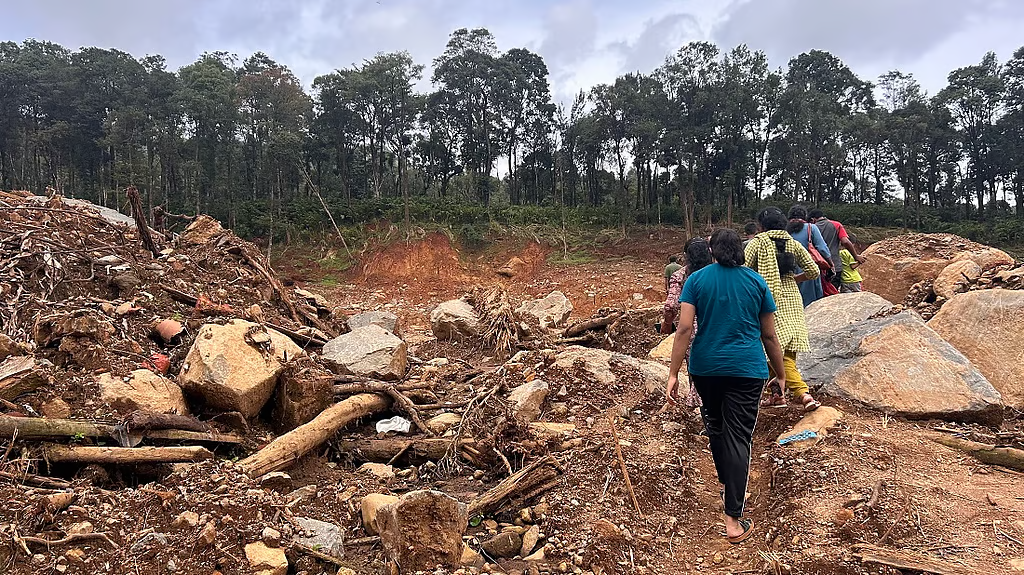
The Kerala State Cabinet has set a precedent for disaster justice by deciding to take over and repay the private bank loans of the survivors of the July 2024 Wayanad Landslide.
What is Disaster Justice?
Disaster Justice reframes disasters as "socio-natural" events, arguing that a hazard becomes a disaster because of pre-existing social inequalities.
Shift in Perspective: It moves the focus from "Acts of God" to failures in policy and planning that expose vulnerable communities to risk. Safety is viewed as a human right, not a privilege.
Core Principles: It integrates three core principles of justice into the disaster management cycle:
Structure of Disaster Injustice
Inequality is not just a side effect of disasters; it is built into every stage of the disaster cycle, from who is forced into high-risk zones to who is allowed to rebuild first.
Pre-Disaster: The Inequality of Exposure
Geography of Class & Caste: The urban poor are often forced to live in high-risk zones like floodplains or unstable slopes.
Policy Failures: Ignoring scientific warnings for economic reasons increases vulnerability.
Asset Vulnerability: While wealthier households can afford to retrofit homes to modern safety standards, low-income families often live in "light material" (wood, bamboo) housing that is inherently less resilient.
The Insurance Gap: Access to financial safety nets like national flood insurance is often a privilege of those with documented land titles and surplus income.
During Crisis: The Inequality of Survival
Digital Divide in Warnings: Smartphone-based early warning systems fail to reach 51.6% of rural women aged 15 and above who lack mobile phones, resulting in gendered mortality disparities. (Source: GSMA Mobile Gender Gap Report).
Forced Exposure: Low-income workers often lack the mobility capacity to evacuate quickly, as they may lack private vehicles or be forced to remain mobile to maintain their daily livelihoods.
Exclusion of Persons with Disabilities (PwD): During the 2020 Assam floods, reports highlighted that PwDs were left behind due to a lack of accessible boats and shelters, exposing that evacuation infrastructure is rarely disability-friendly.
Institutional Bias: Government response sometimes prioritizes affluent areas for rescue and utility restoration, leaving marginalized zones neglected.
Post-Disaster: The Inequality of Recovery
The Compensation Trap: Relief and compensation often require proof of land ownership, excluding tenant farmers, slum dwellers, and forest communities who lack formal titles.
The "Build Back Better" Paradox: Reconstruction projects often displace the poor to urban peripheries, severing them from their livelihoods.
Poverty Traps: Wealthier households often "bounce back" by using savings, whereas the poor may be pushed into a cycle of losses, spending their last savings on basic survival instead of rebuilding.
Displacement as "Reorganization": In some cases, discriminatory rebuilding policies prevent low-income residents from returning to their original neighborhoods, effectively using the disaster to permanently displace marginalized populations.
Key Case Studies of Disaster Injustice
|
Case Study |
Context |
Injustice Highlighted |
|
Bhopal Gas Tragedy (1984 - Present) |
The world's worst industrial disaster. |
Chronic & Restorative Injustice: 40 years on, victims face multi-generational health issues and await adequate compensation. |
|
Delhi Floods (2023) |
Breaching of the Yamuna river banks. |
Distributive Injustice: Thousands of families living on the "illegal" floodplains lost their homes and received delayed and inadequate relief compared to formal, registered colonies. |
|
Wayanad Landslides (2024) |
landslides in the Western Ghats. |
Policy & Ecological Injustice: The disaster was a direct result of policy decisions that diluted the recommendations of the Madhav Gadgil Committee Report, prioritizing economic interests over ecological safety. |
Systemic Drivers of Disaster Injustice
Technocratic Governance
Policymakers often view disasters as engineering problems (e.g., building higher flood walls) instead of addressing the root social issues like poverty and exclusion.
Erosion of Local Democracy
District Disaster Management Authorities (DDMAs) are led by bureaucrats, often sidelining elected local bodies (Gram Panchayats) who possess local knowledge about vulnerabilities.
Global Climate Injustice
Developing nations like India bear the severe impacts of climate change caused by the historical emissions of developed nations.
Way Forward
Amend the Disaster Management Act, 2005: Include statutory provisions for "Post-Disaster Financial Protection" to create a national framework for debt relief.
Create a Catastrophe Insurance Pool: As recommended by the 15th Finance Commission, this would shift the financial burden from the state exchequer to a structured insurance mechanism.
RBI Mandate: The Reserve Bank of India (RBI) should formulate guidelines for "Disaster-Stressed Assets" to ensure banks automatically implement relief measures like interest waivers.
Learn lesson from Kerala's Model of Disaster Justice
Conclusion
Kerala's disaster management sets a precedent for recovery through physical and economic rehabilitation, necessitating a national policy to integrate financial protection and free survivors from debt and debris.
Source: DOWNTOEARTH
|
PRACTICE QUESTION Q. "Disaster management in India has traditionally focused on physical reconstruction, ignoring the 'financial residue' of calamities." Discuss. 150 words |
It refers to the Kerala Government's approach of treating debt relief as a social protection right rather than charity. Unlike traditional models that focus only on physical needs (food/shelter), this model uses state funds (CMDRF) to pay off private debts of survivors to prevent long-term economic ruin.
This term describes the situation where survivors suffer twice: first, from the physical event (landslide, loss of loved ones/homes), and second, from the financial trauma of banks issuing recovery notices and legal threats for loans on assets that no longer exist.
Disaster management is handled through a three-tier institutional structure mandated by the Disaster Management Act, 2005:

© 2026 iasgyan. All right reserved