A recent study finds India facing the world’s worst livability limits from extreme heat, especially in the Indo-Gangetic Plain. Vulnerable groups, agriculture, and construction suffer most. Weakly implemented Heat Action Plans need stronger funding, climate-resilient infrastructure, and focused protection for vulnerable populations.
Copyright infringement not intended
Picture Courtesy: DOWNTOEARTH
A study published in the “Environmental Research: Health 2026” highlights that India loses more person-hours of activity to extreme heat than any other nation.
The study measures 'livability limitation,' which is the restriction on safe physical activity due to extreme heat.
Disproportionate Impact on India
India faces the world's highest livability limitations, leading to an estimated annual loss of 101 billion person-hours for younger adults and 1.1 trillion for older adults.
Vulnerability of the Elderly
Older adults are more susceptible to heat stress due to less efficient sweating. Globally, they now face severe activity limitations for about 900 hours a year, up from 600 hours in the 1950s.
Regional Hotspots
'Unlivable' conditions, unsafe even for resting outdoors, plague the Indo-Gangetic Plain and eastern lowlands. Less severe effects are noted in elevated areas like the Western Ghats and Himalayan foothills.
Exacerbating Inequality
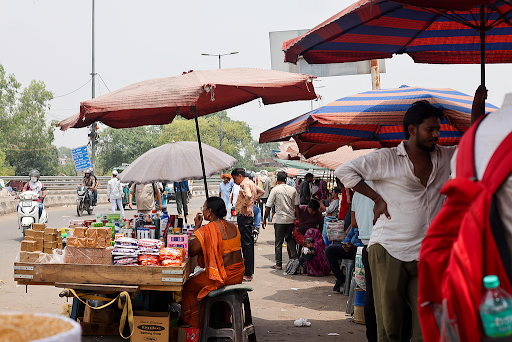
Heatwaves disproportionately affect the poor, who cannot afford adaptive measures like air conditioning. Outdoor laborers must risk their health or lose income.
Labour Productivity
Heat stress directly impairs work capacity. India is projected to lose up to 5.8% of its working hours in 2030 due to heat, equivalent to 34 million full-time jobs. The construction and agricultural sectors are the worst affected. (Source: ILO)
Agriculture
This sector, employing nearly 46% of India's workforce, is highly vulnerable. A 1°C temperature rise can reduce a farmer's income by 6.2% (Kharif) and 6% (Rabi). (Source: Economic Survey)
Public Health
Heat-related illnesses (heatstroke, exhaustion) strain the public health system. A 2021 study estimated that deaths due to heatwaves in India increased by 55% between the periods 2000-2004 and 2017-2021. (Source: The Lancet)
Energy & Water
Surging demand for cooling during heatwaves pressures the electricity grid, leading to power outages. High temperatures accelerate evaporation, worsening water scarcity for both agriculture and drinking purposes.
Mainstream Heat Action into Planning
Integrate heat resilience into all governance levels, from national policies like NAPCC to local urban and rural development plans. Shift from a reactive disaster response to proactive risk reduction.
Invest in Climate-Resilient Infrastructure
Prioritize investments in passive cooling solutions for buildings, green spaces to counter the UHI effect, and resilient power and water grids. Scale up the "cool roofs" initiative nationally.
Strengthen Public Health Systems
Enhance the capacity of the healthcare system to manage heat-related illnesses by training medical professionals and equipping primary health centres with essential supplies like ORS and ice packs.
Protect the Most Vulnerable
Design targeted interventions, including access to public cooling centres, social security for workers who lose wages, and redesigning work schedules in high-risk sectors like construction.
Promote Data-Driven Policy
Invest in research on the local impacts of heat, and establish a robust data collection mechanism for heat-related morbidity and mortality to enable effective and evidence-based policymaking.
Learn Lessons from Global Best Practices
|
Country |
Key Initiative |
Lesson for India |
|
Singapore |
Integrates extensive green infrastructure (parks, vertical gardens) into urban planning to mitigate the Urban Heat Island (UHI) effect under its "City in Nature" vision. |
Incorporate green infrastructure mandates into urban schemes like the Smart Cities Mission. |
|
Australia |
Operates advanced, multi-day heatwave forecasts linked directly to specific public health advisories and response protocols. |
Enhance India's early warning systems by integrating meteorological data with real-time health surveillance. |
|
Qatar |
Implemented mandatory work-hour restrictions for outdoor labourers during peak summer heat and mandated the use of cooling technologies. |
Create a legal framework for occupational safety and health that explicitly includes protection from heat stress for workers. |
Extreme heat demands a proactive, integrated approach with robust governance and resilient infrastructure to protect vulnerable populations, safeguard public health, ensure economic stability, and achieve sustainable development goals.
Source: DOWNTOEARTH
|
PRACTICE QUESTION Q. Consider the following statements regarding the criteria for declaring a heatwave in India: 1. For plains, a heatwave is declared when the maximum temperature is at least 40°C. 2. For hilly regions, a heatwave is declared when the maximum temperature is at least 35°C. 3. A "Severe Heatwave" is declared if the departure from normal temperature is more than 6.4°C. Which of the statements given above is/are correct? A) 1 and 2 only B) 1 and 3 only C) 3 only D) 1, 2, and 3 Answer: B Explanation: Statement 1 is correct: According to the India Meteorological Department (IMD), a heatwave is not considered until the maximum temperature of a station reaches at least 40°C for plains. Statement 2 is incorrect: For hilly regions, the threshold for declaring a heatwave is a maximum temperature of at least 30°C, not 35°C. Statement 3 is correct: A "Severe Heatwave" is declared based on the departure from normal temperature when that departure is more than 6.4°C. |
A Heatwave is a condition of air temperature which becomes fatal to the human body when exposed. It is defined based on temperature thresholds over a region: for Plains, the maximum temperature must reach at least 40°C, and for Hilly regions, at least 30°C.
A Heat Action Plan (HAP) is a comprehensive strategy developed by cities or states to prepare for and respond to extreme heat events. A model HAP, like Ahmedabad's, typically includes building public awareness, implementing an early warning system, training healthcare professionals, and promoting adaptive measures like cool roofs.
The Urban Heat Island (UHI) effect is a phenomenon where urban areas are significantly warmer than their surrounding rural areas due to human activities and infrastructure that absorbs and re-emits the sun's heat. It can be mitigated through urban planning that incorporates green infrastructure, such as parks, vertical gardens, and cool roofs.

© 2026 iasgyan. All right reserved