Oyster reefs are vital "ecosystem engineers" for India’s climate resilience, providing storm buffering and carbon sequestration. Protecting them from illegal mining through CRZ-1A status and ICZM integration is essential to secure coastlines and boost the Blue Economy.
A study in Nature reveals that designing artificial oyster habitats based on their natural structural arrangements improves oyster larval survival and predator protection compared to random designs.
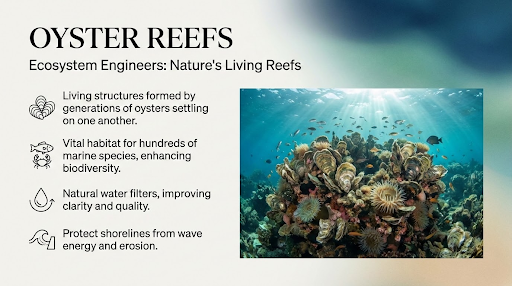
An oyster reef is a dense, natural structure formed by clusters of oysters growing on top of one another.
Formation: Oysters are bivalve mollusks. Their larvae (spat) attach to hard surfaces (rocks or old shells) and grow. Over generations, they fuse together to form massive, calcium carbonate-rich 3D structures.
Keystone Species: Just as corals are the engineers of tropical seas, oysters are the "ecosystem engineers" of estuaries and brackish waters.
Water Filtration
Coastal Defense
Carbon Sequestration
Habitat Creation
Key Locations
The Threat - "Lime Burning"
In many parts of India (e.g., Andhra Pradesh, Tamil Nadu), oyster shells are mined unsustainably and burnt to produce lime (chuna) for industrial use and whitewashing. This destroys the reef structure permanently.
|
Feature |
Coral Reefs |
Oyster Reefs |
|
Water Type |
Clear, warm, saline tropical waters |
Turbid, brackish water (estuaries/creeks) |
|
Light Requirement |
High (for symbiotic algae/zooxanthellae) |
Low (they are filter feeders, not photosynthetic) |
|
Salinity Tolerance |
Stenohaline (narrow range) |
Euryhaline (wide range; can tolerate fresh water influx) |
|
Primary Threat |
Ocean Warming (Bleaching) |
Overharvesting (Lime mining) & Siltation |
Source: SCIENCEDAILY
|
PRACTICE QUESTION Q. Consider the following statements regarding Oyster Reefs:
Which of the statements given above is/are correct? A) 1 only B) 1 and 2 only C) 1 and 3 only D) 1, 2 and 3 Answer: C Explanation: Statement 1 is correct: Oyster reefs are widely recognized as "ecosystem engineers" because they form dense, three-dimensional structures that create habitats, provide shelter, and serve as nurseries for many other marine species, including fish, crabs, and shrimp. Statement 2 is incorrect: While calcification (shell formation) releases CO2, many studies show that oyster reefs can function as net carbon sinks in the long term, especially when factoring in the burial of organic carbon and their role in facilitating the growth of other habitats (like salt marshes) that store carbon. Statement 3 is correct: In India and elsewhere, oyster reefs have historically been, and continue to be, threatened by harvesting for food and the mining of oyster shells for lime production. |
Oyster reefs are massive, three-dimensional biological structures formed in estuaries and brackish waters. They are created by bivalve mollusks (oysters) that attach to hard surfaces and fuse together over generations using extracted calcium carbonate.
The ORWaP is a conservation initiative driven by the National Centre for Sustainable Coastal Management (NCSCM) under the MoEFCC. Its goal is to identify, map, and restore degraded oyster ecosystems across Indian estuaries.
While corals require clear, warm, highly saline (stenohaline) waters and rely on sunlight for their symbiotic algae, oysters thrive in turbid, brackish waters. Oysters are euryhaline (tolerate wide salinity fluctuations) and, being filter feeders, do not require sunlight to survive.



© 2026 iasgyan. All right reserved