The Lipulekh Pass controversy is a territorial dispute between India and Nepal over the Kalapani region, rooted in the ambiguous 1816 Treaty of Sugauli. Driven by cartographic inconsistencies and strategic interests, it requires urgent, evidence-based diplomatic resolution.
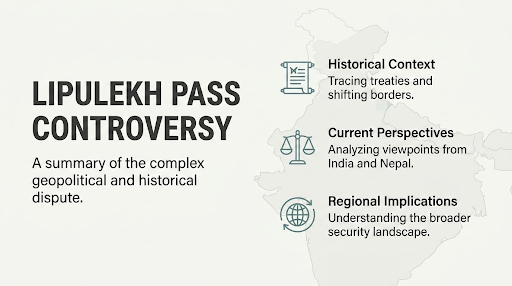
The Lipulekh Pass dispute escalated as India rejected Nepal's protests over resuming the Kailash Mansarovar Yatra through this strategic Uttarakhand crossing.
Location: The Lipulekh Pass is a high-altitude mountain pass (approx. 5,334 meters) located in the western Himalayas.
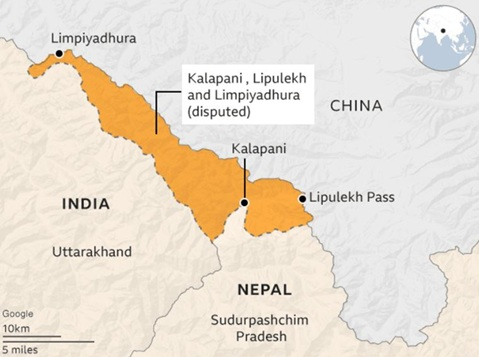
Historically, it has been a vital trans-Himalayan route for barter trade between India's Kumaon region and Tibet (Taklakot/Purang).
It is the traditional and most direct overland route for the sacred Kailash Mansarovar Yatra.
The conflict arises from colonial-era cartographic inconsistencies.
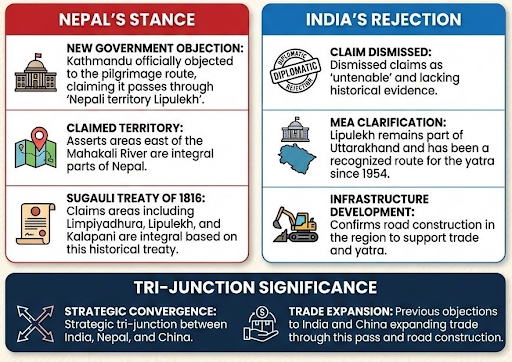
Core Dispute: India vs Nepal
Nepal’s Claim: Nepal asserts that the Kali River originates at Limpiyadhura (northwest of Lipulekh).
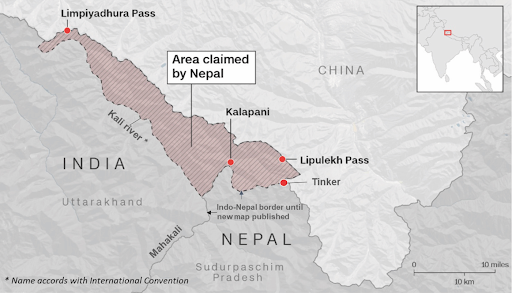
India’s Claim: River originates from springs near Kalapani village / Pankhagad, placing the area within Uttarakhand's Pithoragarh district.
China Factor
Source: TIMESOFINDIA
|
PRACTICE QUESTION Q. The Kalapani territorial dispute is primarily a point of contention between which two countries? (a) India and China (b) India and Nepal (c) Nepal and China (d) India and Bhutan Answer: b Explanation: The Kalapani territorial dispute revolves around the Kalapani, Lipulekh, and Limpiyadhura regions, both India and Nepal claiming sovereignty based on historical treaties and maps. |
The controversy is a territorial dispute between India and Nepal over the Kalapani-Lipulekh-Limpiyadhura tri-junction area. It stems from ambiguous colonial-era maps and the 1816 Treaty of Sugauli regarding the true geographical origin of the Kali River.
Lipulekh is a high-altitude pass connecting India and China for border trade and the Kailash Mansarovar Yatra. It also holds massive strategic importance, allowing Indian forces to monitor Chinese military movements and protect access routes into Uttarakhand.
China considers Lipulekh (which it calls Qiangla Pass) a traditional bilateral border pass with India for trade and pilgrimage. Beijing views the Kalapani territorial dispute as strictly a bilateral issue between India and Nepal and has refused to mediate or take sides.



© 2026 iasgyan. All right reserved