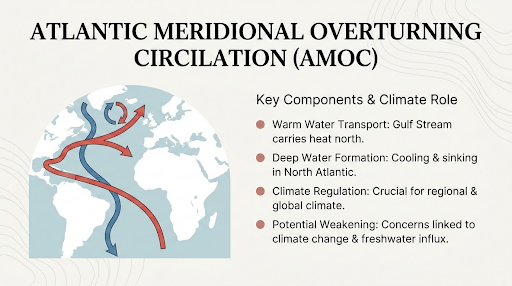
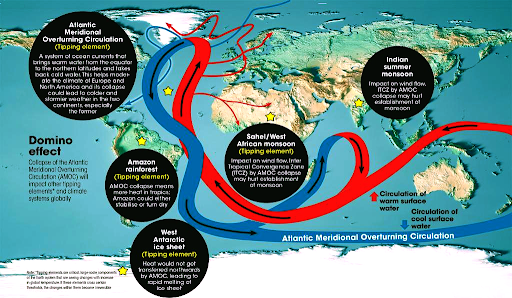
AMOC is a global "conveyor belt" transporting warm surface water north and cold, dense water south. Driven by temperature and salinity, it regulates global climate. Melting ice now threatens to collapse this system, potentially disrupting the Indian Monsoon.
Researchers from Utrecht University are exploring a dam across the Bering Strait to block fresh water inflow and stabilize the weakening Atlantic Meridional Overturning Circulation (AMOC)
The AMOC is an ocean current system that moves warm tropical surface water northward and returns cold, deep water from the North Atlantic toward the equator.
Mechanism
Indian Ocean’s Role: Rapid warming in the Indian Ocean increases local rainfall, drawing air from the Atlantic and reducing its precipitation.
The primary culprit is Global Warming, which is disrupting the delicate salinity balance of the North Atlantic.
Implications of AMOC Collapse
Global Impacts
Impact on India
A collapse of AMOC would have a "teleconnection" effect on the Indian Monsoon, primarily by shifting the Inter-Tropical Convergence Zone (ITCZ) southward.
Historical Precedent: The Younger Dryas Event
About 12,900 years ago, a massive glacial lake (Lake Agassiz) burst, flooding the North Atlantic with fresh water.
Source: DOWNTOEARTH
|
PRACTICE QUESTION Q. Consider the following statements regarding the Atlantic Meridional Overturning Circulation (AMOC): 1. It continuously transports warm, salty surface waters from the northern latitudes to the tropics. 2. The influx of fresh water from melting polar ice sheets increases the density of surface water, accelerating the AMOC. Which of the statements given above is/are correct? a) 1 only b) 2 only c) Both 1 and 2 d) Neither 1 nor 2 Answer: d Explanation: Statement 1 is incorrect: The AMOC transports warm, salty surface waters from the tropics/equator towards the northern latitudes/pole (not from northern latitudes to the tropics). Statement 2 is incorrect: The influx of fresh water from melting polar ice sheets decreases (not increases) the density of surface water, which inhibits the sinking process and causes the AMOC to weaken or slow down (not accelerate). |
The AMOC (Atlantic Meridional Overturning Circulation) is a massive system of ocean currents driven by differences in temperature and salt content (thermohaline circulation). It acts as a global conveyor belt, transporting warm surface water from the tropics to the North Atlantic, where it cools, sinks, and flows southward.
Global warming accelerates the melting of polar ice sheets, such as the Greenland ice sheet. This dumps massive amounts of fresh, less dense water into the North Atlantic. This freshwater prevents the surface water from sinking (downwelling), choking the circulation and slowing down the AMOC.
The AMOC helps regulate the global climate and maintains the normal position of the Intertropical Convergence Zone (ITCZ). A weakening or collapse of the AMOC would force the ITCZ southward, which would severely weaken the Indian Summer Monsoon, leading to droughts and agricultural crises.



© 2026 iasgyan. All right reserved