The Indian Ocean Dipole (IOD), often called the "Indian Niño," is a climate pattern caused by sea-surface temperature differences between the western and eastern tropical Indian Ocean. It influences rainfall, droughts, and monsoons across Africa, Asia, and Australia.
A developing Positive Indian Ocean Dipole (IOD) is expected to act as a buffer against the drying effects of a lingering El Niño during the 2026 monsoon season.
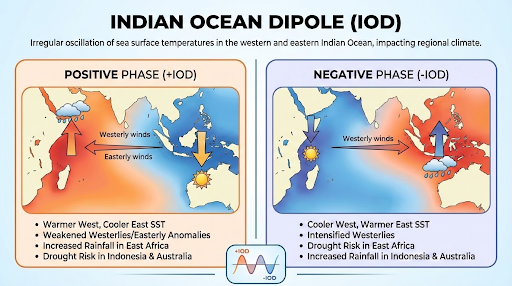
It is an ocean-atmosphere phenomenon characterized by an oscillation in sea-surface temperatures (SST) between the western Indian Ocean (near East Africa) and the eastern Indian Ocean (near Indonesia).
It is often called the "Indian Niño" because it mirrors the Pacific’s El Niño but occurs within the Indian Ocean basin. It develops during the boreal summer (June–August) and peaks in September–November.
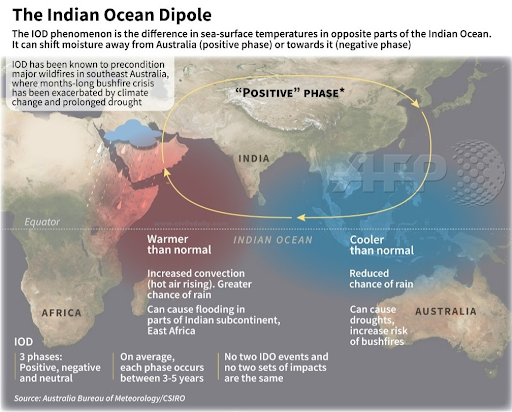
The Three Phases of IOD
The IOD is measured using the Dipole Mode Index (DMI), which tracks the temperature gradient between the western and eastern poles.
|
Phase |
Description |
Impact on India |
|
Positive (+IOD) |
West is Warmer; East is Cooler. |
Higher Rainfall: Enhances the Indian Monsoon; can offset El Niño’s negative effects. |
|
Negative (-IOD) |
West is Cooler; East is Warmer. |
Deficit Rainfall: Suppresses the Indian Monsoon; can exacerbate El Niño-related droughts. |
|
Neutral |
Little to no temperature contrast. |
Normal Conditions: Monsoon follows standard climatological patterns. |
The Science: Air-Sea Coupling
The IOD is driven by coupled ocean-atmosphere interactions:
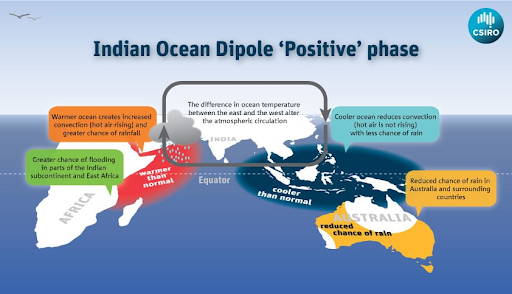
The Reinforcer: A Positive IOD strengthens the monsoon winds and moisture feed, leading to above-normal rainfall. In 2019, an extremely strong Positive IOD resulted in India’s surplus rainfall despite a weak El Niño.
The Dampener: A Negative IOD reduces the moisture available to the Indian landmass, leading to "break" periods in the monsoon.
The Balancing Act: The combined state of ENSO and IOD determines the season's fate. A "Super El Niño" (Pacific warming) can be partially neutralized by a "Strong Positive IOD" (Indian Ocean warming in the west).
Socio-Economic and Ecological Consequences
Agriculture: IOD dictates cropping outcomes for millions. Floods in East Africa and droughts in Australia/Indonesia are classic markers of a Positive IOD phase.
Blue Economy: SST shifts change plankton distribution, affecting fisheries and marine productivity (Source: National Institute of Oceanography, India).
Disasters: Extreme IOD events are linked to severe bushfires (Australia, 2019) and devastating floods.
The IPCC warns that climate change will likely intensify extreme Positive IOD events. With the Western Indian Ocean warming rapidly, severe droughts and floods are becoming the "new normal" for regional nations.
Source: THEHINDUBUSINESSLINE
|
PRACTICE QUESTION Q. Consider the following statements regarding the Indian Ocean Dipole (IOD): 1. A Positive IOD occurs when the eastern Indian Ocean becomes warmer than the western Indian Ocean. 2. A Positive IOD boosts rainfall during the Indian Southwest Monsoon. Which of the statements given above is/are correct? a) 1 only b) 2 only c) Both 1 and 2 d) Neither 1 nor 2 Answer: b) 2 only Explanation: Statement 1 is incorrect: A Positive Indian Ocean Dipole (IOD) occurs when the western Indian Ocean (near the Arabian Sea) becomes warmer than the eastern Indian Ocean (near Indonesia). The statement incorrectly claims the eastern side becomes warmer. Statement 2 is correct: A Positive IOD typically boosts or strengthens the Indian Southwest Monsoon by enhancing moisture transport and convection toward the Indian subcontinent. It is also known to counteract the drying effects of El Niño. |
The IOD is an oceanic phenomenon involving the difference in sea-surface temperatures between the western and eastern parts of the Indian Ocean. A positive IOD features a warmer western Indian Ocean, which generally boosts India's monsoon rainfall, while a negative IOD does the opposite.
El Niño causes anomalous warming in the equatorial Pacific Ocean, disrupting the Walker Circulation. This creates high pressure over the Indian Ocean, which suppresses cloud formation and weakens moisture-laden winds, often leading to rainfall deficits in the Indian subcontinent.
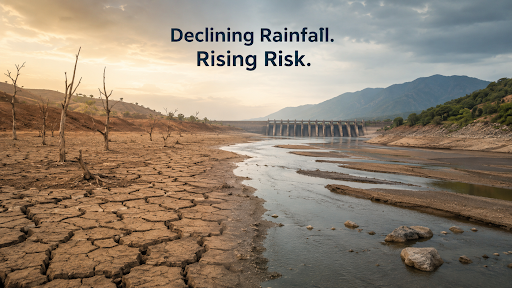
Erratic monsoons severely impact the Indian economy by reducing agricultural output, which triggers food inflation (especially in cereals and pulses). It also causes critical water scarcity in reservoirs, threatening drinking water supplies, reducing hydroelectric power generation, and accelerating rural-to-urban distress migration.


© 2026 iasgyan. All right reserved