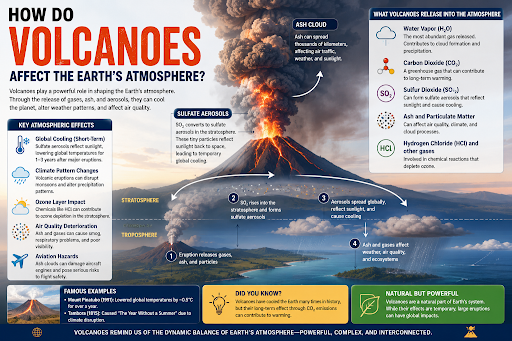
Volcanic eruptions impact Earth's climate by injecting sulfur dioxide and water vapor into the stratosphere. While sulfur aerosols cause global cooling and ozone depletion, human carbon emissions still vastly outpace the natural greenhouse gases released by volcanoes.
Scientists discovered that the 2022 Tonga eruption sent methane into the stratosphere, where ash catalyzed its conversion into formaldehyde, offering insights for global warming mitigation.
Volcanoes act as active vents that release molten rock (magma or lava), volcanic ash, and trapped gases from the Earth's interior into the atmosphere.
They emit primordial gases from the mantle, assimilated crustal constituents, and groundwater.
They release gases continuously through a process called passive degassing, even during non-eruptive, dormant phases, which chemically alters the surrounding soil and water.
They serve as major sources of natural emissions, though human activities currently emit roughly 80 to 270 times more carbon dioxide (CO2) annually than all global volcanoes combined.
Magma ascends toward the surface, causing pressure to drop; this forces dissolved volatile components to exsolve and form rapidly expanding gas bubbles.
Rapid gas expansion violently shatters the viscous magma into fine particles, driving the explosive upward motion of the eruption.
Eruptions inject massive plumes into the stratosphere, consisting of over 60% water vapor (H2O), high concentrations of carbon dioxide (CO2), sulfur dioxide (SO2), and hydrogen sulfide (H2S).
Explosions eject solid tephra (rock fragments) and trigger destructive secondary disasters, such as fast-moving lahars (mudflows containing 40-90% volcanic ash and water) that instantly bury surrounding lowlands.
Global Cooling (Volcanic Winter): Emitted sulfur dioxide turns into stratospheric sulfate aerosols, which reflect sunlight and cool the Earth for several years.
Ozone Layer Depletion: Sulfate aerosols provide a surface that accelerates chemical reactions between human-made CFCs and volcanic halogens, destroying the ozone layer.
Methane Destruction: Volcanic ash mixed with salty seawater and sunlight releases reactive chlorine, which breaks down atmospheric methane and creates formaldehyde.
Radiative Heating Shifts: Underwater eruptions inject massive amounts of water vapor into the middle atmosphere, which traps heat and alters global thermal balances and wind patterns.
Acid Rain and Air Pollution: Volcanic gases dissolve to form acid rain, while ground-level emissions create toxic volcanic smog (vog) and hazardous pools of carbon dioxide.
Examples of Volcanic Impacts on Climate
|
Volcanic Eruption |
Year |
Climate & Atmospheric Impacts |
|
Mount Pinatubo (Philippines) |
1991 |
Injected 20 million tons of SO2 into the stratosphere; reduced global surface temperatures by 0.5 °C for three years; exacerbated global ozone depletion. |
|
Hunga Tonga-Hunga Ha'apai |
2022 |
Injected 146 Tg of water vapor into the stratosphere; fundamentally altered global radiative fluxes; released reactive chlorine that destroyed massive amounts of atmospheric methane. |
|
Mount Tambora (Indonesia) |
1815 |
Lowered global temperatures by up to 3 °C; directly triggered the catastrophic "Year Without a Summer" in 1816 across the Northern Hemisphere. |
|
Laki Fissure (Iceland) |
1783–1784 |
Released 120 million tons of SO2; caused regional cooling across Europe and North America. |
|
Samalas |
1257 |
Produced the single largest sulfur injection of the Common Era; reduced Northern Hemisphere peak temperatures by 1.3 K. |
|
Youngest Toba Tuff |
74,000 BCE |
Triggered a massive 1,500-year cooling period (Greenland Stadial 20); caused a severe population bottleneck in early human species. |
Source: THEHINDU
|
PRACTICE QUESTION Q. Consider the following statements regarding different types of volcanoes:
Which of the statements given above is/are correct? (a) 2 only (b) 1 and 2 only (c) 1 and 3 only (d) 2 and 3 only Answer: A Explanation: Statement 1 is incorrect: While shield volcanoes are the largest of all volcanoes on Earth, they are primarily composed of fluid, low-viscosity basaltic lava rather than highly viscous andesitic lava. Statement 2 is correct: Composite volcanoes (stratovolcanoes) are characterized by their tall, steep, conical shapes formed by alternating layers of hardened lava, volcanic ash, cinders, and tephra. They are known for highly explosive and violent eruptions. Statement 3 is incorrect: This statement describes the features of shield volcanoes, not cinder cones. Cinder cones are actually relatively small, steep-sided cones built entirely from blobs of congealed lava (cinders) ejected from a single vent. In contrast, it is fluid lava sheets that spread over vast distances to build shield volcanoes. |
A volcanic winter is a reduction in global temperatures that occurs when an explosive eruption injects huge amounts of sulfur dioxide into the stratosphere. This gas converts to sulfuric acid droplets (sulfate aerosols), which rapidly increase the Earth's albedo by reflecting incoming solar radiation back into space.
Volcanic sulfate aerosols provide a chemical surface in the stratosphere. These surfaces accelerate reactions that—when combined with human-made chlorofluorocarbons (CFCs) and injected volcanic halogens—increase the abundance of highly reactive chlorine monoxide, which actively destroys the ozone layer.
Lahars are giant, fast-moving mudflows composed of 40-90% volcanic ash, rock, and water. As observed after the Mount Pinatubo eruption, they cascade down slopes at extreme speeds, burying surrounding lowlands, destroying infrastructure, and posing a severe threat for years after the initial eruption.

© 2026 iasgyan. All right reserved