A recent Western Disturbance brought snowfall to the Himalayas and rain to northern plains, aiding Rabi crops and water security but causing warmer nights, poor air quality, and transport disruptions. The episode shows climate-linked weather variability, highlighting the need for better forecasting, air quality management, and climate-resilient planning.
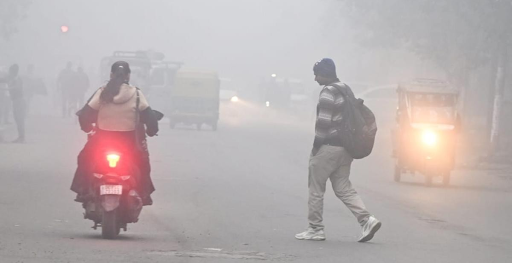
Copyright infringement not intended
Picture Courtesy: THE HINDU
Context
A powerful Western Disturbance is causing Himalayan snowfall, temperature shifts on the North Indian plains, and poor air quality in Delhi.
What are Western Disturbances (WDs)?
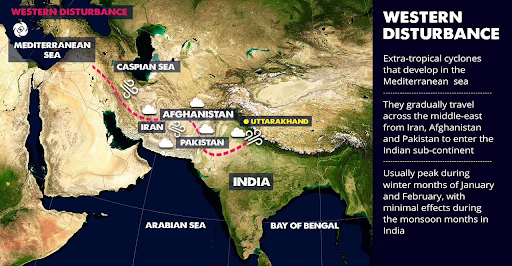
Western Disturbances (WDs) are extratropical storms originating in the Mediterranean region that travel to the Indian subcontinent via the subtropical westerly jet stream.
Meteorological Impacts of the WD
Precipitation & Water Security
Temperature & Visibility
Extreme Weather Events
Climate Change Variations
Deteriorating Air Quality
Calm winds and high humidity, before a Western Disturbance, trap local vehicular and industrial pollutants, worsening Delhi's Air Quality Index (AQI) to the 'poor' category.
Way Forward For India
Enhance Early Warning Systems
Better preparedness under the Disaster Management Act, 2005 requires investing in advanced Doppler radars and weather modeling to improve heavy precipitation forecast accuracy.
Adopt Integrated Air Quality Management
Shift from reactive measures like Graded Response Action Plan (GRAP) to a sustained, year-round strategy addressing root causes like emissions and stubble burning through interstate coordination.
Promote Climate-Resilient Agriculture
Promote resilient crop varieties; strengthen Pradhan Mantri Fasal Bima Yojana (PMFBY) to shield farmers from weather losses.
Ensure Sustainable Himalayan Development
Himalayan infrastructure must factor in climate risks, aligning with the Ravi Chopra Committee's recommendations for balancing development and ecology.
Learn Lessons from Global Practices
Conclusion
The recent weather events in North India highlight the urgent need for a cohesive policy framework to strengthen forecasting, manage air quality, and build agricultural climate resilience, to ensure a sustainable future.
Source: THE HINDU
|
PRACTICE QUESTION Q. The term 'Chillai-Kalan', often seen in the news, refers to: (a) A traditional harvest festival in Himachal Pradesh. (b) The harshest 40-day period of winter in Kashmir. (c) A specific type of wind pattern in the Thar desert. (d) A government scheme for managing snowfall on national highways. Answer: (b) Explanation: Chillai-Kalan is a Persian term meaning "major cold". It refers to the most severe phase of winter in the Kashmir Valley, which begins on December 21 and concludes on January 30 or 31 each year. |
A Western Disturbance is an extratropical storm originating in the Mediterranean region. It is a low-pressure system that travels eastward, propelled by the subtropical westerly jet stream, gathering moisture along the way. When it reaches the Himalayas, it releases this moisture as rain in the northern plains and snow in the mountains, primarily during the winter season.
Climate change, particularly the rapid warming of the Arctic (Arctic Amplification), is making Western Disturbances more erratic. It is causing them to become more frequent in summer, less predictable in winter, and is shifting precipitation from gentle, prolonged spells to short-duration, high-intensity events, leading to cycles of long dry spells and sudden downpours.
Arctic Amplification is the phenomenon where the Arctic region is warming two to three times faster than the global average. This reduces the temperature difference between the poles and the tropics, which in turn weakens and slows down the jet stream. Since the jet stream steers Western Disturbances, its wavier and slower path directly influences the track, intensity, and timing of WDs reaching India.

© 2026 iasgyan. All right reserved