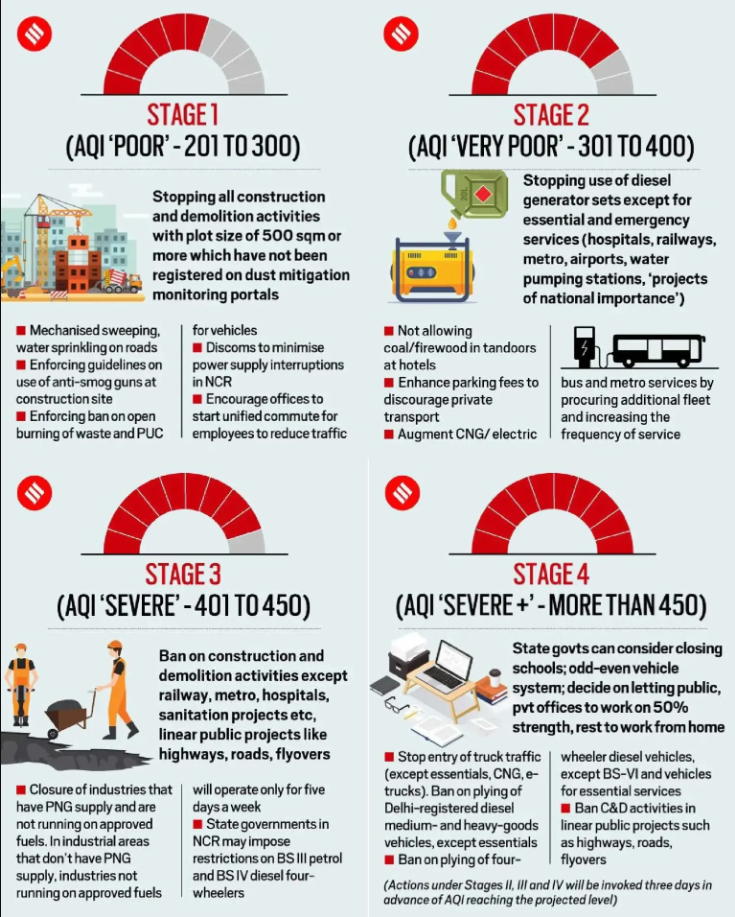
The Graded Response Action Plan (GRAP) is a rule-based emergency framework for Delhi–NCR that links Air Quality Index (AQI) levels with pre-defined pollution control measures. With air quality currently in the severe to severe+ category, GRAP-IV has been activated to curb emissions and reduce public exposure. While effective in managing short-term pollution spikes, the situation highlights the need for long-term structural solutions to address recurring air quality crises.

Copyright infringement not intended
Picture Courtesy: Down to Earth
|
Must Read: GRAP | |
|
Aspect |
Air Quality Index (AQI) |
Graded Response Action Plan (GRAP) |
|
Basic Meaning |
AQI is a scientific indicator that reflects the current status of ambient air quality by converting pollutant concentrations into a single, easy-to-understand value. |
GRAP is a policy-driven action framework that translates worsening air quality conditions into mandatory regulatory and administrative responses. |
|
Primary Purpose |
Its purpose is to inform citizens, policymakers, and health agencies about how polluted the air is at a given time and the associated health risks. |
Its purpose is to control and prevent further deterioration of air quality by prescribing timely interventions once pollution crosses critical thresholds. |
|
Nature of Functioning |
AQI functions as a diagnostic and monitoring tool, continuously tracking pollution levels across monitoring stations. |
GRAP functions as a corrective and preventive mechanism, activated in stages as pollution severity increases. |
|
Basis of Operation |
AQI is calculated using real-time data on pollutants such as PM₂.₅, PM₁₀, NO₂, SO₂, CO and O₃. |
GRAP relies on AQI categories to trigger pre-defined actions, ensuring responses are rule-based rather than ad-hoc. |
|
Geographical Scope |
AQI is applied nationwide across cities and regions in India for public information and health advisories. |
GRAP is region-specific, designed exclusively for Delhi and the National Capital Region (NCR) due to its recurrent pollution episodes. |
|
Stages / Levels |
AQI is divided into categories such as Good, Satisfactory, Poor, Very Poor, Severe and Severe+, indicating rising health risk. |
GRAP is divided into four cumulative stages (I to IV), each corresponding to worsening AQI categories. |
|
Role in Decision-Making |
AQI provides the evidence base, highlighting the severity and trend of pollution. |
GRAP provides the decision pathway, outlining what authorities must do at each pollution level. |
|
Outcome for Citizens |
AQI primarily results in health advisories and awareness, guiding individual behaviour such as reducing outdoor exposure. |
GRAP directly affects daily life by restricting activities like construction, vehicular movement, office functioning and school operations. |
|
Overall Relationship |
AQI acts as the signal and warning system for air pollution. |
GRAP acts as the institutional response, converting warnings into concrete action. |
|
Practice Question With reference to the Graded Response Action Plan (GRAP), consider the following statements: 1. GRAP is a rule-based framework that prescribes emergency actions based on Air Quality Index (AQI) levels. 2. Measures under GRAP are cumulative, meaning actions from earlier stages continue to apply in higher stages. 3. GRAP is implemented uniformly across all major cities of India experiencing severe air pollution. Which of the statements given above is/are correct? A. 1 only Answer: B Explanation: |
The primary objective of GRAP is to prevent further deterioration of air quality in Delhi–NCR by enforcing pre-defined emergency measures when pollution crosses critical AQI thresholds.
GRAP is implemented under the supervision of the Commission for Air Quality Management (CAQM), and its directions are binding on the governments of Delhi and NCR states.
Delhi–NCR experiences recurrent and severe air pollution episodes due to a combination of high emissions and unfavourable meteorology, making a region-specific emergency framework necessary.



© 2026 iasgyan. All right reserved