Global sand demand has surged fivefold, driving illegal extraction by organized sand mafias. This "green crime" causes severe ecological degradation, groundwater depletion, and socio-economic conflicts. Sustainable alternatives like Manufactured Sand (M-Sand) and robust international legal frameworks are urgently needed.
According to a United Nations Environment Programme (UNEP) report on Sand and Sustainability, global sand demand increased fivefold between 1970 and 2020, creating environmental and public health crises.
|
Read all about: ILLEGAL SAND MINING IN INDIA l RIVER SAND MINING |
What are the Highlights of the United Nations Environment Programme (UNEP) Report?
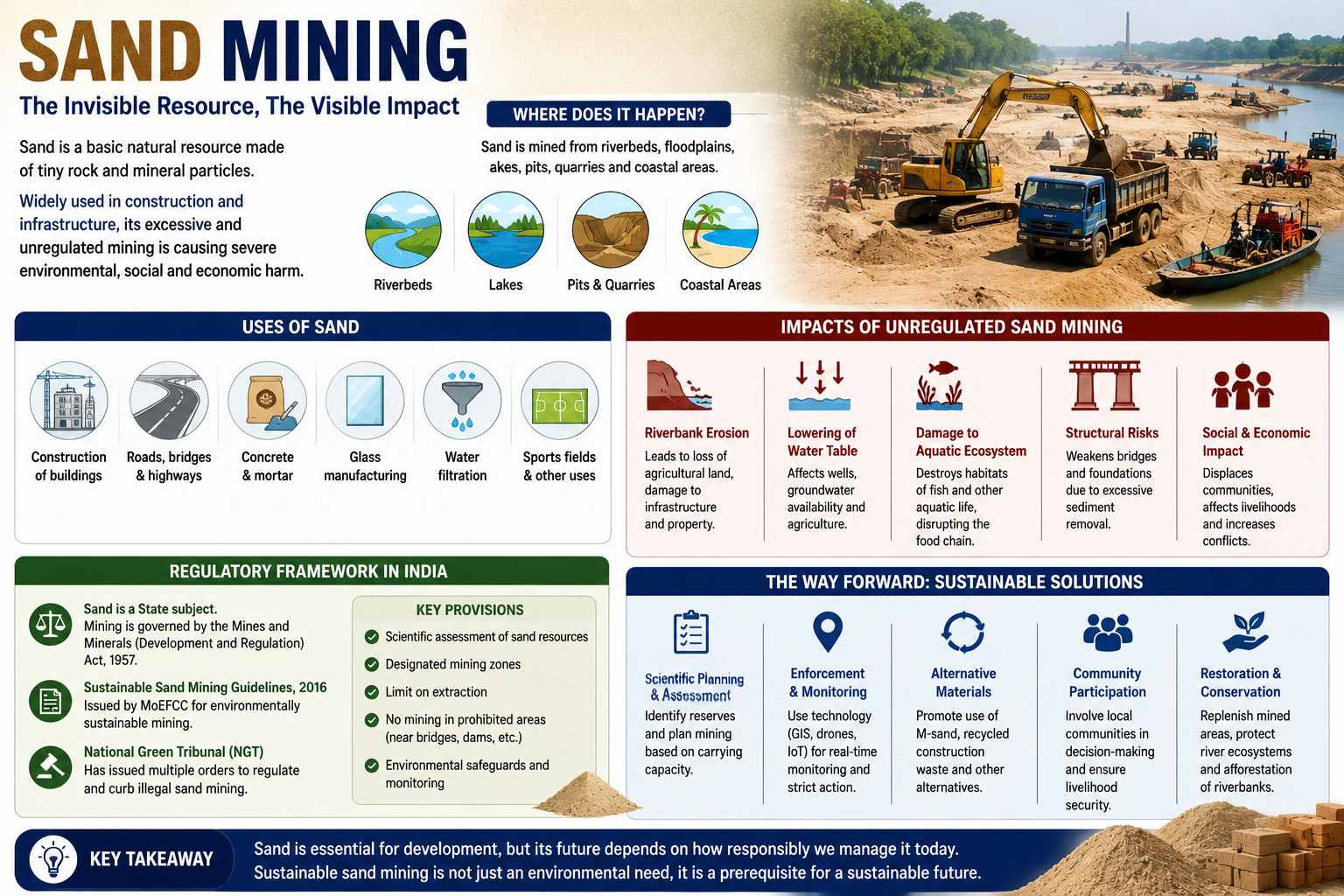
Sand mining involves the physical extraction of sand and gravel from natural environments—such as rivers, coastlines, and marine ecosystems—to supply crucial materials for global infrastructure, construction, and climate adaptation projects.
Demand & Market Scale
Global sand demand surges fivefold from 9.6 billion tonnes in 1970 to approximately 50 billion tonnes in 2020, and grows at a 3.2% average annual rate.
Forecasts warn the building sector's sand demand rises by 45% by 2060.
Primary Drivers
Global population exploded from 3 billion in 1960 to 8.2 billion in 2025, projecting toward 9.6 billion by 2050.
Rapid urbanisation drives nearly 45% of the global population into cities by 2025.
Material-intensive lifestyles expand the average built-up area per person from 43 square metres in 1975 to 63 square metres in 2025.
Ecological & Economic Value
Healthy sandy ecosystems directly support the food security of approximately 2.3 billion people who rely on small-scale fisheries.
Coastal tourism attracts more than 750 million visitors annually, generates over US $1.5 trillion, and sustains millions of jobs.
Extraction Impacts
Uncontrolled extraction damages marine ecosystems, alters natural river flows, erodes beaches, lowers groundwater levels, and destroys aquatic habitats.
Coastal mining removes natural buffers, which directly increases vulnerability to floods, storms, and sea-level rise.
Public Health Crises
Airborne sand dust causes respiratory illnesses, while workers exposed to silica face high risks of incurable silicosis.
Abandoned mining pits collect stagnant water and breed malaria-carrying mosquitoes.
Strategic Solutions
Governments must legally classify sand as a strategic resource to balance development and sustainability, rather than treating it as an unlimited commodity.
Policymakers need to implement 24 strategic actions to improve sand governance, promote recycling and circularity, and integrate biodiversity protection into planning.
The challenge is not merely reducing sand extraction, but ensuring that developmental needs are aligned with ecological sustainability through responsible governance and innovation.
Source: DOWNTOEARTH
|
PRACTICE QUESTION Q. Examine the cascading ecological and geomorphological impacts of excessive river sand mining. 150 words |
Desert sand grains are wind-smoothed and rounded, which makes them non-adherent and completely unusable for industrial concrete. The construction industry requires sand with angular edges that lock together, which is primarily found in rivers, coastlines, and seabeds.
Excessive river sand mining leads to severe water quality degradation, catastrophic riverbank collapse, and groundwater depletion because it removes the permeable sand layers that allow aquifers to recharge. It also causes massive biodiversity loss by destroying aquatic habitats and altering thermal regimes in rivers.
Manufactured sand is an aggregate material (less than 4 mm) processed from crushed rock or gravel. It is an essential, sustainable alternative to natural river sand because its cubical shape and rough texture provide a strong bond in cement concrete, helping to reduce the environmental degradation caused by excessive river mining.


© 2026 iasgyan. All right reserved