Sand mining in the Chambal Sanctuary destroying vital sandbar habitats and pushing the gharial and Ganges river dolphin toward extinction.
Sand mining is the process of extraction of sand and gravel from natural environments such as riverbeds, beaches, lakes, and inland dunes.
It serves as a foundational resource for the construction industry, providing essential ingredients for concrete, mortar, and asphalt.
The material is also vital for industrial applications, including glass manufacturing, electronics production, and coastal land reclamation.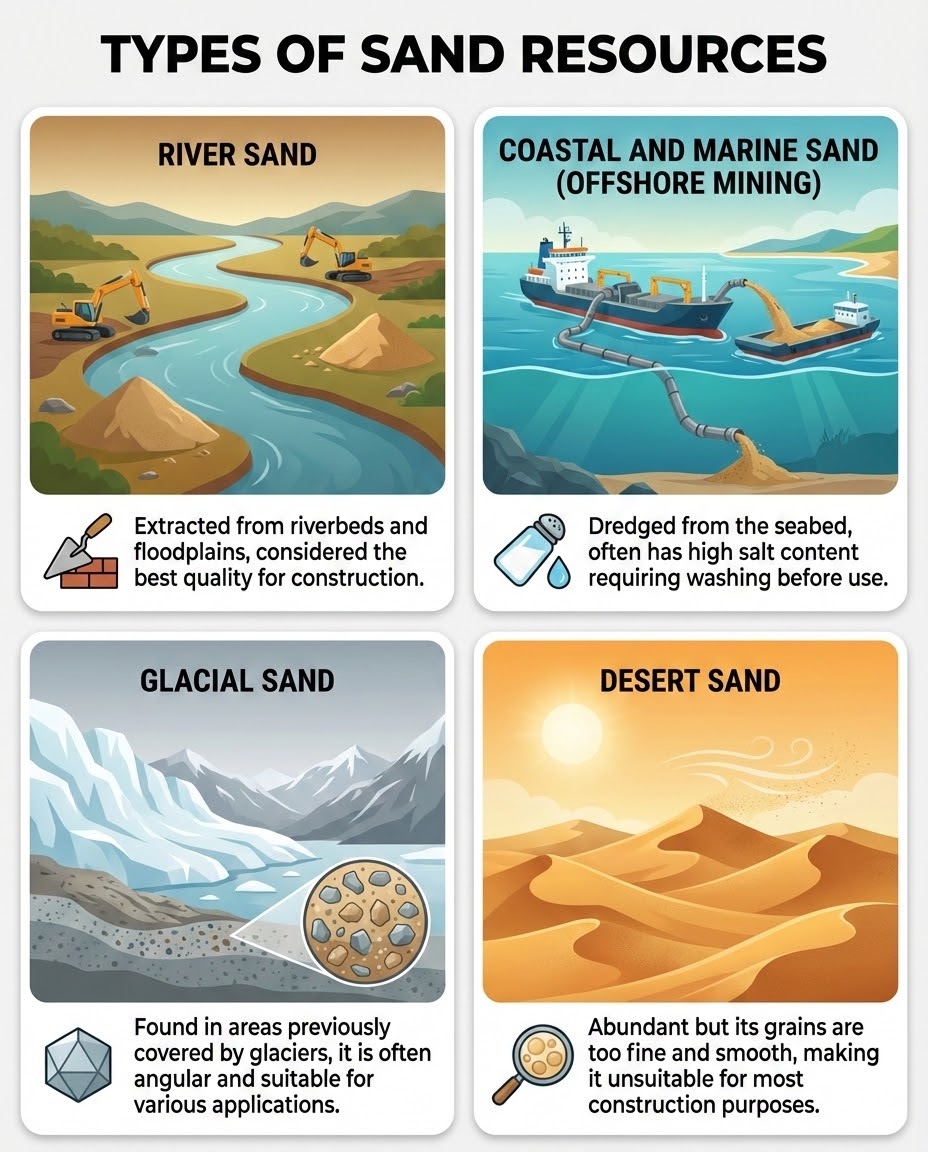
Sand mining in India is regulated through a multi-layered framework involving Central Acts, Environmental Guidelines, and State-specific rules.
Constitutional and Legislative Framework
Classification as Minor Mineral: Under Section 3(e) of the Mines and Minerals (Development and Regulation) Act, 1957 (MMDR Act), sand is classified as a "minor mineral".
State Jurisdiction: Section 15 of the MMDR Act empowers State Governments to frame rules for granting mineral concessions (leases/permits) and collecting royalties for minor minerals.
Prevention of Illegal Mining: Section 23C empower states to frame rules to curb illegal mining, transportation, and storage.
Environmental Clearance & Mandates
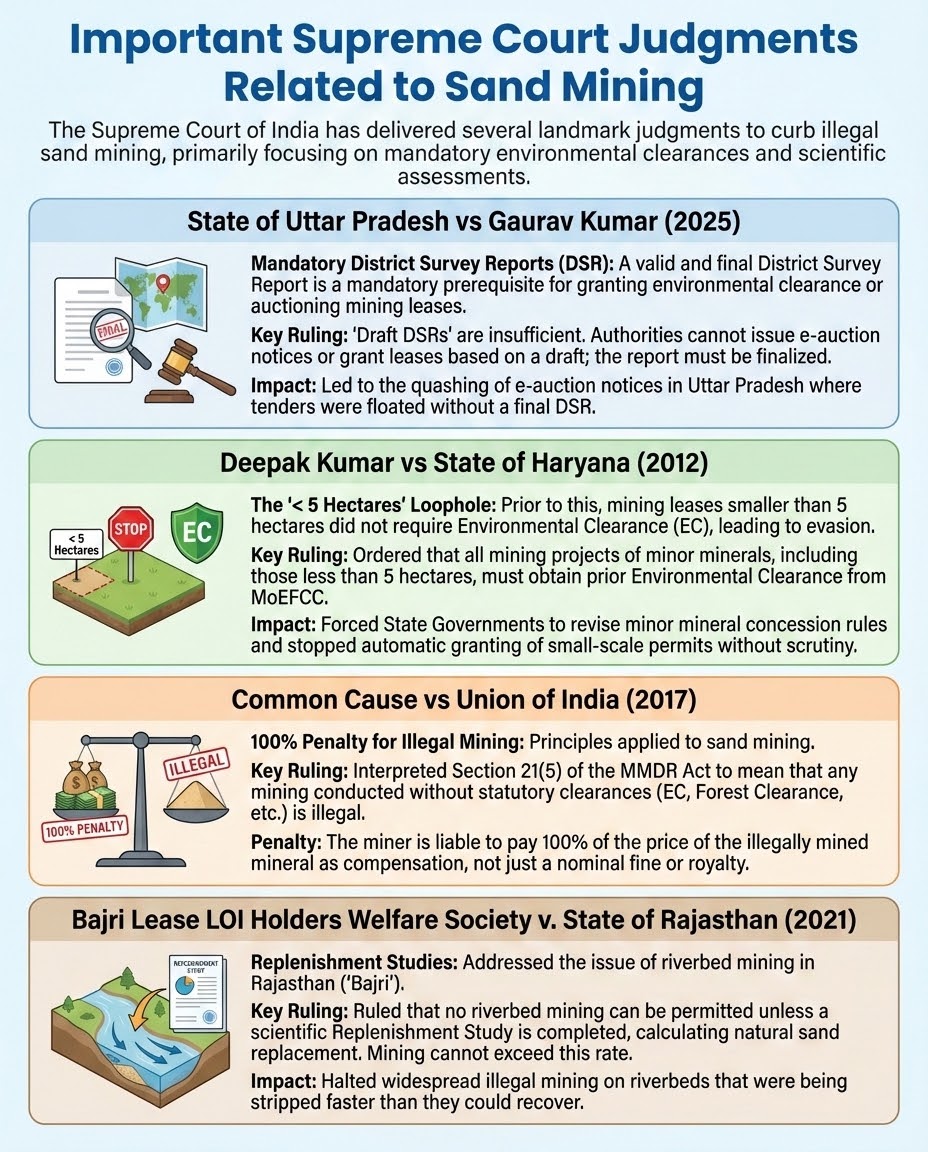
Mandatory Environmental Clearance (EC): Asper the 2012 Supreme Court ruling in Deepak Kumar vs State of Haryana, Environmental Clearance is strictly required for every sand mining project, including those under 5 hectares.
Environmental Impact Assessment (EIA) Notification 2006: Governs the process of granting EC, requiring assessing authorities (like SEIAA - State Environment Impact Assessment Authority) to evaluate the potential ecological damage before approval.
Regulatory Bodies & Enforcement
State Pollution Control Boards (SPCB): Monitor compliance with air and water pollution standards under the Air Act (1981) and Water Act (1974).
National Green Tribunal (NGT): Actively intervenes to ban mining activities that lack valid clearances or violate replenishment norms.
District Task Forces: Comprising the District Collector, police, and mining officials, these teams are responsible for ground-level enforcement and seizing illegal equipment.
 What Are The Impacts of Sand Mining?
Environmental & Ecological Impacts
Loss of Biodiversity: Mining destroys the benthic (bottom-dwelling) habitats of rivers, killing organisms like fish, crustaceans, and microorganisms.
Riverbank Erosion: Large-scale extraction destabilizes the banks, leading to increased erosion and the loss of adjacent agricultural land.
Water Turbidity: The process stirs up sediment, making water murky. This blocks sunlight for aquatic plants and clogs the gills of fish, leading to a decline in fish populations.
Hydrological Impacts
Groundwater Depletion: Sand in riverbeds acts like a sponge, holding water and recharging local aquifers. Removing this sand causes the water table to drop, leading to the drying up of nearby wells and hand pumps.
Saline Water Intrusion: In coastal areas, the removal of sand barriers allows seawater to seep into the freshwater table, making local drinking water salty and unfit for consumption.
Infrastructural & Economic Impacts
Damage to Bridges and Dams: Excessive sand mining lowers the riverbed (bed degradation), exposing the foundations and "piers" of bridges. This increases the risk of structural collapse during floods.
Increased Flood Risk: By deepening river channels and removing natural buffers, mining alters the flow of water, making downstream areas more prone to sudden and severe flooding.
Socio-Economic Impacts
Threat to Livelihoods: Traditional fishing communities suffer as fish stocks decline. Similarly, farmers lose land due to riverbank shifting and face water scarcity for irrigation.
Rise of "Sand Mafias": High demand and illegal extraction lead to the rise of organized crime groups, resulting in local violence and loss of state revenue.
Policy & Legislative Framework
Sustainable Sand Mining Management Guidelines (SSMG) 2016
Sand Mining Framework (2018): Released by the Ministry of Mines to assist State Governments in framing their own minor mineral policies, focusing on availability, affordability, and sustainability.
Enforcement & Monitoring Guidelines for Sand Mining (EMGSM), 2020:
Technological Surveillance & Monitoring
Mining Surveillance System (MSS): Developed by the Indian Bureau of Mines (IBM) and Bhaskaracharya Institute for Space Applications and Geo-informatics (BISAG).
Drone & Night Vision Technology: The 2020 guidelines recommend the use of drones and night-vision cameras to monitor riverbeds for illegal nocturnal mining.
GPS Tracking: Transport vehicles carrying sand must be equipped with GPS tracking devices to prevent diversion and illegal sourcing.
Promotion of Alternatives: Manufactured Sand (M-Sand)
To reduce the pressure on river ecosystems, the government is promoting M-Sand (crushed stone sand) as a viable and stronger alternative.
High Demand-Supply Gap
Rapid Urbanization: Construction sector, the second-largest employer, faces a massive sand shortage for concrete. This demand gap fuels a lucrative illegal black market.
Infrastructure Growth: National projects like the Pradhan Mantri Awas Yojana and highway expansions put constant pressure on existing sand resources.
Implementation & Governance Gaps
Complexity of District Survey Reports (DSR): Developing scientifically sound DSRs requires specific hydrogeological skills often missing in district departments. Inaccurate data results in excessive mining or legal disputes that hinder sustainable initiatives.
The "Sand Mafia": Illegal mining is controlled by powerful, well-organized syndicates. These groups operate with local political patronage, making enforcement dangerous and difficult for local officials.
Monitoring & Technological Limitations
Remote Locations: Illegal mining often happens at night or in remote, inaccessible stretches of rivers where physical patrolling is nearly impossible.
Data Lag: While the Mining Surveillance System (MSS) uses satellite data, there is a time lag between detecting a "trigger" and local officials taking action on the ground.
Scientific & Environmental Challenges
Replenishment Calculation: Precise measurement of annual river sand replenishment is technically complex. Lacking accurate data, mining leases authorize volumes surpassing natural recovery rates, resulting in ecological collapse.
Monsoon Variability: Changing rainfall patterns affect sediment flow. A poor monsoon means less sand replenishment, but the demand for construction remains constant, leading to illegal extraction.
Barriers to Alternatives (M-Sand)
Consumer Perception: Despite scientific proof of Manufactured Sand (M-Sand)'s superiority, many small-scale builders and homeowners still favor river sand, believing it is stronger.
Setup Costs: High setup costs and power needs for M-Sand plants deter small entrepreneurs, who instead favor the low-cost "entry" of illegal river mining.
Strengthening the Regulatory Ecosystem
Finalization of District Survey Reports (DSRs): As per the Supreme Court judgement in State of UP vs Gaurav Kumar (2025), states must finalize District Survey Reports (DSRs) through scientific and public review before auctioning mining leases.
Uniform Royalty & Pricing: Implementing a standardized royalty and pricing structure across neighboring states can prevent "inter-state sand smuggling" driven by price differences.
Technological Integration
Blockchain for Traceability: Implementing blockchain technology to track the "Transit Pass" can ensure that sand sold is legally sourced and cannot be double-counted or forged.
Real-time Satellite Monitoring: Enhancing the Mining Surveillance System (MSS) to provide high-frequency satellite updates can help authorities identify illegal pits as soon as they appear.
Promotion of Alternatives
Scaling M-Sand Production: Governments should provide "Industry Status" and financial incentives (like GST concessions) to M-Sand units to make them more competitive than river sand.
Utilizing Overburden (OB) from Coal Mines: Expanding initiatives where waste rock from coal mines is processed into sand can reduce the load on riverbeds.
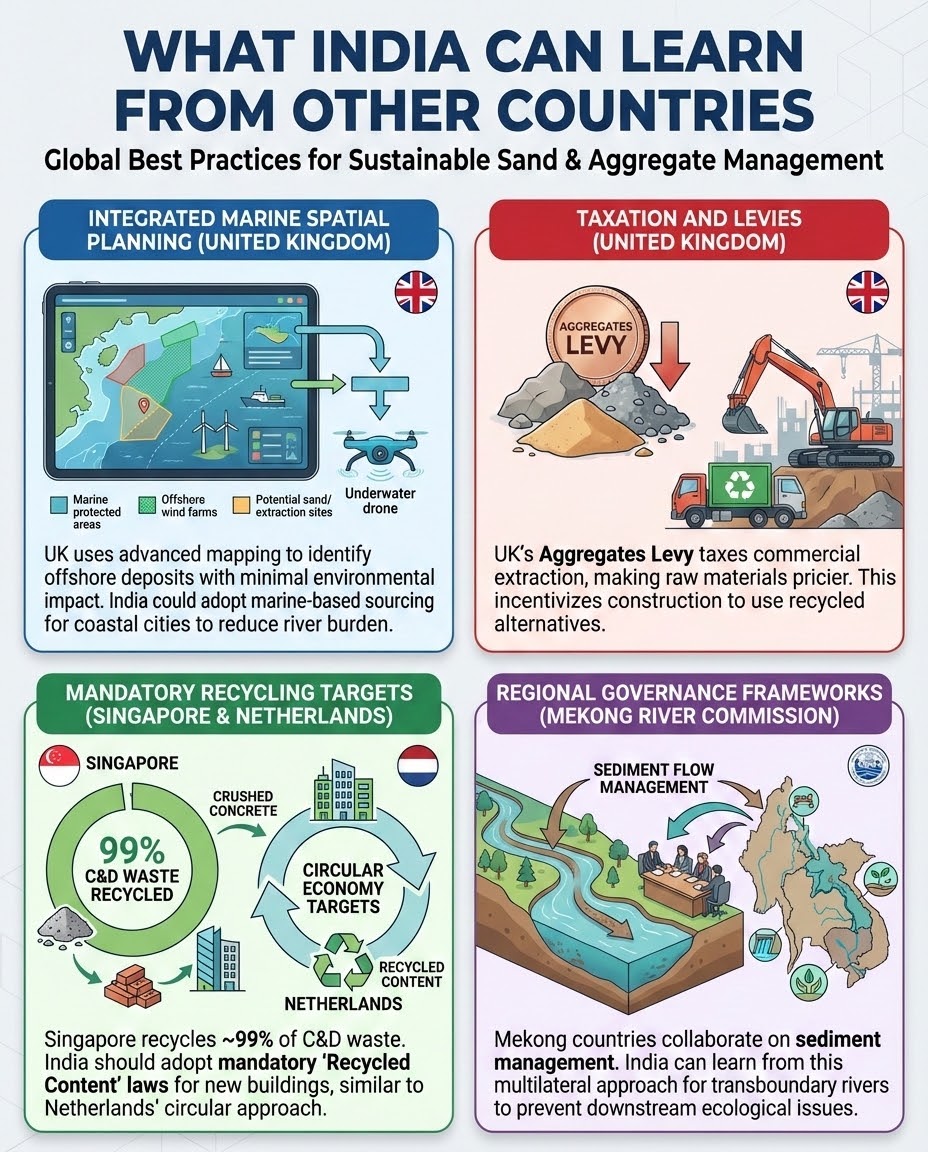
Recycling Construction Waste: Mandating the use of Recycled Concrete Aggregates (RCA) in non-structural construction components can decrease the total demand for fresh sand.
Scientific Management
Mandatory Replenishment Studies: Extraction must remain within the river's natural replenishment limits. Independent, accredited agencies should conduct these studies to provide objective data.
Restoration of Mined Areas: Mining leases should include a "closure and restoration plan" where miners are legally bound to restore the riverbank and plant local vegetation post-extraction.
Public Awareness and Governance
Certification of Sand Quality: Introducing a "Green Certification" for sand can help consumers identify and prefer sustainably sourced sand or high-quality M-Sand.
Social Audits: Involving local Gram Sabhas and communities in monitoring local river stretches provides a "human wall" against illegal night-time mining.
 Conclusion
Balancing infrastructure needs with ecological preservation requires a shift to a circular economy, leveraging satellite monitoring and sustainable alternatives like M-Sand to ensure long-term environmental and resource security.
Source: THE HINDU
|
PRACTICE QUESTION Q. With reference to the Enforcement and Monitoring Guidelines for Sand Mining (EMGSM) 2020, consider the following statements:
Which of the statements given above is/are correct? A) 1 and 2 only B) 2 and 3 only C) 1 and 3 only D) 1, 2, and 3 Answer: D Explanation: Statement 1 is correct: The guidelines specifically mandate the use of modern technology, including drones (UAVs) and night vision surveillance, to monitor mining sites and prevent illegal activities. Statement 2 is correct: The EMGSM 2020 emphasizes sustainable mining by requiring Sand Replenishment Studies. These studies are used to determine how much sand can be extracted without damaging the river ecosystem, effectively setting the mining limit. Statement 3 is correct: These guidelines were issued by the Ministry of Environment, Forest and Climate Change (MoEF&CC) and are legally binding as they are framed under the powers conferred by the Environment Protection Act, 1986. |
Sand mining is the physical extraction of sand and gravel from natural environments like riverbeds and shorelines. It is a major concern because indiscriminate and unscientific mining alters river hydrodynamics, causes habitat loss, depletes groundwater, and destabilizes critical infrastructure like bridges.
As per Section 15 of the MMDR Act, State Governments have the complete authority to frame rules and regulations regarding the extraction, transportation, and prevention of illegal mining of minor minerals like sand.
Manufactured Sand (M-Sand) is an artificial substitute for natural river sand, produced by crushing hard stones or granite into fine, sand-sized angular particles. It is heavily promoted by state governments to reduce the ecological pressure on river ecosystems.
© 2026 iasgyan. All right reserved