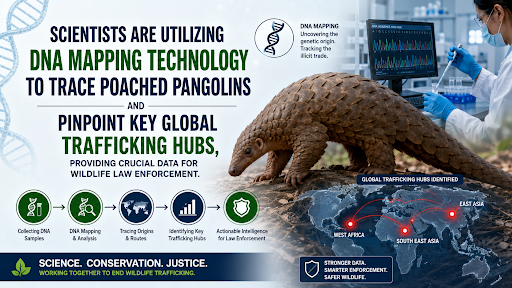
Scientists use advanced DNA mapping to trace illegal pangolin trafficking hubs, aiding wildlife conservation. Pangolins, vital ecosystem gardeners, face severe threats from poaching for scales and meat, necessitating strict enforcement under CITES and India's Wildlife Protection Act.
Why In News?
Scientists are utilizing DNA mapping technology to trace poached pangolins and providing data for wildlife law enforcement.
About Pangolins
Pangolins belong to the order Pholidota and represent the only mammals completely covered in protective keratin scales,,.
These nocturnal animals (active during the night) lack teeth and capture ants and termites using a sticky, muscular tongue longer than their bodies, which they store in a special stomach pouch.
They swallow gastroliths (small stones) to grind their insect prey inside their spiny stomachs.
They curl into an impenetrable ball to defend themselves against natural predators.
They secrete a noxious-smelling chemical from anal glands to deter threats, similar to the defense mechanism of a skunk.
Ecological Significance
Pangolins function as ecosystem gardeners and natural pest controllers.
A single adult consumes approximately 70 million insects annually, which regulates termite and ant populations and prevents agricultural damage.
They aerate the soil and cycle organic matter through their extensive digging and burrowing activities, which improves soil health and supports biodiversity.
Pangolin Species in India
The world hosts eight pangolin species evenly divided between Africa and Asia.
Conservation Status
IUCN Red List: Indian Pangolin as Endangered and Chinese Pangolin as Critically Endangered.
The Indian government grants maximum legal protection to both species by placing them in Schedule I of the Wildlife (Protection) Act, 1972,.
The Convention on International Trade in Endangered Species of Wild Fauna and Flora (CITES) lists all eight global pangolin species in Appendix I, imposing a complete ban on international commercial trade.
Pangolins currently hold the title of the most trafficked wild mammals globally, driven by demand in East and Southeast Asian markets.
Source: THEHINDU
|
PRACTICE QUESTION Q. Consider the following statements about Pangolins:
Which of the statements given above is/are correct? A) 1 and 2 only B) 1 and 3 only C) 2 and 3 only D) 1, 2, and 3 Answer: B Explanation: Statement 1 is correct: Both the Indian Pangolin (Manis crassicaudata) and the Chinese Pangolin (Manis pentadactyla) are naturally found in India. Statement 2 is incorrect: The Indian Pangolin is classified as Endangered on the IUCN Red List. It is the Chinese Pangolin that is classified as Critically Endangered. Statement 3 is correct: All eight species of pangolins globally (both Asian and African) hold the highest level of international protection under CITES Appendix I, which completely bans their international commercial trade. |
Traffickers poach pangolins for their keratin scales, promoted in Traditional Chinese Medicine (TCM), and for their meat, which consumers consider a luxury delicacy in parts of Asia.qa
India hosts two native species: the Indian Pangolin, listed as Endangered, and the Chinese Pangolin, listed as Critically Endangered.
Cyber HAWK is a citizen-science application developed by the Wildlife Trust of India (WTI) to empower the public to monitor and report cyber wildlife crime occurring on social media and e-commerce platforms.




© 2026 iasgyan. All right reserved