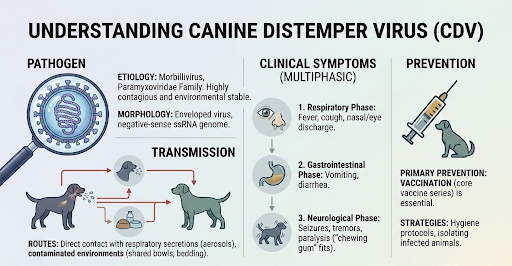
Canine Distemper Virus (CDV) is a highly contagious, fatal viral disease affecting dogs and wild carnivores like tigers. It attacks the respiratory, gastrointestinal, and central nervous systems. The virus spreads through airborne droplets, often spilling over from domestic dogs to wildlife.
Why In News?
A highly contagious Canine Distemper Virus (CDV) outbreak is suspected in Madhya Pradesh's Kanha Tiger Reserve after a sixth tiger died within a month.
About Canine Distemper Virus (CDV)
Canine Distemper Virus (CDV) is a highly contagious, single-stranded RNA virus belonging to the Paramyxoviridae family.
Origin: First reported in Spain in 1761, described by Edward Jenner in 1809, and its viral cause was identified by Henri Carré in 1905.
Transmission: The virus spreads rapidly through the inhalation of aerosol droplets, saliva, and direct contact with infected bodily fluids, feces, urine, or contaminated food and water.
Host Range: CDV infects a wide variety of mammal species, including domestic dogs (most common), wild canines (wolves, foxes), felines (tigers, lions), mustelids (ferrets, badgers), and pinnipeds (seals). The virus does not affect humans.
Affected System: The virus attacks multiple body systems, targeting the respiratory, gastrointestinal, and central nervous systems (CNS).
Clinical Symptoms: Infected animals show symptoms including high fever, labored breathing, eye and nose discharge, vomiting, and diarrhea.
Treatment: No specific treatment or cure for CDV. Treatment relies entirely on supportive care like IV fluids, antibiotics for secondary infections, and anti-seizure medications.
Prevention: Vaccination is highly effective in domestic dogs and serves as the primary tool for preventing Canine Distemper Virus.
Source: THEHINDU
|
PRACTICE QUESTION Q. Which one of the following best describes the ecological phenomenon known as "Spillover infection", recently seen in the news? (a) The natural migration of an invasive plant species from agricultural buffer zones into core forest areas. (b) The transmission of a pathogen from a domestic or reservoir animal population to a naive wild animal population. (c) The sudden explosion of herbivore populations due to the loss of top-order apex predators. (d) The contamination of forest water bodies due to chemical run-offs from peripheral industrial zones. Answer: B Explanation: Spillover infection (or pathogen spillover) is the cross-species transmission of a disease-causing agent, such as a virus or bacteria, from a natural reservoir host or domestic animal into a new, susceptible (naive) population. In the context of wildlife reserves, this often occurs when diseases spread from stray animals, livestock, or nearby human-wildlife interfaces into isolated or vulnerable endangered wildlife populations. |
CDV is a highly contagious viral disease affecting carnivores that causes respiratory, gastrointestinal, and neurological symptoms, and is often transmitted from domestic or stray dogs to wildlife.
The virus bounces between dogs and tigers, spreading through direct contact or contaminated materials when free-ranging or domestic dogs interact with wild carnivores at the edges of forests.
It is difficult to assess the scale of the outbreak or safely capture wild tigers for treatment in dense forest regions, making proactive prevention the only realistic solution.





© 2026 iasgyan. All right reserved